


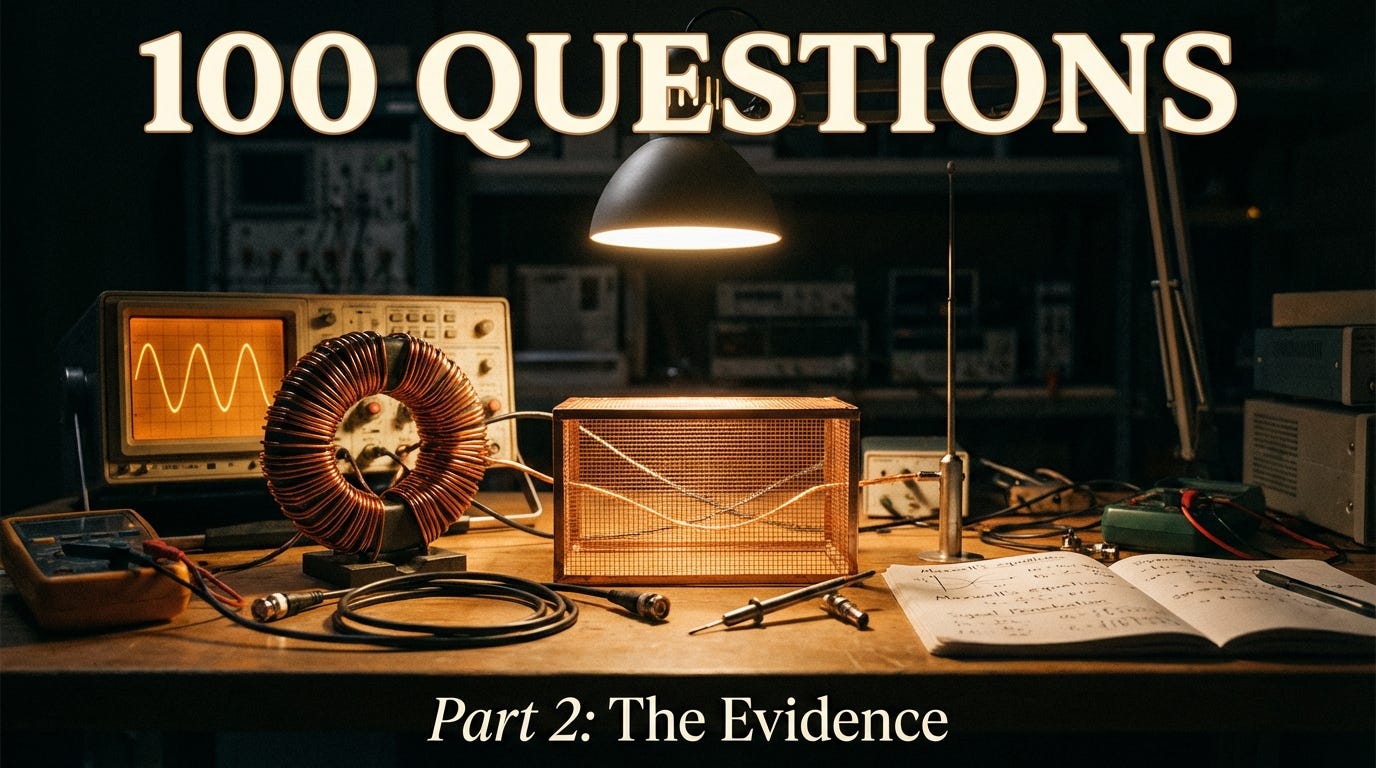
Part 1 laid out what the scalar-longitudinal mode is, where it comes from mathematically, and why standard electrodynamics doesn’t include it. The theory is clean. Four independent derivations. Peer-reviewed uniqueness theorems. A parameter space where standard Maxwell sits at a single special point.
But theory without evidence is speculation. This is where the rubber meets the road.
Twenty-five questions about what’s been measured, what’s been demonstrated, and what a definitive confirmation would look like.
⬅️ Previous: 25 foundational questions about scalar-longitudinal waves, answered with equations and sources.

26. What is the Aharonov-Bohm effect and why does it matter here?
In 1959, Aharonov and Bohm predicted that a charged particle traveling through a region where 𝐄 = 0 and 𝐁 = 0 would still experience a measurable quantum phase shift, if the vector potential 𝐀 in that region was nonzero. Osakabe confirmed it definitively in 1986 using electron holography. The result: the potential 𝐀 produces physical effects where the fields do not. This is the foundational evidence that potentials carry physical content beyond what fields represent. Without AB, the entire potential-primary argument would be philosophical. With it, the argument is experimental.
27. Does AB prove that scalar-longitudinal waves exist?
No. AB proves that the vector potential is physical, not that the scalar-longitudinal mode propagates. AB demonstrates potential primacy in the static/topological regime. The scalar-longitudinal mode is a dynamical prediction about propagating waves. They’re connected conceptually (both require potentials to be real) but AB alone doesn’t confirm wave propagation. It removes the objection that potentials are “just math.”
28. What does superconductor physics prove?
Superconductors provide the strongest engineering evidence for potential primacy. The London equation (1935) defines the supercurrent as a direct function of 𝐀: J_s = -(nq²/m)𝐀. Not a function of 𝐄 or 𝐁. The vector potential itself. Flux quantization, ∮𝐀·dl = n(h/2e), shows that nature doesn’t treat gauge freedom as redundancy. It picks a value of 𝐀 and enforces it physically. Every SQUID magnetometer, every MRI machine, every particle accelerator operates on this principle. The potential isn’t auxiliary in superconductor physics. It’s the primary variable.
29. What are persistent currents in normal metal rings?
Buttiker predicted in 1983, and Levy confirmed experimentally in 1990, that normal metal rings (not superconductors, ordinary copper) carry equilibrium persistent currents that oscillate with the Aharonov-Bohm period h/e. The vector potential governs the ground-state energy of a many-body system in a normal conductor. This extends potential primacy beyond quantum curiosity (AB phase shifts) and beyond exotic states (superconductors) into ordinary thermodynamics.
30. What is the Maxwell-Lodge effect?
The classical analogue of Aharonov-Bohm, demonstrated by Blondel in 1914 and revisited by Rousseaux and colleagues in 2008. A toroidal solenoid produces 𝐀 outside but 𝐁 = 0 outside (standard result). A secondary coil linked to the torus picks up an induced EMF, despite sitting in a region with zero 𝐁. The standard explanation (Faraday’s law applied to the flux through the torus) works, but the point is structural: the measurement responds to 𝐀, not to the local field. The effect is classical, macroscopic, and reproducible on a bench.
31. What did the NASA Breakthrough Propulsion Physics program find?
The NASA BPP program (1996-2002) documented transmission of longitudinal electrostatic waves through solid dielectrics. Pages 404-407 of the final report describe signals propagating through glass and Plexiglas with less dispersion than through air, detected through closed wooden doors at several meters. The waves carried no associated magnetic field. The enhanced transmission through dielectrics is significant: transverse EM waves are attenuated by dielectrics, while a longitudinal mode coupling to the electric polarizability would experience reduced dispersion. Consistent with EED predictions. Not independently replicated.
32. What does US Patent 9,306,527 demonstrate?
The Vector Potential Transformer (VPT) patent describes through-barrier transmission using a coiled-coil toroidal geometry that produces 𝐁 = 0 in the exterior with nonzero 𝐀. The patent claims signal transmission through conductive barriers that would block standard electromagnetic radiation. A granted patent is not peer review, but it is a legal attestation that the described apparatus works as claimed. The VPT topology is the basis for the discriminator experiment protocol.
33. What is the dynamical Casimir effect and why is it relevant?
Wilson and colleagues demonstrated it in 2011 using a SQUID-based circuit. By rapidly modulating the effective boundary condition (the SQUID inductance, controlled by magnetic flux Φ = ∮𝐀·dl), they created real photon pairs from the quantum vacuum. The boundary wasn’t a moving mirror. It was a modulated potential. This is direct evidence that potential configurations, not just field configurations, couple to vacuum structure. The vacuum responds to 𝐀.
34. What about Newton’s third law?
The Grassmann force law (the differential form underlying the Lorentz force) is provably non-reciprocal for open circuits: F₁₂ ≠ -F₂₁ when ∇·J ≠ 0. This is a mathematical fact. Van Vlaenderen (2016) showed that restoring the longitudinal Ampere force via the Whittaker force law fixes the symmetry for both open and closed circuits. The longitudinal force exists only in the scalar-longitudinal sector. Standard EM can’t represent it because the Lorenz gauge suppresses it.
35. Has the N3LM violation been measured?
The mathematical violation is proven. Experimental attribution is harder. Railgun anomalies and exploding-wire dynamics involve extreme conditions where magnetohydrodynamic instabilities and material effects compete with any longitudinal force signature. The mathematical point stands independently: the Grassmann law is non-reciprocal for ∇·J ≠ 0. Whether the longitudinal Ampere force is the correct fix is an experimental question. That standard EM has a problem is a mathematical fact.
36. What are toroidal dipole moments?
Kaelberer and colleagues demonstrated in 2010 (Nature Materials) that electromagnetic fields in metamaterials require a third multipole family beyond electric and magnetic multipoles. The toroidal dipole moment has no representation in standard 𝐄/𝐁 electrodynamics. Its order parameter, toroidization T(t), is analogous to electric polarization P and magnetization M. Standard EM can’t represent it because it requires the interplay of longitudinal and transverse potentials, which gauge fixing suppresses.
37. What is the Heaviside energy paradox?
Heaviside himself recognized that the Poynting vector 𝐄×𝐁 is not unique. You can add the curl of any vector and the total flux through any closed surface stays the same. The non-Poynting (Heaviside) component around a current-carrying wire is enormously larger than the Poynting component that enters the wire. Almost all electromagnetic energy near a conductor passes by without being intercepted. Standard EM declares this component unphysical. The potential-primary formulation, through the generalized Poynting vector with the -𝐄S term, provides a mechanism: the “excess” energy flows through the scalar channel.
38. What would a definitive confirmation experiment look like?
The three-test discriminator protocol (from Part 1, Question 13): a single apparatus producing all three signatures simultaneously. VPT source (coiled-coil, 𝐁 = 0 exterior), Faraday-caged monopolar receiver, distance sweep. Three binary results: (1) signal penetrates the cage, (2) monopolar antenna receives while dipole doesn’t, (3) attenuation follows 1/r² not 1/r. Each signature alone has alternative explanations. All three together rule out near-field artifacts, capacitive coupling, and standard radiation leakage.
39. Why hasn’t someone built this experiment already?
Several reasons. The EED framework was formalized only between 2003 and 2020. The synthesis paper connecting all the threads doesn’t yet exist in the peer-reviewed literature (that’s what my paper addresses at the pre-print level). The VPT patent demonstrates the effect but wasn’t designed as a discriminator experiment. COMSOL FEM simulation could validate the predicted signatures before building hardware, but standard Maxwell solvers enforce the Lorenz gauge, which is exactly the constraint you need to relax. A custom PDE module is required.
40. Could COMSOL simulate this?
In principle, yes. COMSOL’s custom PDE module allows user-defined equations. You’d implement the Stueckelberg Lagrangian with γ = 1 instead of the standard Maxwell module (which enforces the Lorenz gauge). The simulation would predict field patterns for a VPT geometry, including the scalar field C that the standard module zeros out by construction. A simulation paper would be publishable independently and would define the expected signatures before anyone builds hardware.
41. What’s the role of topology?
The torus is the simplest multiply connected geometry that produces field-free regions with non-zero 𝐀. Its topology can promote the gauge group from U(1) to SU(2) under specific excitation conditions (Barrett, 2008), enabling non-Abelian phase factors that have no representation in terms of fields alone. Simply connected geometries (solenoids, dipole antennas) can confine fields to their interior but can’t produce the topological conditions for scalar-longitudinal emission. The geometry matters because the physics is topological, not just local.
42. What is the electric Aharonov-Bohm effect?
Aharonov and Bohm proposed a dual to the magnetic effect: a charged particle in a field-free region of nonzero scalar potential φ acquires a phase shift. The theoretical basis is identical to the magnetic case. It awaits clean experimental confirmation. If confirmed, it would extend potential primacy to the scalar potential φ independently of the vector potential 𝐀.
43. What is Taylor relaxation?
Taylor showed in 1974 that turbulent plasmas relax into discrete states labeled by winding numbers. No ℏ. No quantum mechanics. Classical quantization from topology. The conserved quantity is magnetic helicity, defined as ∫𝐀·𝐁 dV, which requires the vector potential in its definition. Fields alone can’t express it. If discrete states can emerge from topological conservation without quantum mechanics, the boundary between classical and quantum may be less fundamental than assumed.
44. What does “gauge-invariant observable” mean in this context?
A gauge-invariant observable is a measurable quantity that doesn’t change when you perform a gauge transformation on the potentials. Examples: enclosed flux ∮𝐀·dl (the AB phase), magnetic helicity ∫𝐀·𝐁 dV (Taylor relaxation), flux quantization in superconductors. These are all defined in terms of potentials but are immune to gauge ambiguity. The standard argument (”potentials are unphysical because they’re gauge-dependent”) fails here: the observables constructed from potentials are gauge-invariant, even though the potentials themselves are not.
45. What’s the current status of the evidence?
Potential primacy: confirmed (AB 1986, superconductors since 1935, flux quantization, dynamical Casimir 2011). Scalar-longitudinal propagation: predicted by four independent derivations, consistent with NASA BPP observations and VPT patent, but not independently replicated with the three-test discriminator protocol. The gravitational bridge: formal analogy confirmed (GP-B 2011), deeper connection via Kaluza-Klein is mathematical, not experimental. The honest summary: potential primacy is settled physics. The scalar-longitudinal mode is well-motivated, has suggestive support, and awaits a clean confirmation experiment.
46. What is the Li-Torr gravitomagnetic London moment?
Li and Torr (1991) showed that the London equations extend to gravitomagnetic fields. A rotating superconductor should generate a gravitomagnetic field B_g = -(2m/e)ω, where ω is angular velocity. The same Cooper pair condensate that fixes 𝐀 may simultaneously fix the gravitational vector potential A_g. If confirmed, superconductors are not just EM devices. They’re gravitational devices.
47. What’s the difference between the magnetic and electric AB effects?
The magnetic AB effect (confirmed 1986) involves a charged particle acquiring phase from A in a 𝐁 = 0 region. The electric AB effect (proposed 1959, not cleanly confirmed) involves phase from φ in an 𝐄 = 0 region. Same structure, different potential component. Clean confirmation of the electric version would extend potential primacy to the scalar potential independently.
48. Why is the 1/r² attenuation law significant?
Standard far-field radiation attenuates as 1/r (amplitude) because the self-sustaining 𝐄×𝐁 cross-coupling maintains the wave indefinitely. The scalar-longitudinal mode lacks this cross-coupling (𝐁 = 0). Without the self-sustaining mechanism, the wave attenuates as 1/r². This difference is binary and measurable. It distinguishes the SL mode from any standard radiation leakage, which always follows 1/r in the far field.
49. Can the scalar-longitudinal mode exist in curved spacetime?
Hively and Loebl (2020) derived the dispersion relation for scalar-longitudinal waves in curved spacetime. It connects to the Hubble constant and the Ricci tensor. This suggests the SL sector bridges electrodynamics and gravitation at the wave-propagation level, not just at the potential level (Kaluza-Klein). Whether this dispersion relation is experimentally accessible depends on whether the SL mode propagates at all. Confirmation of the mode in flat spacetime comes first.
50. What’s the single strongest piece of evidence for potential primacy?
Flux quantization in superconductors. ∮𝐀·dl = n(h/2e). Nature picks a value of the vector potential and enforces it as a macroscopic quantum number. Not the fields. Not an approximation. The potential itself, quantized, physical, measurable in every SQUID on Earth. No interpretation of gauge freedom as “redundancy” survives this fact.
Part 2 of 4. 50 questions down, 50 to go.
https://advanced-rediscovery.com/research/deleted-degrees-of-freedom
If you want every claim in this series in one place — the equations, the experiment specs, the FAQ, the annotated reading list — that’s The EED Playbook. For paid subscribers.
⏭️ Next: Part 3: Engineering. What becomes buildable when you stop treating gauge freedom as redundancy. Tuesday.