


Hello everyone, and a special welcome to all new subscribers! 👋❄️
I spent the last week wrestling with a fluid hypothesis of electromagnetism that explains everything—until it doesn’t. The model is elegant. The math works. The Aharonov-Bohm effect makes perfect sense. Then mutual inductance shows up and the whole thing collapses.
Or does it?
👉 Subscribe to Advanced Rediscovery. I’m sharing what I’m finding as I decode zero point energy, the quantum vacuum, and extended electromagnetism — 12+ years of independent research. Weekly briefings from my home lab to your inbox.
In today’s briefing
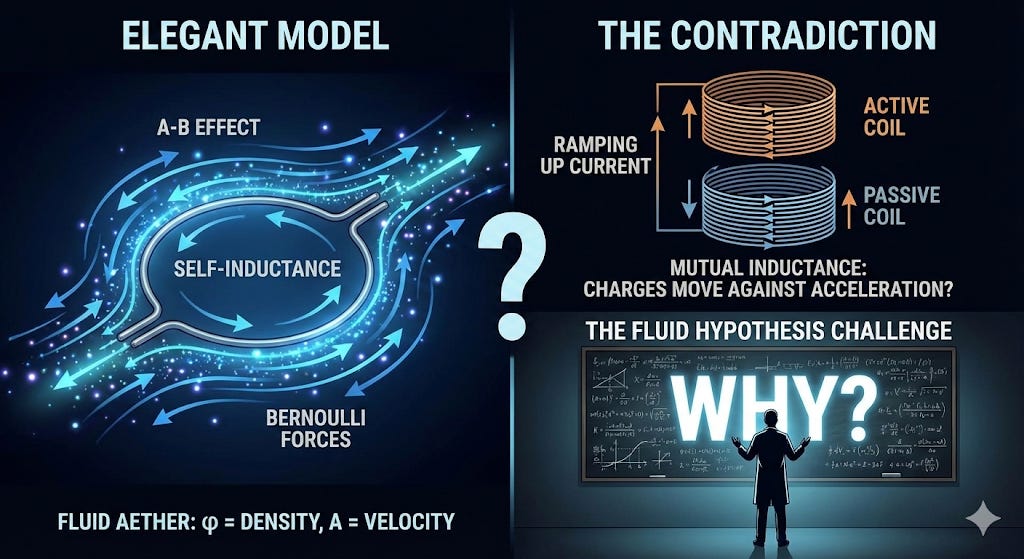
🧲 Fluid aether model: φ = density, A = velocity
⚡ Explains Aharonov-Bohm, Bernoulli forces, self-inductance
🔬 Mutual inductance: charges pushed opposite fluid acceleration
🧪 Alexandre Martins says it works. I can’t see how
🤔 One contradiction. One unsolved puzzle. Next week: resolution attempt
The Fluid Hypothesis: When Maxwell Gets Simple
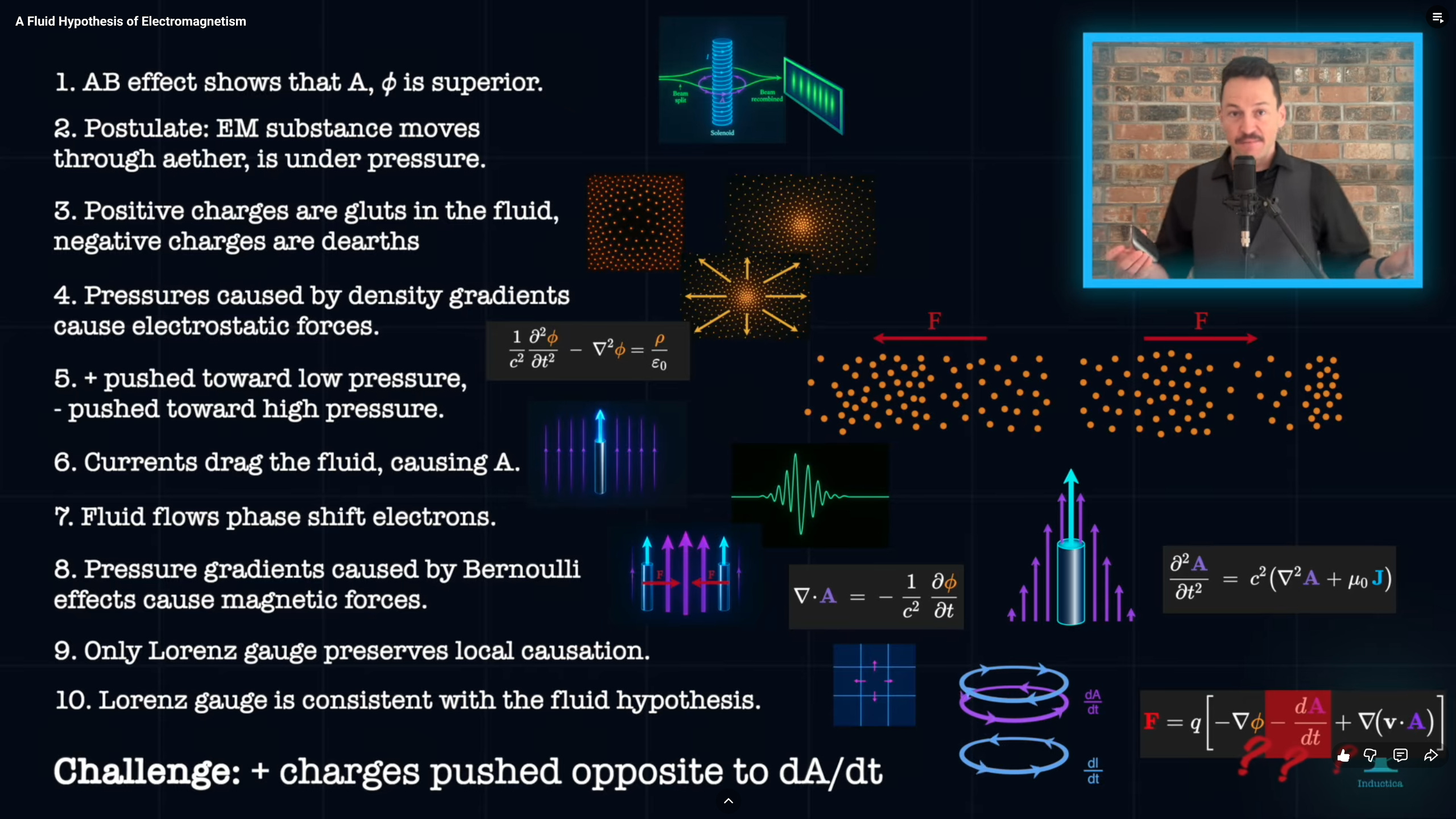
Here’s what caught my attention in a video by Inductica (Hosted by James Ellias), one of the sharpest channels doing serious physics education on YouTube: A Fluid Hypothesis of Electromagnetism
He’s covering research by Alexandre Martins, a plasma physicist who published papers on the parallels between electromagnetism and fluid mechanics. The core idea: what if the electromagnetic aether is literally a fluid? Not metaphorically—literally. Each point in space contains more or less of this substance. It flows. It exerts pressure. It drags on charges.
The model:
φ (scalar potential) = fluid density
A (vector potential) = fluid velocity
Positive charges = gluts (excess fluid)
Negative charges = dearths (deficiency)
Think about that. Instead of abstract field vectors and curl operations, you get pressure gradients and Bernoulli effects. Charges don’t “experience forces from fields”—they get pushed by fluid pressure or dragged by fluid flow.
Electric forces: Density gradients create pressure differences. Positive charges get pushed toward low-density regions. Negative charges toward high-density. That’s Coulomb’s law, but with a mechanism.
Magnetic forces: Currents drag the fluid along. Faster flow between parallel wires = lower pressure (Bernoulli). The wires get pulled together. No right-hand rule gymnastics needed.
Self-inductance: Ramping up current accelerates the fluid. Charges experience drag pulling the fluid along. Back-EMF appears naturally.
And here’s what really convinced me: the Aharonov-Bohm effect. Electrons passing around a toroidal solenoid get phase-shifted even when the magnetic field B is completely confined inside the coil. Zero field where the electrons travel. But the vector potential A still swirls outside. The fluid flows, the waves phase-shift, the interference pattern changes.
A and φ tell you something about the aether that E and B don’t. That’s not speculation—that’s measured in labs.
So I’m reading this, nodding along, thinking “finally, someone gets it.” Then the video drops this bomb: Ten reasons the fluid hypothesis works. One reason it might not.
The Contradiction: Mutual Inductance
Two coils. One active (bottom), one passive (top):
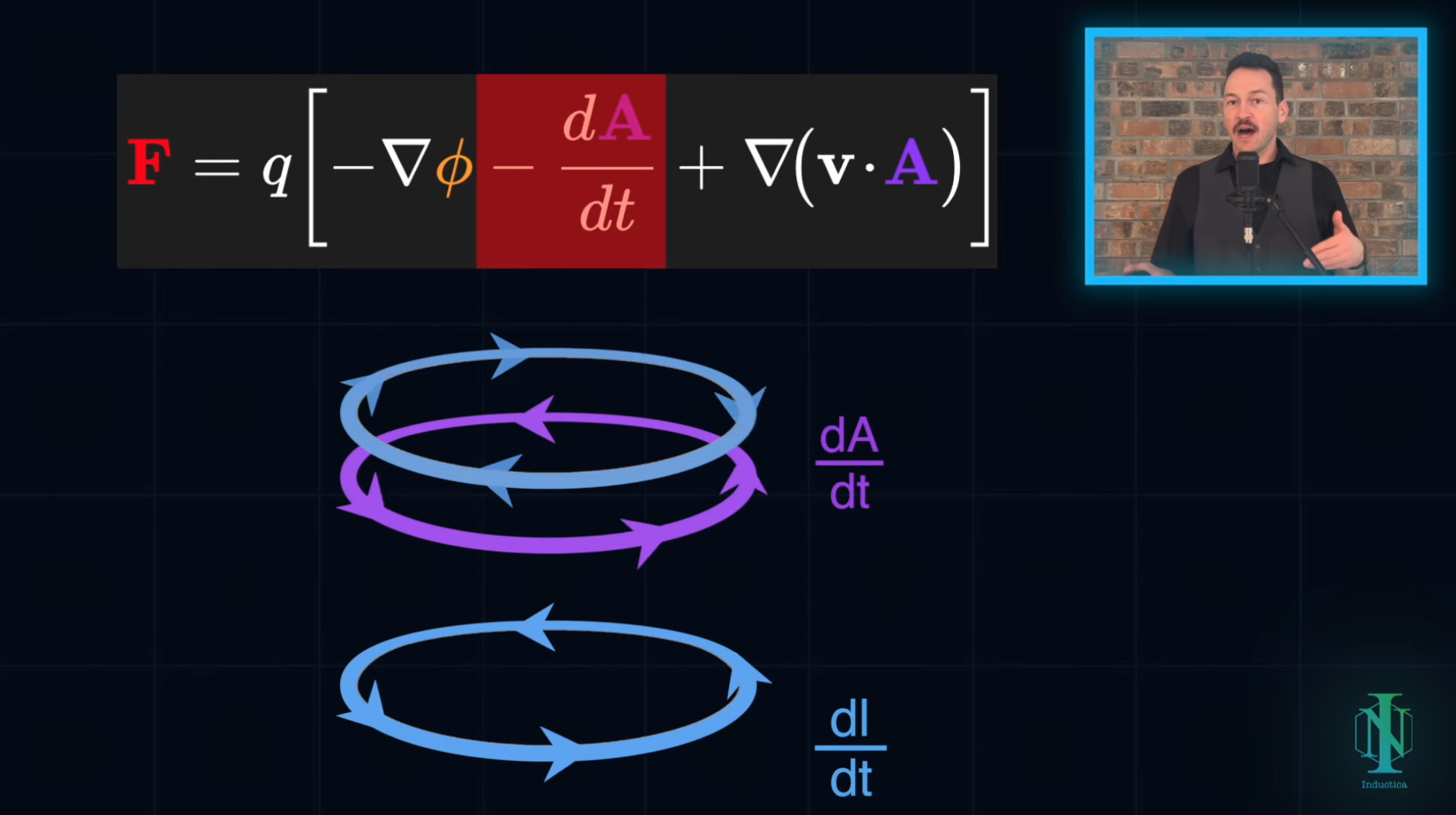
Now ramp up current in the active coil.
What happens? Current appears in the passive coil flowing opposite the active current. That’s mutual inductance. Standard textbook stuff.
Now apply the fluid hypothesis:
Active coil current drags fluid into rotation (vector potential A swirls)
Fluid motion propagates upward (viscous coupling)
At the passive coil location, fluid is accelerating (dA/dt increasing)
Charges in passive coil experience force opposing acceleration
💥 Wait. Opposing the acceleration?
According to the Lorentz force written with potentials, charges get pushed opposite to dA/dt. The fluid accelerates one way, charges go the other way.
👉 Here’s what doesn’t make sense: if charges are gluts and dearths in the fluid, why would they move against the fluid’s acceleration? That’s like saying a cork accelerates backward when you push water forward.
Martins claims it’s consistent. His papers say mutual inductance works within the fluid framework. But neither Inductica nor I can figure out how.
“According to the Lorentz force law and according to experiment, the current in the passive coil goes opposite the direction of the increasing current in the active coil. This does not seem to make any sense.”
💀 One of two things is true:
There’s a subtlety we’re missing (phase relationships, drag coefficients, something)
The fluid hypothesis breaks down here
Why This Matters
If the fluid model fails, we’re back to abstract field math with no physical mechanism. If it doesn’t fail—if there’s a resolution—then we have a framework that could reshape how we engineer electromagnetic systems.
This isn’t academic. Understanding the mechanism behind induction could unlock new device topologies, energy extraction methods, or field manipulation techniques that standard Maxwell formalism can’t predict.
And if the model is right but incomplete, figuring out what’s missing might reveal entirely new physics:
What’s Next
Next week I’m going deeper. I’ll analyze the force equation step-by-step, check phase relationships, look at energy flow directions, and see if there’s a resolution hiding in the math.
Maybe fluid acceleration isn’t the right variable. Maybe there’s a reactive component I’m ignoring. Maybe Martins is right and the answer is staring me in the face.
Or maybe the fluid hypothesis is beautiful but wrong?
🚀 Here’s my challenge: Watch the video. Work through it yourself. If you crack this before I do, reply and show me. Let’s figure out if the aether is a fluid or if we need to keep searching.
Because the models that almost work are usually the ones pointing toward something deeper.
— Paul
💡 One elegant hypothesis. One stubborn contradiction. Reply with what you think is happening. Next week: resolution attempt.
🧑🏼 Follow @drxwilhelm on X Twitter, Substack, Medium, TikTok, YouTube
Hi Paul https://medium.com/@mysteron/dipole-standing-waves-as-the-unified-field-8abc241c2915 here is my paper there is another technical one that derives the fine structure constant from first principles also - You are describing a dipole standing wave and if the Universe was not a Bang but a fluid phase collapse it would be made of a sea of these waves that quantise the fluid - these waves encode Alpha, Gamma, Gravity - you can show how ionisation works, inertia and more. You are describe part of their internal workings but not all - you are nearly there. I have a lot more than I've published I'm happy to share but just ho through the idea and think about all the effects and I think you will get it - its very intuitive one you know.
When an object, such as plane's wing, travels through the air rather quickly, a group of swirls develop behind the wing which push against the backside of the wing in the opposite direction of the primary flowing air.