


Squeezed vacuum states create it. Topological structuring stabilizes it.
⬅️ Yesterday: three extraction mechanisms physics ignores.
Physicists have spent decades coaxing slivers of negative energy out of the electromagnetic vacuum, only to watch them vanish almost as quickly as they appear. Quantum squeezing techniques can generate fleeting regions where the vacuum dips below its zero-point baseline, but the universe always balances the books. The negative phase is chased by a compensating positive surge, leaving the average stubbornly positive.
The missing ingredient isn’t in the generation but in the stabilization. If negative energy could be pinned down, topologically locked so it can’t self-cancel, then the wildest ambitions of spacetime engineering would move from fantasy to blueprint. Traversable wormholes, warp drives, and metric engineering all demand negative energy as their enabling resource. The real trick is less about squeezing harder, and more about shaping the vacuum’s topology so negative energy can’t escape.
👉 Subscribe to Advanced Rediscovery. I’m sharing what I’m finding as I decode zero point energy, the quantum vacuum, and extended electromagnetism — 12+ years of independent research. Weekly briefings from my home lab to your inbox.
Chasing persistent negative energy
Every time physicists squeeze the quantum vacuum, they see negative energy flicker into existence, only to watch it disappear before it can be harnessed. The vacuum is its own best accountant, always restoring the balance sheet.
The oscillatory nature of squeezed vacuum states makes negative energy a transient guest, never a tenant. If negative energy is the passport to warp drives and wormholes, the inability to stabilize it is the hard wall.
Squeezed vacuum states create fleeting negative energy dips, but the vacuum always restores equilibrium.
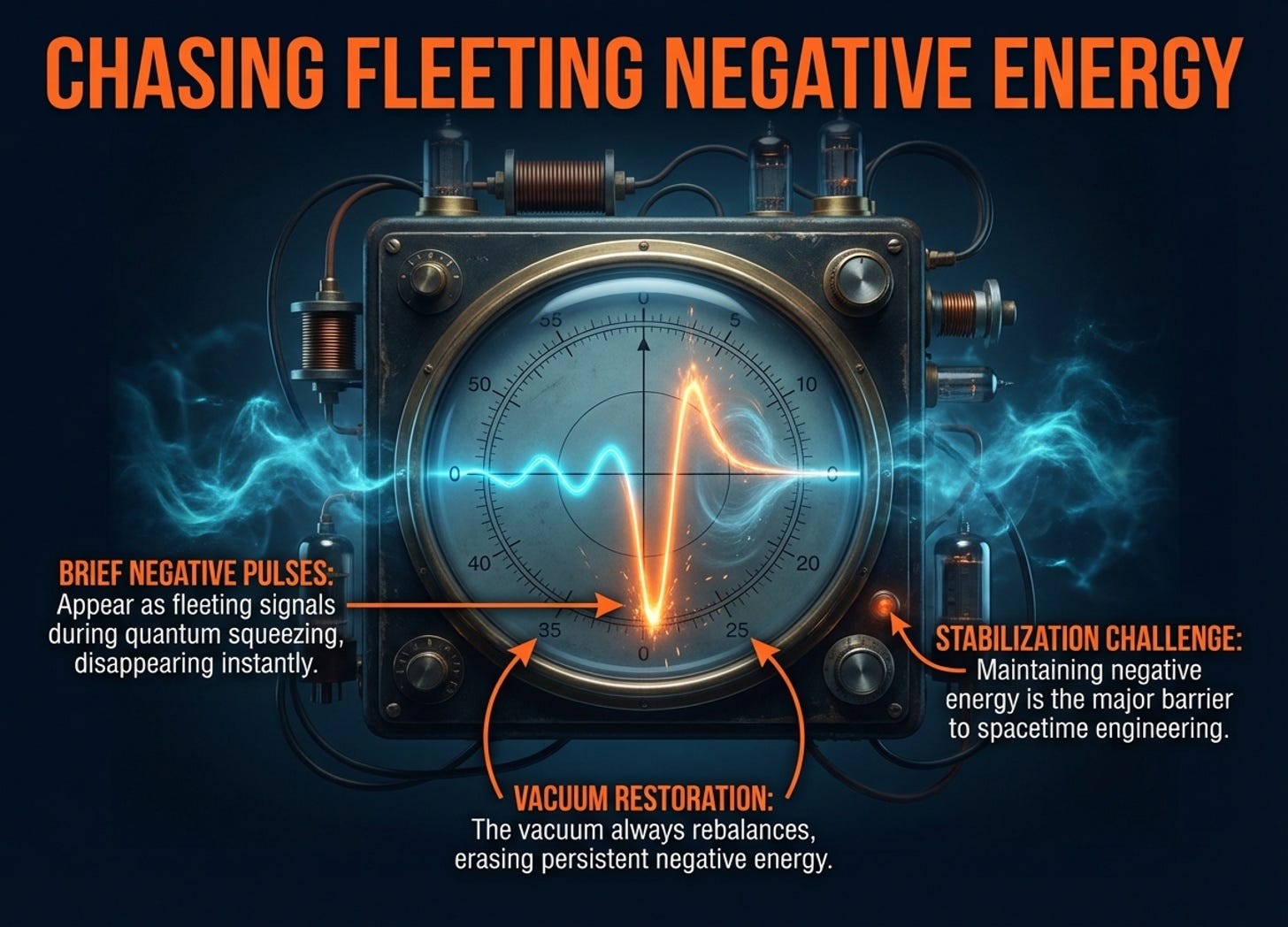
Generating genuine negative energy density in the electromagnetic vacuum starts with quantum squeezing. Quantum fluctuations are redistributed between field quadratures, creating brief pockets where the vacuum’s energy dips below its zero-point. The energy density in a squeezed vacuum oscillates at twice the field frequency, with amplitude set by the squeezing parameter ξ, guaranteeing a negative swing once per cycle for any nonzero squeezing.
But the universe doesn’t let you keep what you borrow. The negative energy phase is always countered by a compensating positive phase, making the time-averaged energy density positive. No matter how clever the squeezing, the vacuum self-equalizes, leaving only fleeting negative pulses. Quantum tomographic techniques, still being refined, are racing to catch and map these ephemeral regions, an essential step for any future application.
The real bottleneck isn’t generating negative energy but making it stick. Theoretical advances are needed to break the vacuum’s bookkeeping, by stabilizing the negative phase or decoupling conjugate observables. Until then, negative energy remains a laboratory curiosity, not an engineering resource for spacetime manipulation.
The chase for persistent negative energy is a story of promise and frustration. Without a stabilization mechanism, even the most advanced squeezing leaves us empty-handed when it comes to practical spacetime engineering.
Scaling the squeeze
Squeezing the vacuum is an experimental arms race, with physicists pushing nonlinear crystals and photonic devices to their limits, all in search of more negative energy, more often, more reliably.
Every advance runs into the same wall: the negative energy is always local, always fleeting. Scaling up from a blip in a crystal to a resource for engineering spacetime is a leap that current setups can’t make.
Nonlinear crystals and photonic engineering generate squeezed vacuum states, but scaling negative energy remains elusive.
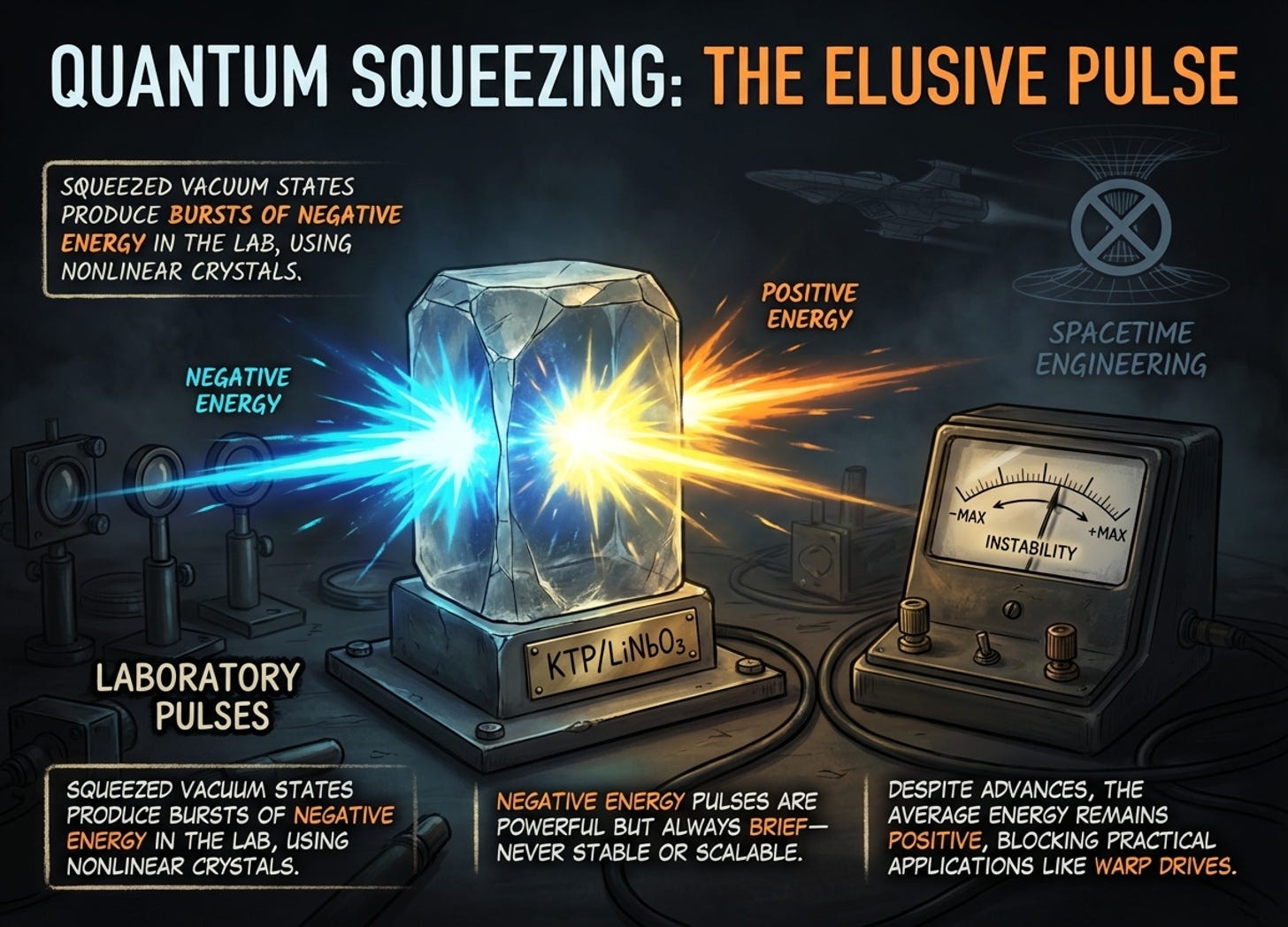
In the lab, squeezed vacuum states are produced using nonlinear crystals like potassium titanyl phosphate (KTP) or lithium niobate (LiNbO₃) in parametric amplifiers. These devices convert high-energy pump photons into pairs of lower-energy photons, creating alternating negative and positive energy pulses. The squeezing operator, controlled by parameter ξ, lets physicists tune the squeeze by adjusting pump amplitude, coupling strength, and interaction time.
Sophisticated setups using semi-monolithic MgO:LiNbO₃ amplifiers and frequency-doubled lasers have achieved up to 7.2 dB of squeezing, with active stabilization via injection-seeding to maintain quantum control. Photonic crystal waveguides now allow for engineered bursts of intense negative energy by superposing single-photon states, hinting at future custom-tailored pulses.
But the same limitation always bites: the time-averaged energy density remains positive, as dictated by Pfenning’s equation. Even with machine learning optimization or advanced metamaterials, the negative energy remains a pulse, never a plateau. The gap between laboratory pulses and spacetime engineering remains wide, waiting for a mechanism that can stabilize or scale the effect.
Every experiment pushes the envelope, but the envelope snaps back. Without a way to separate, stabilize, or accumulate negative energy, squeezing alone can’t deliver the goods for warp drives or wormholes.
Detecting negative energy
You can’t use what you can’t see. Detecting negative energy in the vacuum is its own technical gauntlet, one that’s only recently started to yield to quantum tomographic techniques.
From optical homodyne tomography to switched particle detectors, every method faces the same challenge: catching the signal before it vanishes.
Quantum tomographic techniques are closing in on mapping negative energy, but the signal remains elusive.
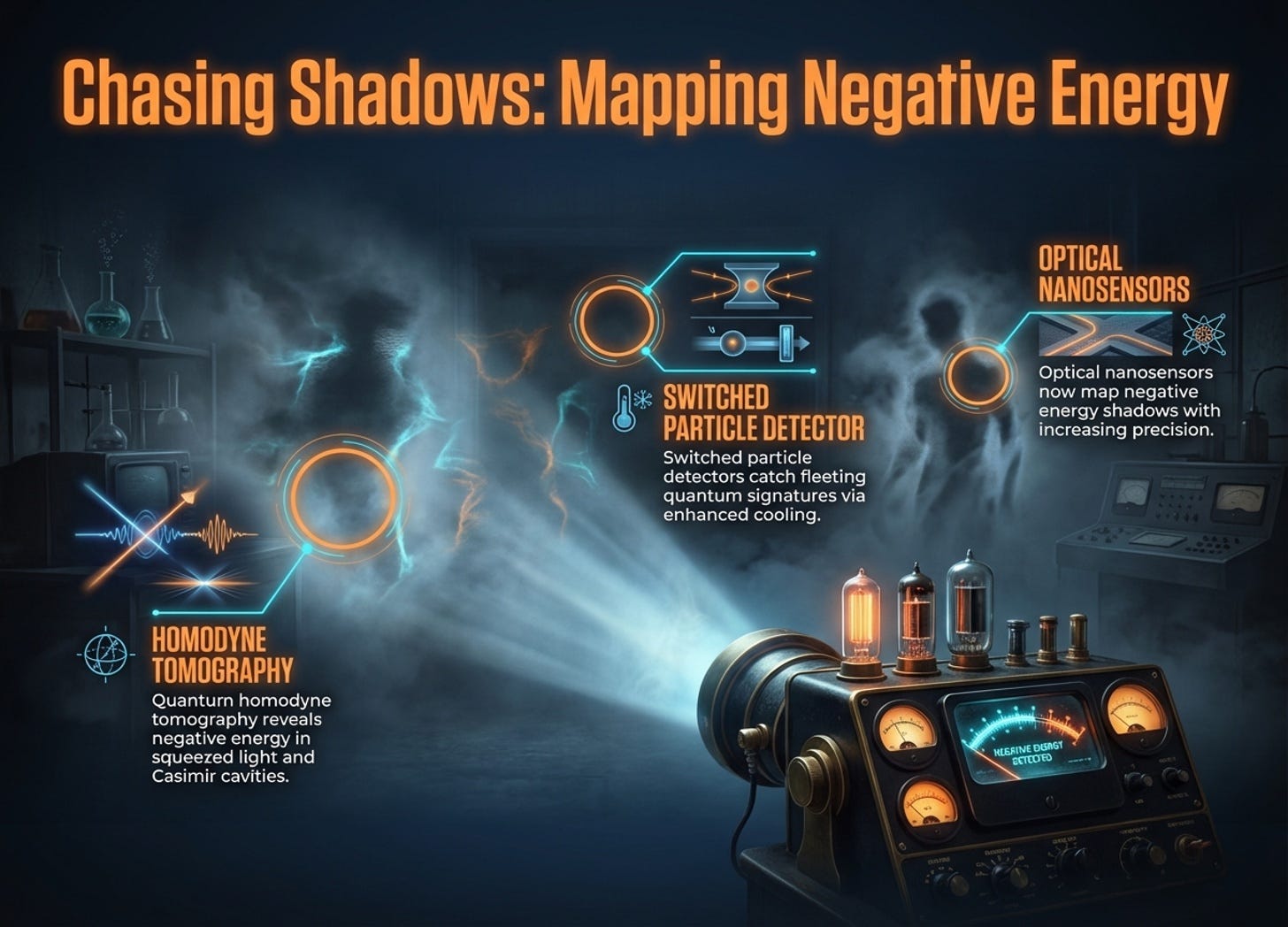
Quantum optical homodyne tomography reconstructs the Wigner function from quadrature distributions, letting physicists infer negative energy states in both squeezed light and Casimir cavities. Balanced homodyne detectors, adapted for Casimir geometries, can spatially map quantum vacuum fluctuations by measuring position- and frequency-dependent responses.
The Casimir effect and squeezed vacuum states are the main laboratory sources of measurable negative energy, each demanding unique detection strategies. Switched particle detectors, inspired by the work of Davies and Ottewill, use time-dependent switching to target negative energy windows, predicting enhanced cooling as a telltale signature. But these responses are deeply model-dependent, and scaling them for practical use is a work in progress.
Astronomical methods for observing negative energy lensing, like the creation of an umbra with bright caustics, are being miniaturized for the lab, using ultrafast optics and nanosensors. The holy grail is a real-time, high-resolution map of negative energy regions, which would finally make active feedback and control possible.
Until negative energy can be reliably detected and mapped, it remains an elusive target for engineering. The tools are improving, but the signal still slips through.
Squeezing vs. topology
If squeezing the vacuum is the hammer, topology is the anvil. The real contest is between two fundamentally different routes to negative energy: dynamic squeezing versus topological structuring.
Squeezed vacuum states are accessible but fleeting. Topological Casimir effects are theoretical but promise stability. The question: which approach can finally pin negative energy down long enough to matter?
Squeezing generates negative energy. Topology stabilizes it. The hybrid is the missing link for engineering spacetime.
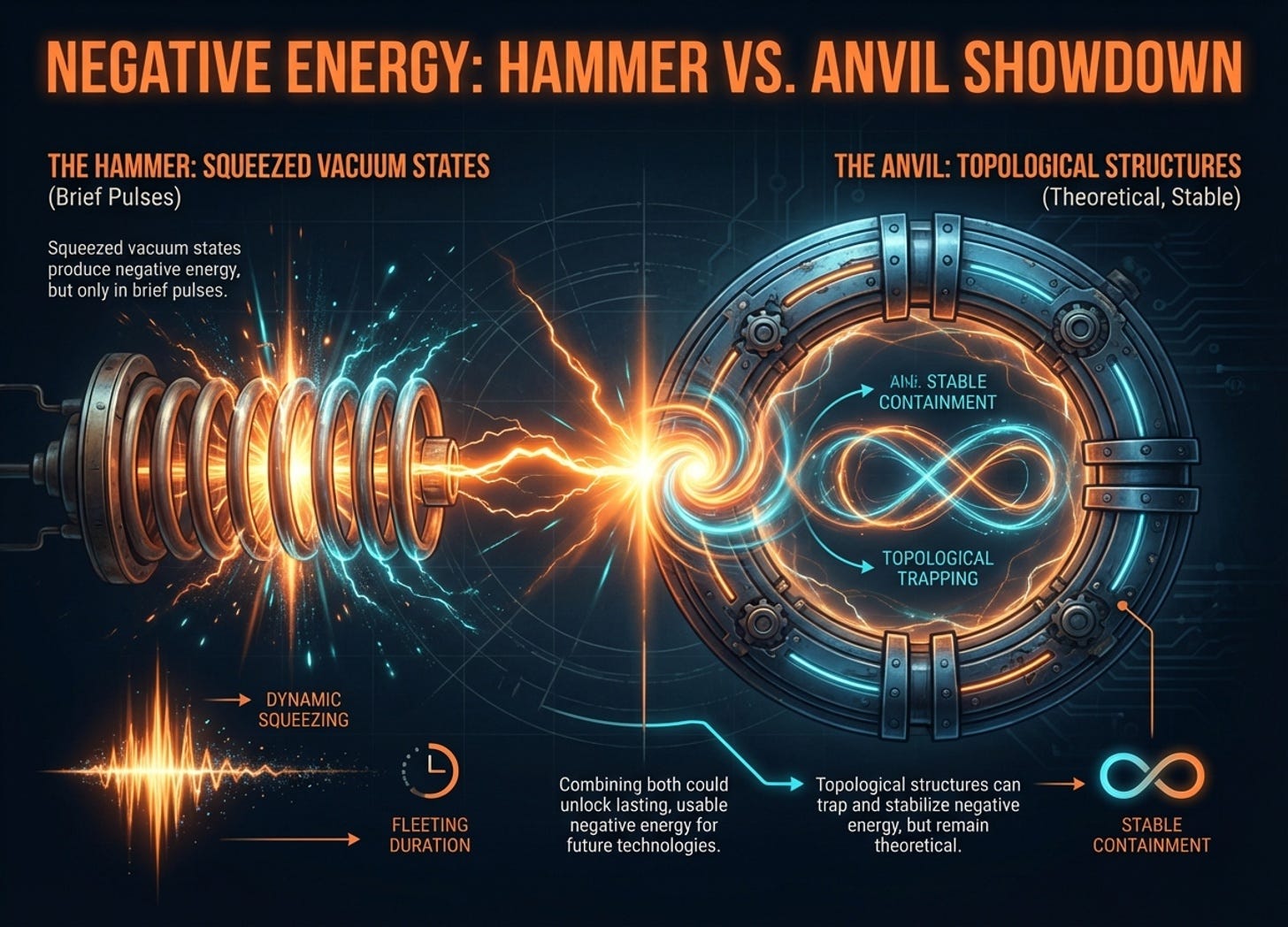
Squeezed vacuum states generate negative energy by reducing quantum fluctuations in one observable (say, electric field) while increasing them in its conjugate. This distorts the vacuum’s phase space into an ellipse, producing negative energy regions that come and go with clockwork regularity. Laboratory techniques have managed to create these states with laser light, but always with the same limitation: the negative energy is a blip, not a base.
The topological Casimir effect takes a different route, leveraging boundary conditions in curved manifolds to produce negative energy locked in by geometry. For boson fields on a topology like ℝ² × S¹, the energy density is ρ_CT = −Aμ ℏc d⁻⁴, where Aμ encodes field degrees of freedom. Unlike the standard Casimir effect, which is too weak for engineering, the topological version is theoretically robust but experimentally untested.
Here’s the twist: squeezing is the generation mechanism, but topology is the stabilization mechanism. The real engineering leap comes from hybridizing the two, using topology to trap the negative energy produced by squeezing, preventing it from self-canceling. This division of labor is what could transform negative energy from a fleeting anomaly into a metric-engineering tool.
The contest isn’t about which method is better. It’s about how they fuse. Squeezing gives us access. Topology gives us permanence. The future of spacetime engineering depends on marrying the two.
Final thoughts
Negative energy is no longer a theoretical ghost. It’s a fleeting laboratory reality. Quantum squeezing offers a handhold on the vacuum’s hidden structure, yet the real leap comes not from squeezing harder, but from learning to stabilize what we’ve caught. Topological constraints, not brute-force quantum tricks, hold the promise of making negative energy persistent, and therefore usable.
If the division of labor between squeezing and topology can be engineered, negative energy becomes more than a lab curiosity. It becomes a resource. The question now is not whether negative energy exists, but whether we can structure the vacuum so it stays where we put it. That’s the threshold between curiosity and engineering, and it’s still wide open.
⏭️ Tomorrow: From 1996 to 2002, NASA funded a program whose explicit goal was to figure out if warp drives were physically possible. You probably didn’t hear about it.
🔁 Restack and join the Advanced Rediscovery community at

🧑🏼 Follow @drxwilhelm on Substack, X Twitter, Medium, YouTube, TikTok
"Squeezed vacuum states create fleeting negative energy dips, but the vacuum always restores equilibrium." -- Probably due to oscillations. But if current is not allowed to travel, then it arises everywhere simultaneously out-of-phase with voltage by either zero or one-half cycles of displacement (but no other displacement is allowed) if everything is prevented from oscillating. The oscillatory wave form shape remains, but none of it moves. Hence, the trick is to get the oscillations to freeze their motion. This, then, overcomes the time-lag of electrical causation whose rate of propagation is ascertained to be the speed of light. A lag of time induces entropy and other anomalous conditions while a failure for effects (elsewhere) to lag behind their causations neutralizes entropy and these other anomalies. Eric Dollard gives an example how the electric utility grid is managed in such a way that hundreds of miles of electrical traversal along transmission lines is overcome so as to maintain synchronous phases at disparate locations along the transmission line. They do this with enlarged banks of capacitors positioned every 100 miles or so along the line. Otherwise, an explosion would occur at one end of the line due to the buildup of energy at one location over and above the levels of energy at every other location.
https://is.gd/spacedisjunction
https://www.youtube.com/watch?v=cCJcU7INwnU&t=13515s