


⬅️ Yesterday: NASA’s secret propulsion program.
Nikola Tesla’s 1892 high-frequency experiments revealed something that shouldn’t exist: lamps glowing without a return wire, sparks leaping across the air, and entire rooms bathed in cold, silent light. The textbooks say electromagnetic fields need a loop, a push and a pull, yet Tesla’s single-wire setups broke the rules, and the world shrugged.
Over a century later, mainstream physics is only now circling back. Twisted light and orbital angular momentum experiments hint at a missing topological layer in electrodynamics, one that Tesla’s machines exploited and that Maxwell’s equations only partially describe. The real story isn’t about wireless power. It’s about the physics we left behind, and the evidence that never fit.
👉 Subscribe to Advanced Rediscovery. I’m sharing what I’m finding as I decode zero point energy, the quantum vacuum, and extended electromagnetism — 12+ years of independent research. Weekly briefings from my home lab to your inbox.
Tesla’s high-frequency paradoxes
Every physics graduate learns the same rule: current flows in a loop, and energy transfer demands a closed circuit. Yet in 1892, Nikola Tesla‘s high-frequency experiments made lightbulbs glow using a single wire, no return path in sight. The world saw a magic trick. Tesla saw a crack in the laws themselves.
The drama wasn’t in the spectacle alone. Tesla’s machines filled rooms with cold, blue light, created flames that wouldn’t burn, and sent energy leaping through the air as if the ether itself was alive. These effects were a direct challenge to the completeness of Maxwell’s equations.
Tesla’s 1892 high-frequency experiments: single-wire transmission and room-filling electrostatic light.
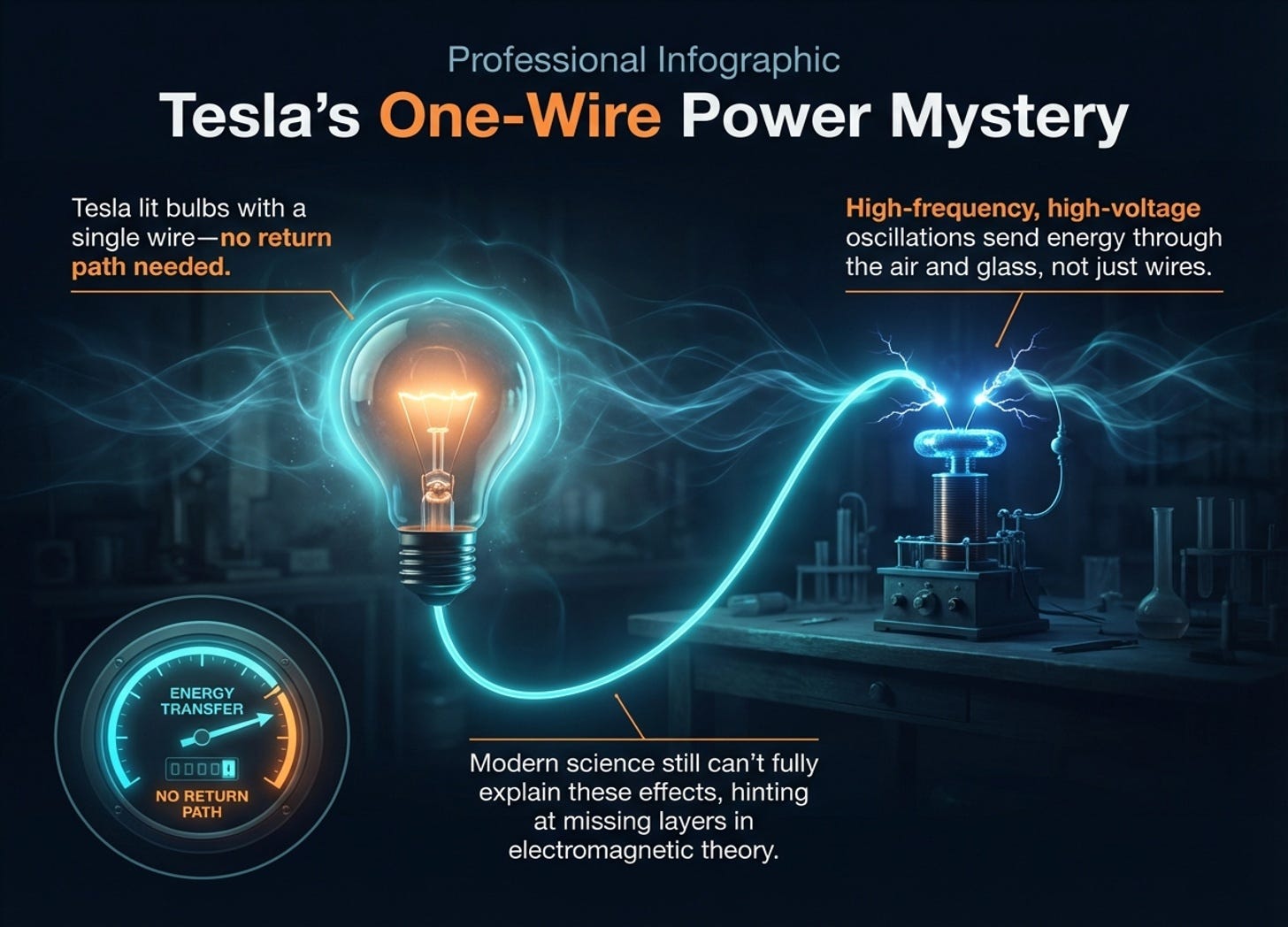
Tesla’s single-wire power transmission upended the dogma of closed-circuit necessity. He demonstrated that high-frequency, high-potential oscillations could deliver real, usable energy through a single conductor, lighting lamps and powering devices at a distance. The secret wasn’t in the wire but in the longitudinal electrostatic waves, subtle, non-Maxwellian carriers of potential that classical theory systematically ignores.
