


⬅️ Yesterday: QED vs SED — the interpretation war.
The quantum vacuum is supposed to be the ultimate nothing, yet calculations say it’s the densest thing in physics. Quantum Electrodynamics (QED) predicts a vacuum energy density so large it should rip the universe apart, while cosmological measurements see only a faint nudge, off by 120 orders of magnitude. Not 10%. Not 10×. Ten to the power of 120. The single worst prediction in science.
But what if this ‘mistake’ is actually an open door? The real story is not about fixing a broken formula. It’s about recognizing that the vacuum’s energy isn’t locked away by the laws of nature, but by the limits of our theory. Microfabricated Casimir chips are already showing us how to locally gate, sculpt, and extract energy from the vacuum. The physics crisis is an engineering invitation.
👉 Subscribe to Advanced Rediscovery. I’m sharing what I’m finding as I decode zero point energy, the quantum vacuum, and extended electromagnetism — 12+ years of independent research. Weekly briefings from my home lab to your inbox.
The quantum vacuum paradox
Physics textbooks teach that the quantum vacuum is immutable, a featureless background with infinite energy density. Yet the observed universe acts as if this energy barely exists. This contradiction sits at the heart of the vacuum catastrophe.
The problem isn’t philosophical. QED’s math predicts a vacuum so dense it should overwhelm all matter, but the cosmos expands gently, not explosively. The gap, 10¹²⁰ orders of magnitude, forces physicists into mathematical contortions like renormalization. The real issue may be deeper: our models of the vacuum are simply wrong.
Microfabricated Casimir chip: local boundary control sculpts vacuum energy density, challenging the notion of an immutable quantum vacuum.
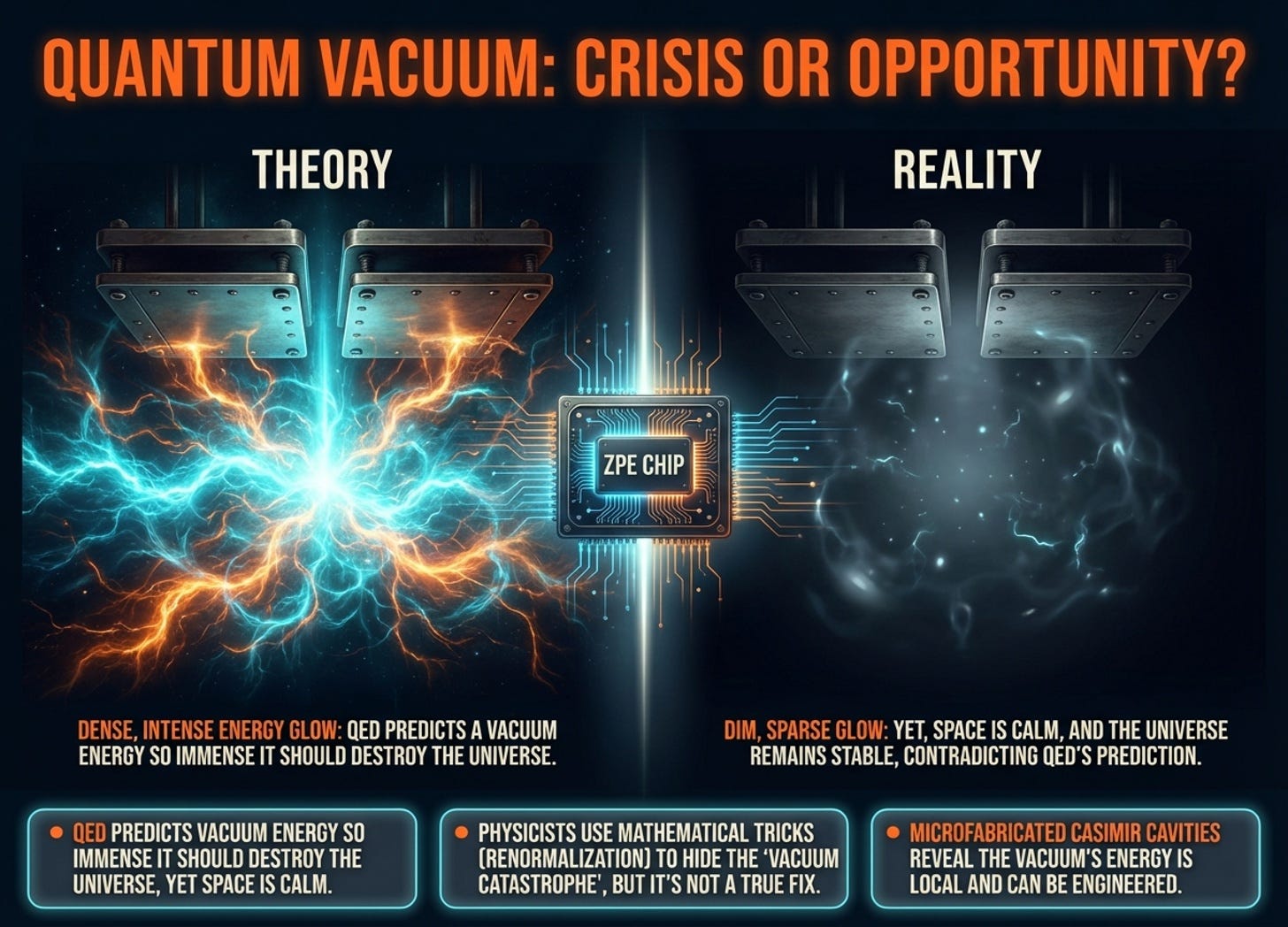
Quantum Electrodynamics (QED) treats the vacuum as an infinite sea of fluctuating fields, each contributing energy at every possible frequency. Add up all these modes, and you get a vacuum energy density so high it should instantly collapse the universe. To salvage predictions, physicists use renormalization, discarding these infinities and focusing only on energy differences, like the force between two plates in the Casimir effect.
This move works for calculating atomic shifts and Casimir forces, but it’s a patch, not a solution. The underlying math is so unsatisfying that even Paul Dirac called it a failure. QED’s core axiom, that the vacuum is non-degradable, locks the door to any continuous conversion of zero-point energy (ZPE) into usable work. You can measure the vacuum’s push, but you can’t extract its power.
Yet experiments with microfabricated structures, Casimir cavities, show that local boundary conditions can gate and even invert vacuum energy density. These are the first hints that the vacuum’s energy is not a cosmic constant, but a local variable, shaped by geometry. The 10¹²⁰ discrepancy is not an embarrassment but an engineering opportunity. If the vacuum is manipulable, then the real challenge is scaling up, not rewriting physics.
The vacuum catastrophe is a symptom of deeper confusion. Both QED and cosmology are right within their own frameworks, but the frameworks are incomplete. The breakthrough comes when we stop treating the vacuum as untouchable and start engineering its boundaries. Microfabricated ZPE chips aren’t fantasy. They’re the first step in turning the universe’s biggest math error into its greatest energy source.
Rethinking cosmic energy
Most physicists treat the vacuum as an unyielding background, but a growing camp argues that’s a category error. The real action might lie in the interplay between matter self-fields, classical backgrounds, and extra dimensions. If so, the vacuum’s energy is not a fixed quantity but a tunable result.
Alternative theories like Stochastic Electrodynamics (SED) and neoclassical models don’t tweak the math. They reimagine what the vacuum is. Some even allow for continuous energy conversion, hinting that the biggest obstacle to vacuum engineering is mindset, not physics.
Competing visions: is the vacuum an immutable backdrop, or a tunable resource shaped by matter and geometry?
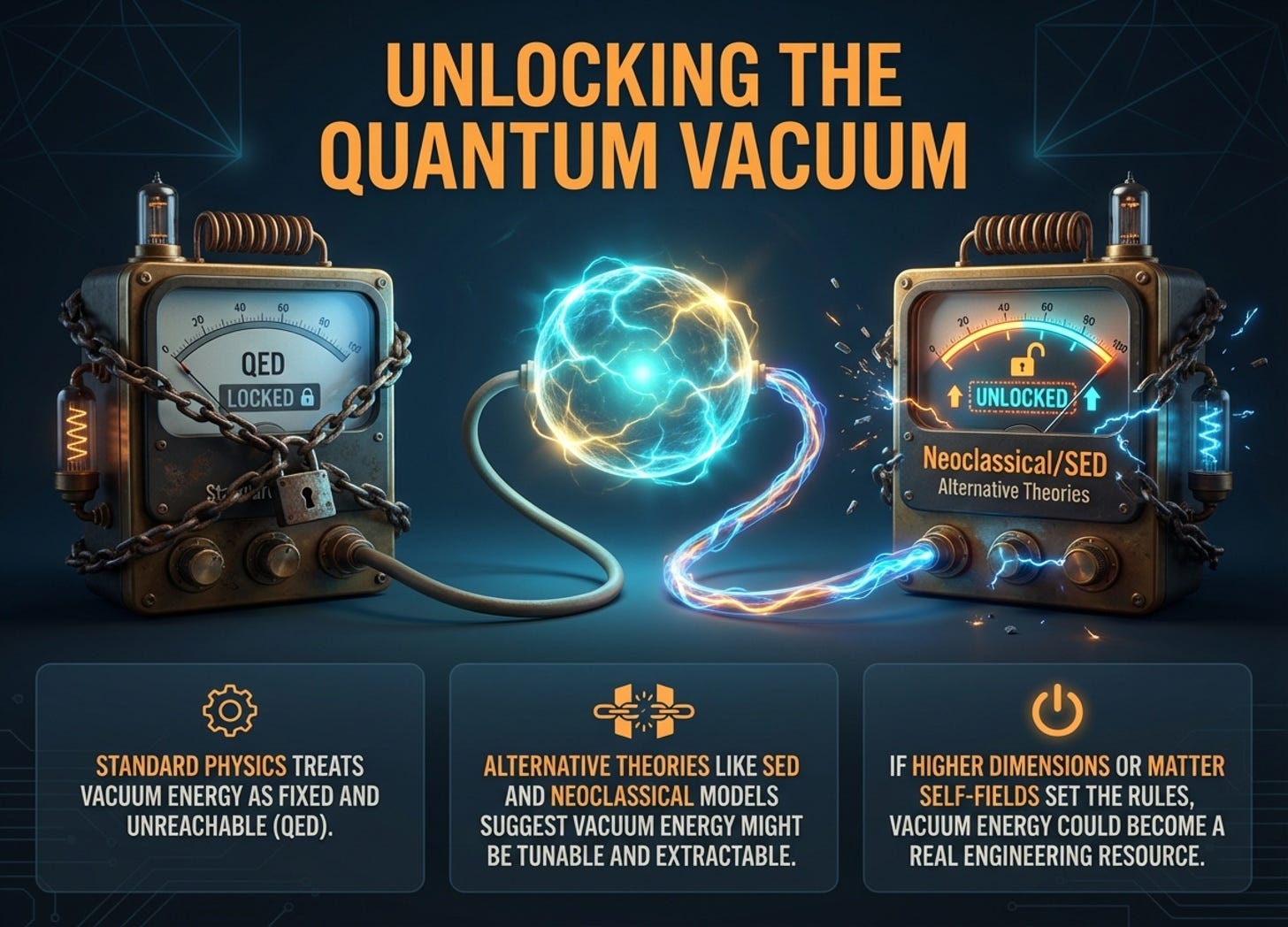
Canonical QED sees the vacuum as a bottomless pit of energy, with immutable, infinite degrees of freedom. This makes the vacuum non-degradable, a perfect backdrop but a dead end for energy extraction. Neoclassical theorists flip the script: they see quantum effects as emerging from matter self-fields and treat vacuum fluctuations as secondary.
Stochastic Electrodynamics (SED) models the vacuum as a classical, random background field. In SED, zero-point energy can, in principle, be converted continuously, sidestepping QED’s hard prohibition. The catch: SED fails to match quantum predictions for nonlinear systems, so its reach is limited. Linear SED (LSED) tries to fix this by imposing constraints that mimic quantum mechanics, but the question of ZPE convertibility remains open.
Barut’s approach goes further, using only matter wave functions and skipping vacuum field quantization altogether. This reproduces many QED effects while keeping the door open for vacuum energy manipulation. Meanwhile, higher-dimensional theories suggest that the observed cosmological constant is not a fundamental number but a tunable parameter, possibly set by the geometry of extra dimensions or by the balance of positive and negative energy contributions from virtual fields.
The standard story, vacuum energy as an untouchable constant, may be a relic of outdated theory. If matter self-fields or higher-dimensional tunings set the rules, then the vacuum’s energy is up for grabs.
Casimir cavities unleashed
The Casimir effect is more than a physics curiosity. It’s the first proof that the vacuum can be shaped, gated, and made to push back. Every microfabricated cavity is a testbed for locally controlling vacuum energy density.
MEMS and AFM experiments don’t just confirm the math. They give engineers a toolkit for manipulating the vacuum, one geometry at a time.
MEMS Casimir devices: from fundamental physics to programmable vacuum energy landscapes.
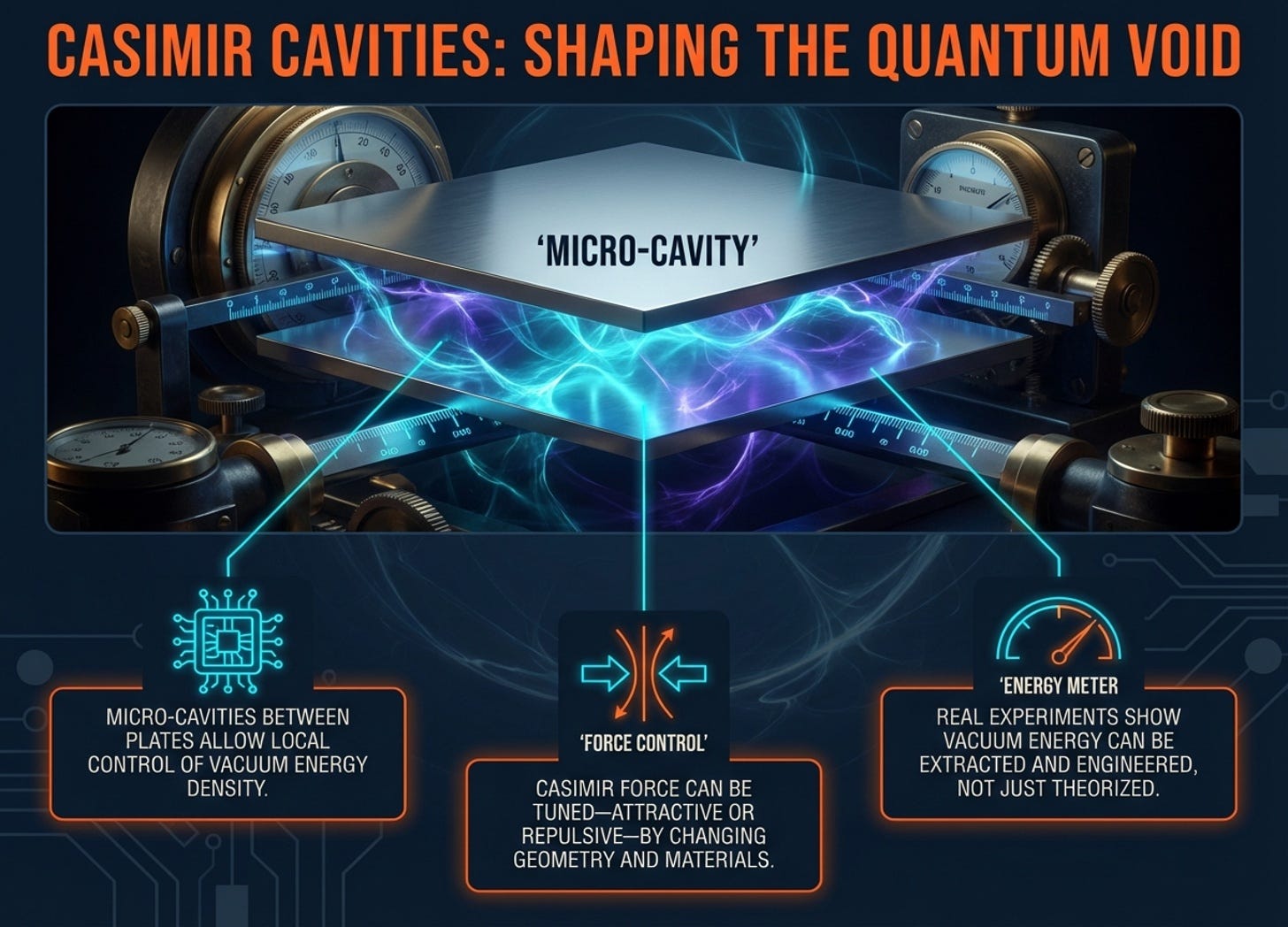
Casimir cavities, tiny gaps between metallic plates, let researchers sculpt the vacuum’s energy field. By carefully choosing the shape, size, and material, it’s possible to create regions of positive, negative, or even zero vacuum energy density. The Casimir effect arises because boundary conditions suppress certain vacuum fluctuations, producing a measurable force that matches theory to within 1%. Direct evidence that the vacuum’s energy can be manipulated.
Photolithographically defined micro-cavities, MEMS, and advanced materials like negative-index metamaterials expand the design space. Some geometries even flip the Casimir force from attractive to repulsive, hinting at applications from micro-actuators to levitation. Crucially, cyclically changing cavity dimensions can extract net energy: the system does not require as much work to reset as it gives up during collapse, suggesting a pathway to real vacuum energy extraction.
QED sidesteps its own infinity problem by focusing on energy differences caused by boundaries. But the deeper implication is clear: if energy differences are real and manipulable, then so is the underlying reservoir. Microfabricated ZPE chips are the first step toward engineering the vacuum as a resource, not a constant.
The Casimir effect’s real lesson is that the vacuum is locally programmable. The only barrier to scaling up is engineering, not physics.
Final thoughts
The 10¹²⁰ vacuum catastrophe isn’t a black mark on physics. It’s an arrow pointing at new engineering frontiers. When the math breaks this badly, our theoretical scaffolding is obsolete. Microfabricated Casimir chips, by locally controlling vacuum energy density, turn the impossibility into a challenge for engineers, not a dead end for theorists.
If the vacuum’s energy is not an immutable constant but a resource shaped by geometry, boundaries, and perhaps entanglement, then the old dichotomy (QED’s infinite plenum versus cosmology’s faint ghost) collapses. The real question is not whether the vacuum can be tapped, but how soon we’ll scale the first working ZPE chips from lab to civilization. The biggest failure in physics may be its most abundant promise.
⏭️ Tomorrow: Three mechanisms that could actually extract energy from the vacuum. Physics acknowledges all of them. It also shows zero urgency about developing them.
🔁 Restack and join the Advanced Rediscovery community at

🧑🏼 Follow @drxwilhelm on Substack, X Twitter, Medium, YouTube, TikTok
The source for limitless energy and its use are not subject to the same rules of engagement. The way we conventionally think about both is how to think about its application. But the source of this ZPE is not a reservoir. It's a template which cannot be spent. It is an archetypal substrate around which energy is built by continuous oscillations of reactance. This substrate cannot be "spent" since it is formulated during a transient surge, at initial startup, which reverses time (for all practical purposes) by invoking a parasitic frequency of reactance which is the initial response for a paltry input of real power. The real power input is subject to entropy, but the parasitic oscillation which it spawns is not.
"For all practical purposes" is due to our perspective. It is not absolute. It is a composition of relative amplitudes and frequencies between reactance and its initiation performed in such a way as to undermine the logic behind Conservation.
When input is scant resulting in a parasitic oscillation which builds up its reactive amplitude without interference from this input's potential for suppressing the buildup of this reactive amplitude if this input were large enough to do so, then Conservation plays no role since there is no causal linkage between input and output (aka, nonlinear). This is an important criterion since causation lies at the heart of the accountability of Conservation.
Catalysts are not subject to Conservation. And within the context of initiating a transient surge, the overall summation of a transient has the potential of appearing to engage time reversal. This is merely apparent but diagnostically signifies a foundation has been laid for the potential for unlimited growth of the consequences of reactance if taken advantage by an appropriate layout (geometry) of circuit structure.
What’s called the “worst prediction in science” may actually be a category error. The vacuum is not nothing, and it does not behave identically across scales. At the quantum scale it appears maximally dense because it is the underlying structured field; at the cosmological scale it appears minimally dense because only the tiny net residual of that structure contributes to large-scale curvature. The apparent 10^120 mismatch comes from comparing local field density with global gravitational effect as though they were the same thing 🌀