


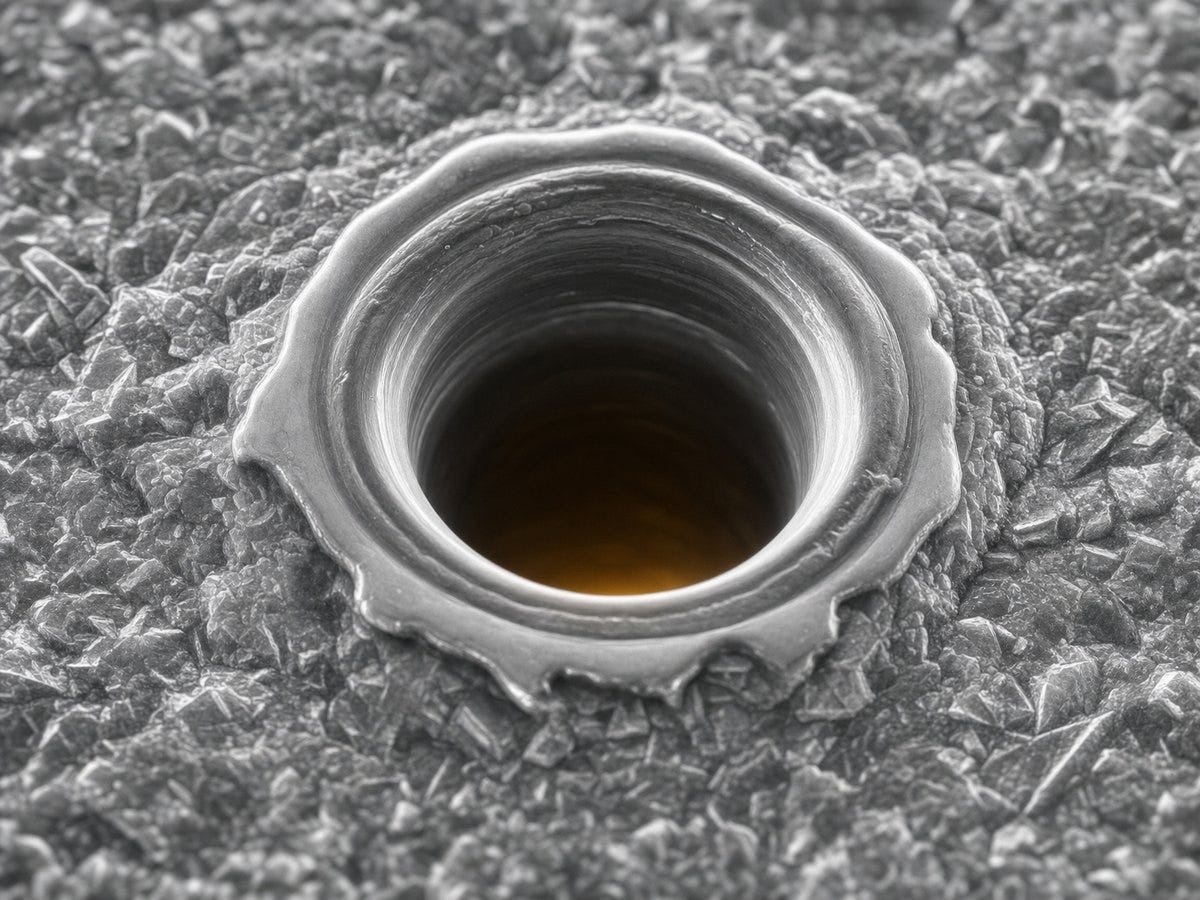
Shuffle across a carpet in socks and touch a doorknob. The little spark is electric charge leaving you. It’s carried by electrons, the same tiny particles that carry the current in every wire in your house, and electrons all carry the same kind of charge. Like charges push each other apart. That’s why the charge jumps off you at the first chance it gets.
Now imagine packing a hundred billion electrons into a cluster smaller than a speck of dust.
It should blow apart at once. At that crowding the electrons push outward millions of times harder than the rock presses at the centre of the Earth. Nothing in physics as we know it would hold such a cluster together for even a trillionth of a second.
An American engineer named Kenneth Shoulders said he made clusters like that anyway, again and again, from the 1980s until he died in 2013. He wasn’t an amateur. In 1958 he set up the microelectronics programme at the Stanford Research Institute in California, and he’s credited as one of the early pioneers of electron-beam lithography, the technique still used to draw the master patterns for computer chips.
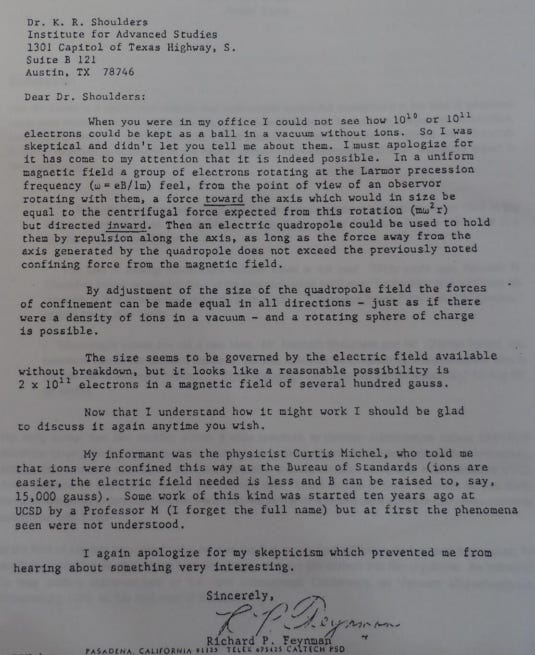
What he described were tiny objects, far thinner than a human hair, made with short sparks of high voltage in a near-vacuum. They raced along surfaces at about a tenth of the speed of light and burned tracks and tunnels into whatever they hit. Richard Feynman, the Nobel Prize-winning physicist, didn’t believe it when he first heard about it, and later wrote to Shoulders to apologise.
People who come across this story tend to land in one of two camps. Either Shoulders fooled himself, or physics is missing something big. I’ve been reading the cold fusion literature in public on this newsletter since August, and these clusters keep turning up in it, so I promised to do something neither camp seemed to have done: take his numbers and check the arithmetic, every step in the open.
I checked Shoulders’ numbers, and something is definitely off…
The paradox needs no new physics. The hundred billion was wrong: the voltages Shoulders measured around his own clusters fit about two million electrons. Two million still shouldn’t stay together as long as his clusters did, and below I explain what might hold them and which cheap experiment would settle it.
This one is for paid subscribers, to keep the others free.
