


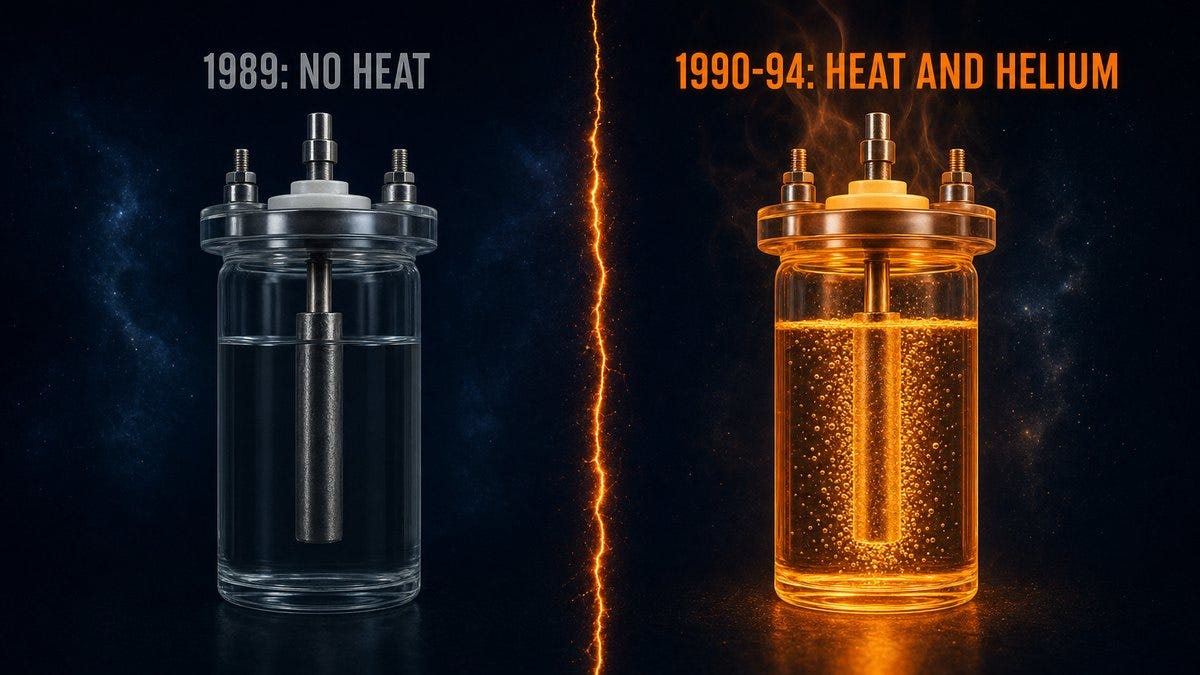
Everybody knows how the cold fusion story ends. Two chemists announced it in 1989, the world’s best laboratories tried to repeat it, nobody could, and the whole thing collapsed inside a year.
That account is true. It is also missing a laboratory.
Before we go further: nothing here is about free energy, and nobody in this literature is claiming any. Whatever is or isn’t happening in these cells, the energy books balance. The argument is about which account pays.
What the experiment actually is
You need to be able to picture the thing, because almost nobody can.
Heavy water in a glass vessel. Heavy water is ordinary water where the hydrogen is deuterium, hydrogen with a neutron attached. A rod of palladium sits in it. Palladium has an unusual appetite for hydrogen, so when you run a current through the cell, deuterium drives into the metal and packs in.
Then you measure how much energy goes in and how much heat comes out, and you argue about the difference ever since.
That’s it. That is the whole apparatus at the centre of the most notorious controversy in modern physics.
The laboratory that got nothing
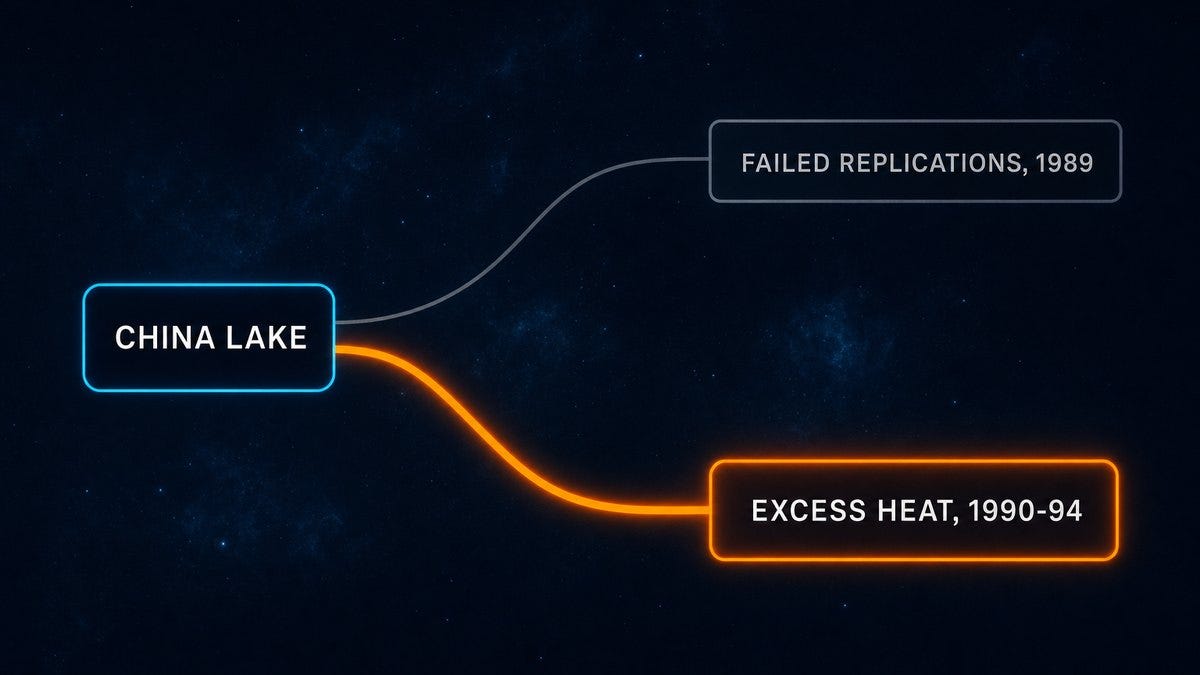
In 1989 the US Navy ran this at China Lake, a weapons research site in the California desert, under an electrochemist called Melvin Miles.
For six months, nothing. No excess heat, and nothing else anomalous he could have put in a report.
Those results went into the record. When the lists of failed replications were compiled, China Lake was on them, next to Caltech, next to MIT, next to Harwell. Four serious laboratories, four nulls, case closed.
The same laboratory, three years later
Between 1990 and 1994 Miles ran three more sets of experiments in the same building.
This time the cells produced excess heat. Not once. In the deuterated runs, consistently.
The difference was the metal. The later work used palladium made specially by Johnson-Matthey, and the material turned out to matter more than anyone had allowed for.
That should stop you, because of what it does to the argument. The standard story explains the positive results by saying the people who got them were careless. It explains the negative results by saying they settled the question. China Lake produced both. The same electrochemist, the same protocol, and the same building where he had got nothing at all three years before. You cannot call him sloppy on the strength of one dataset and rigorous on the strength of the other.
The entry condition nobody had in 1989
Three years after the verdict, two groups working independently found out why the metal mattered.
Michael McKubre at SRI in California, and Kunimatsu’s group in Japan, both pinned down the same number in 1992. The palladium has to be loaded with deuterium past a ratio of roughly 0.85 before anything happens at all. Below that, you get nothing, however carefully you work.
Loading palladium that far is hard. It depends on the purity, the metallurgy, how the rod was drawn, how long you run it. It is exactly the sort of thing a first-rate laboratory can fail at while doing everything else perfectly.
The famous 1989 replications ran below it.
Heat a pot to 70°C, write down that no boiling was observed, and you have not disproven boiling. You have measured where you stopped.
The number that should be famous
Miles asked the sharper question. If these cells are genuinely fusing deuterium, they should be producing helium. So measure the heat and measure the helium, and see whether they move together.
They moved together. Excess heat came with excess helium-4 in 18 of 21 runs. No excess heat came with no helium in 12 of 12. Thirty-three experiments, thirty of them agreeing.
Then he did the arithmetic that matters. Deuterium fusing to helium-4 releases 23.8 million electron volts per atom. If that is what’s happening, the ratio of energy released to helium produced is fixed, and you can check it.
His measurement came out at 23.8. The textbook value is 23.85.
The odds of his heat and helium numbers correlating that well by experimental error alone were computed at one in 750,000.
Which is why one recent null belongs in this section. In September 2026 a privately funded program called Project Callisto released 607 pages of failed replications and recommended terminating LENR research. It ran hundreds of sealed cells for weeks, and it owned a mass spectrometer that can tell helium from deuterium. It never measured the helium in a single one. I was one of the reviewers of the response, which is at https://callisto.review/.
What the critics say, in full
They say the measurements are not good enough to carry the claim.
Steven Jones and others went through this work and argued that both halves are unreliable: the heat measurement and the helium detection. They found inconsistencies in the data and in the analysis, and concluded that the evidence was far from compelling.
That is a real objection from serious people and it has not been resolved. Helium is present in ordinary air at about five parts per million, so contamination is a permanent worry in any experiment that claims to find it. Anyone who quotes the one-in-750,000 figure at you without mentioning that the underlying measurements are contested is selling something.
I am not in a position to adjudicate it. I have never run one of these.
Where this actually leaves it
Miles’ funding was cut in 1995.
A word on how I got here, since it is plainly not thirty years in this literature. It is a month of evenings, and something I built to read it with me. The papers say what they say either way. The series stays free because the occasional paid one covers it.
None of the above makes cold fusion real. I want to be precise about the claim, because this subject is drowning in people who are not.
What it makes is the 1989 verdict unsafe. That verdict rests on a set of nulls produced before anyone knew what condition the effect required, by laboratories that in at least one documented case went on to get a positive result once the material changed. A verdict like that is not a refutation. It is a snapshot of what people could do in the first six months.
The question those experiments were supposed to answer is still open. That is a much smaller claim than the one this field is usually accused of making, and it is considerably harder to argue with.
⬅️ Previous: a hundred billion electrons that turned out, on their discoverer’s own numbers, to be about two million, and the one-shot measurement that would settle the count.
📬 Article 5 of 5 in a read-along through the cold fusion literature, and it is free. Subscribe and whatever I turn up next lands in your inbox.
🔁 If this one was useful, a Restack helps other people find it.
Research papers free at advanced-rediscovery.com/research · @drxwilhelm on X · Substack · YouTube
The death of cold fusion did not entirely occur within a year due to lack of replication since reading Eugene Mallove's introduction to the English translation to Tadahiko Mizuno’s book, “Nuclear Transmutation: The Reality of Cold Fusion” has convinced me that denial and death are not the same types of results garnered from research.
The introduction:
https://lenr-canr.org/acrobat/MizunoTnucleartra.pdf
More links to Mallove's written material on this subject:
https://vinyasi.substack.com/p/fire-from-ice-searching-for-the-truth