


The story of the Casimir effect is about human psychology more than quantum physics. For nearly half a century, the prediction that empty space could push two metal plates together drifted through the scientific wilderness. When the effect was finally measured, first with a 100% error margin, then down to less than 1%, the world shrugged.
Each leap in experimental precision should have triggered a revolution. Instead, the evidence was quietly shelved, the implications boxed up as curiosities. The more undeniable the measurements, the more invisible the opportunity. The vacuum is not empty, and we have the numbers to prove it. So why does nothing change?
👉 Subscribe to Advanced Rediscovery. I’m sharing what I’m finding as I decode zero point energy, the quantum vacuum, and extended electromagnetism — 12+ years of independent research. Weekly briefings from my home lab to your inbox.
The 49-year silence
In 1948, the prediction that zero-point energy could push two metal plates together was almost heretical. The force was so small, the effect so counterintuitive, that most physicists dismissed it as a mathematical oddity. For decades, the idea drifted on the margins, ignored not because it was disproven, but because it was inconvenient.
The real story here isn’t technical difficulty. It’s how institutions handle evidence that threatens established narratives. The Casimir effect’s journey from wild conjecture to sub-1% precision reveals a pattern: the more robust the proof, the more determined the neglect.
The Casimir effect: two metal plates in a perfect vacuum, forced together by the energy of empty space.
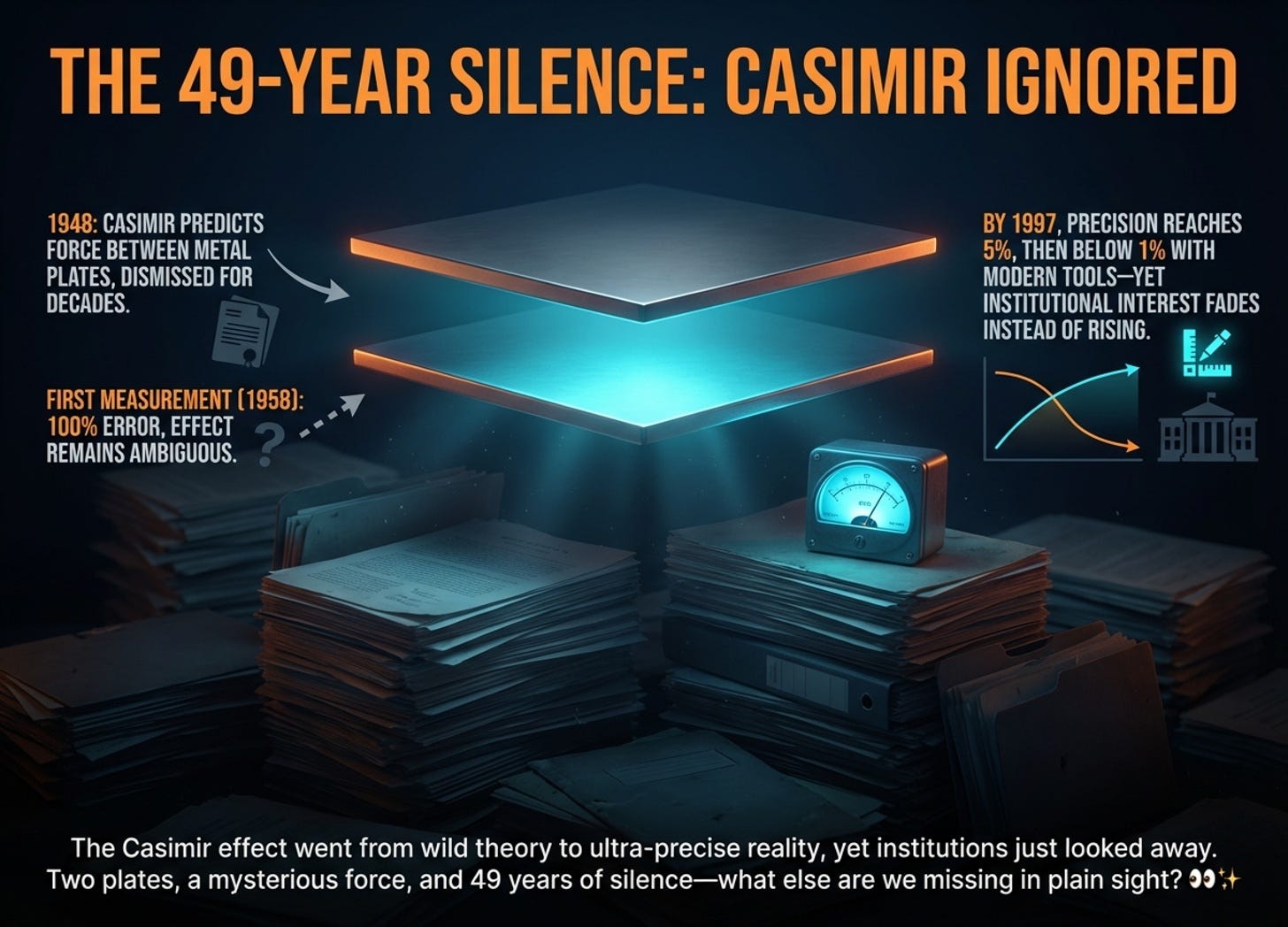
Early experimentalists faced a gauntlet of obstacles. The Casimir force is minuscule — on the order of 2.08 × 10⁻⁷ dynes per square centimeter at a five-micron gap. Dust, stray charges, and fabrication defects swamped the signal. In 1958, the first major attempt at measurement landed with a 100% error margin, making the result as ambiguous as a coin toss.
It took until 1997 for anyone to break the deadlock. Using a torsion pendulum, the force was measured to within 5% of theoretical prediction. Suddenly, the vacuum wasn’t so empty. It was a structured, energetic medium, and the numbers matched. But even as atomic force microscopy (AFM) and microelectromechanical systems (MEMS) drove error bars below 1%, the institutional response was a collective yawn.
Here’s what makes this maddening. As the measurements became more precise, the appetite for action shrank. The effect could be amplified by clever geometry or new materials, but these paths remain unexplored and unfunded. The evidence sits in plain sight, growing sharper, while the world keeps burning oil.
The Casimir effect’s measurement arc tells you everything about how human systems absorb and forget disruptive truths. The more undeniable the evidence, the more invisible the opportunity.
One experiment. Zero funding.
Measuring the Casimir force is a technical frustration. The signal is weak, the noise is relentless, and every improvement in precision reveals new sources of error. Each time a team solves one problem (surface contamination, stray static, roughness), another appears, as if the vacuum itself resists being measured.
The real barrier isn’t technical. The tools are here: MEMS, AFM, and clean room fabrication. What’s missing is the institutional will to scale the effect beyond the lab bench.
Atomic force microscopy and MEMS fabrication have pushed Casimir force measurement accuracy below 1%.

The Casimir force’s weakness demands extreme sensitivity. At separations of just a few microns, the force is easily drowned out by dust, oxide layers, or even the faintest electrostatic residue. Researchers now use gold coatings and silver epoxy to make electrical contacts, but achieving atomically smooth surfaces, especially on curved geometries, remains an open problem.
Modern atomic force microscopy has pushed detection limits to atto-newton-per-meter spring constants, with nanometer-level control over plate separation. High vacuum environments reaching down to 10⁻⁶ torr are now routine, slashing contamination and boosting signal-to-noise. But even with these advances, the field faces persistent headaches: aligning nanostructures, eliminating contact resistance, and modeling real materials with enough accuracy to predict forces in anything but the simplest setups.
Superconductors are often proposed as the next leap, promising ways to suppress surface charges or modulate the force entirely. So far, mostly speculation. The practical issues (contact resistance, fabrication, electrostatics) remain stubbornly unsolved. The tools exist. The evidence is overwhelming. The engineering push is absent.
The Casimir effect could be the foundation for a new class of microdevices, actuators, or propulsion systems. Instead, it’s treated as a curiosity. The technology is ready. The will to build is not.
The vacuum isn’t empty
Classical physics pictured empty space as a void, a perfect nothingness. Quantum mechanics ended that. The vacuum is an ocean of zero-point energy (ZPE), fluctuating even at absolute zero.
The Casimir effect is the proof, not the theory. When two plates are close enough, they gate the quantum vacuum, suppressing certain fluctuations and creating a measurable force. A direct demonstration that empty space is structured, energetic, and potentially engineerable.
Quantum fluctuations in the vacuum create a measurable force between plates, the Casimir effect in action.
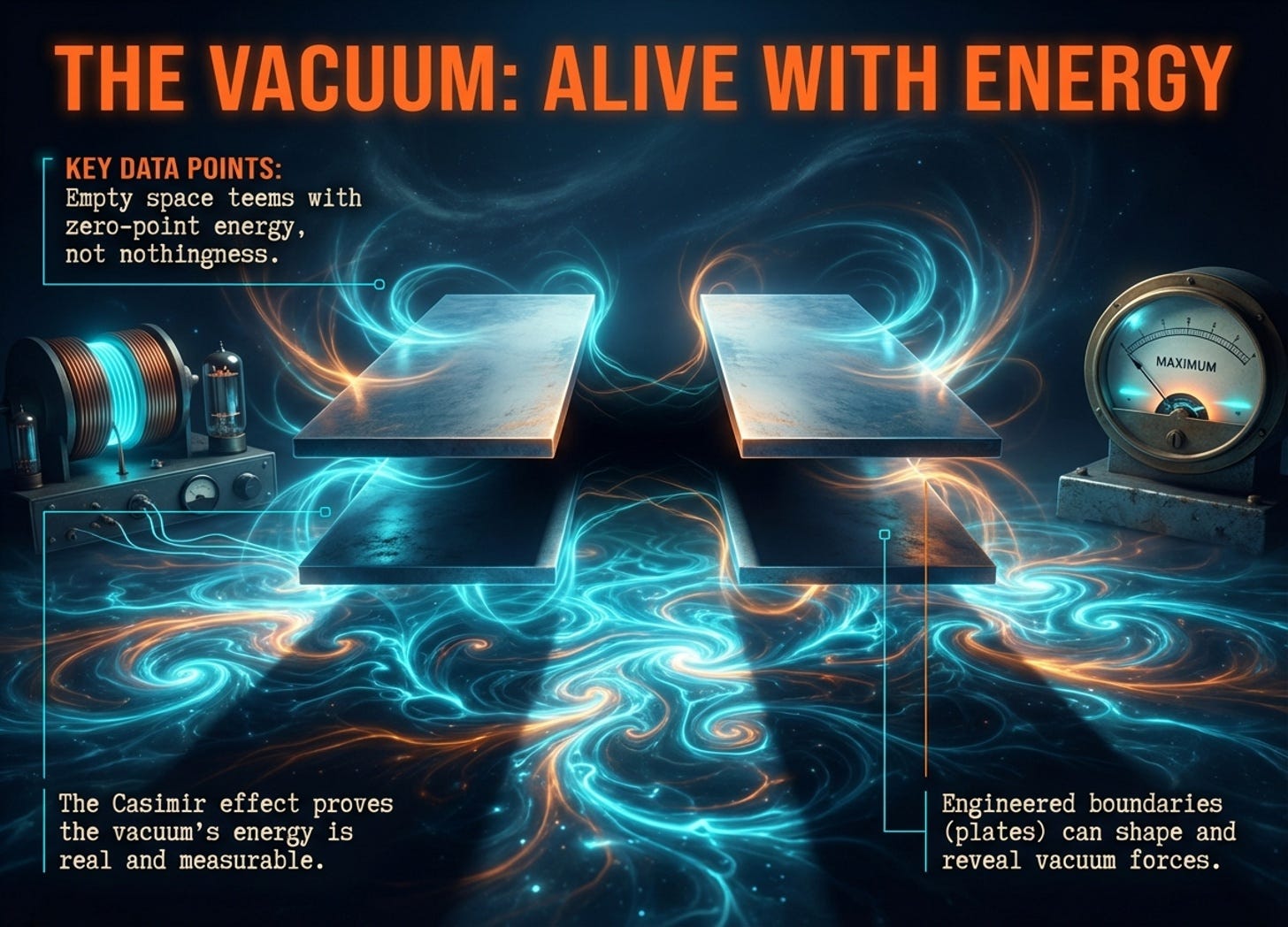
The quantum vacuum is not passive. Thanks to the Heisenberg Uncertainty Principle, every quantum field vibrates even in its lowest state. These fluctuations give rise to a nonzero energy density, the zero-point energy. At the atomic scale, this energy is immense, theoretically dwarfing nuclear densities, though practical calculations require renormalization to avoid runaway infinities.
The Casimir effect exposes this hidden structure. The plates act as boundaries, filtering out wavelengths that can’t fit between them. The result is an imbalance in radiation pressure, pushing the plates together. The measured force matches predictions to a precision that would make any classical engineer blush.
Quantum field theory treats the vacuum as the ground state of all fields, filled with restless energy. This active background can bend light, shift atomic energy levels, and, if you’re ambitious, be engineered for technological applications. Vacuum engineering is no longer science fiction. It’s the next step, waiting for someone to take it seriously.
The numbers are in. The vacuum is alive with energy, and we can shape its effects. The only thing missing is the willingness to act on what’s already proven.
The force that shouldn’t exist
If the Casimir effect is real, why not engineer it? Because the math gets ugly, fast. Calculating vacuum forces for anything beyond two flat plates requires quantum electrodynamics (QED), creative geometry, and a willingness to wrestle with infinities.
With each new model, the gap between proof and action widens. The more we demonstrate the effect’s versatility (repulsive forces, tunable cavities, negative energy), the less anyone funds the work. The opportunity is right there. The institutional response: classify, don’t capitalize.
Complex geometries allow Casimir forces to be tuned, attractive, repulsive, or zero, by design.
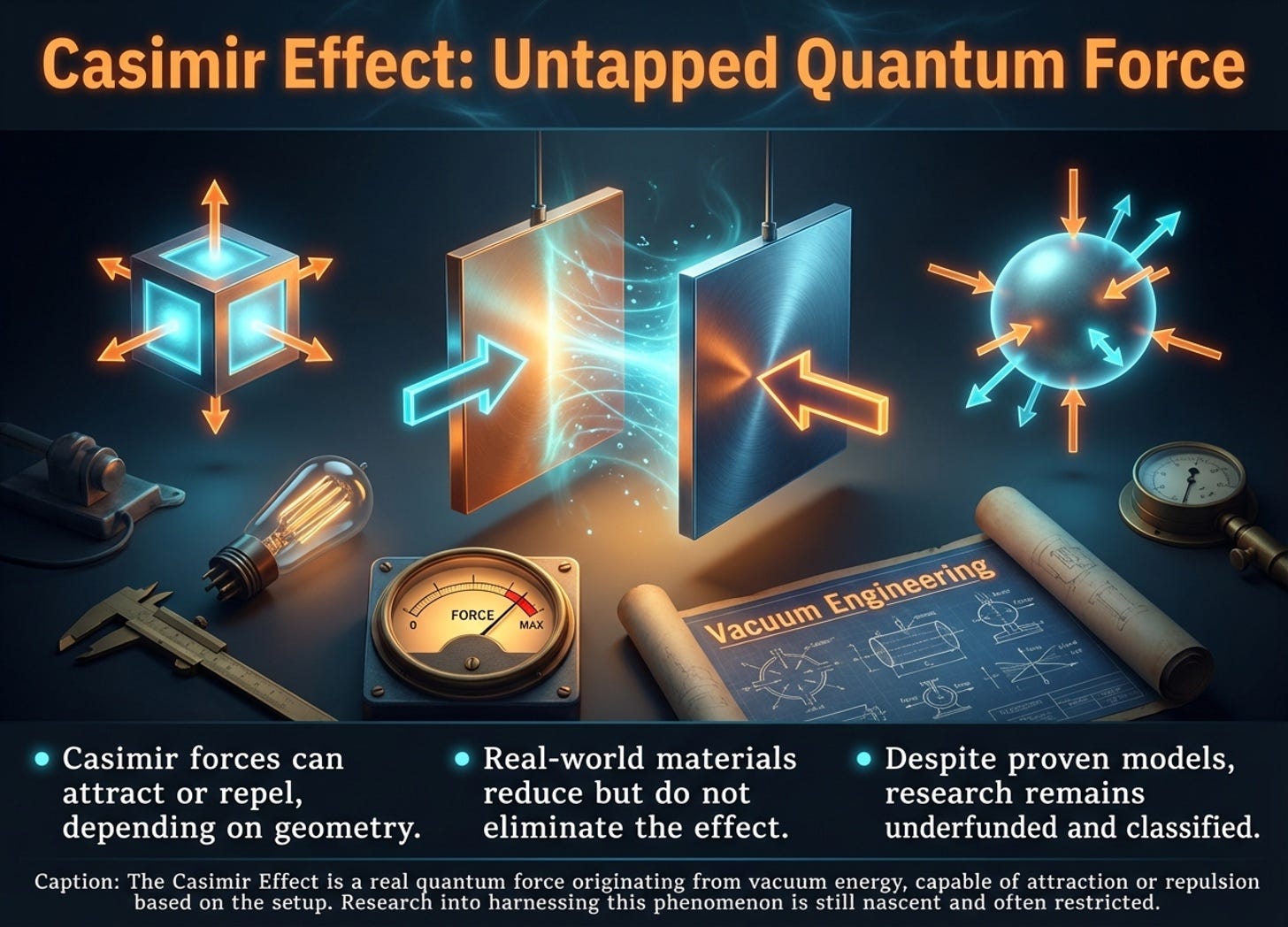
Modern QED models can predict Casimir forces in rectangles, slabs, spheres, and multilayered materials. Real metals like gold show a 30% reduction in force compared to ideal conductors, but the effect is still robust. In some geometries, the force flips direction. Cubic cavities can even exhibit repulsion on all faces.
These calculations aren’t academic exercises. They’re the blueprint for vacuum engineering. By tailoring boundary conditions and material properties, it’s possible to amplify, suppress, or reverse the Casimir force. The dynamical Casimir effect goes further: accelerate a mirror in a vacuum, and you literally create photons from nothing. A propulsion concept so exotic it sounds like science fiction, yet mathematically sound.
Every advance brings new technical headaches. Perfectly sharp boundaries lead to mathematical divergences, and real-world fabrication is never ideal. Still, the models are improving, the measurements are catching up, and the only thing lagging is the will to build. The effect is proven, the math is tractable, the engineering is within reach.
The Casimir effect is a toolkit for manipulating the quantum vacuum. Nobody is using it. The more we know, the less we do.
Final thoughts
The Casimir saga is a mirror for how societies handle inconvenient truth. Decades of mounting, ever more precise evidence have not sparked a rush to engineer the quantum vacuum. They’ve deepened the silence. The measurements are not ambiguous. The force is real, the vacuum is alive with energy, and the tools to shape it are in our hands.
The institutional reflex is to treat this as a solved curiosity, not an open frontier. When proof grows sharper, resistance hardens. What happens when the world finally pays attention to the numbers it has been ignoring?
⏭️ Tomorrow: Two frameworks have been fighting for 70 years over whether vacuum energy is “real” or “virtual.” The answer might be the most consequential mislabeling in the history of physics.
🔁 Restack and join the Advanced Rediscovery community at

🧑🏼 Follow @drxwilhelm on Substack, X Twitter, Medium, YouTube, TikTok
The day will come when this experiment will not be executed in its raw, unadulterated format since that's doing it the hard way. The easy way is to enhance the intended effect, by utilizing the principles of reactance, and then subtract the additional assist to achieve the raw data that is sought. Although this seems like fudging, it'll simultaneously demonstrate overunity.
This is what I do but in a simplistic, white-washed format. Yet, it works and demonstrates what we've been alluding to ever since, that: noise is a resourceful substrate of empowerment. It's hard to avoid breaking out the proverbial champagne, so-to-speak, when writing about what I enjoy hoping for.