


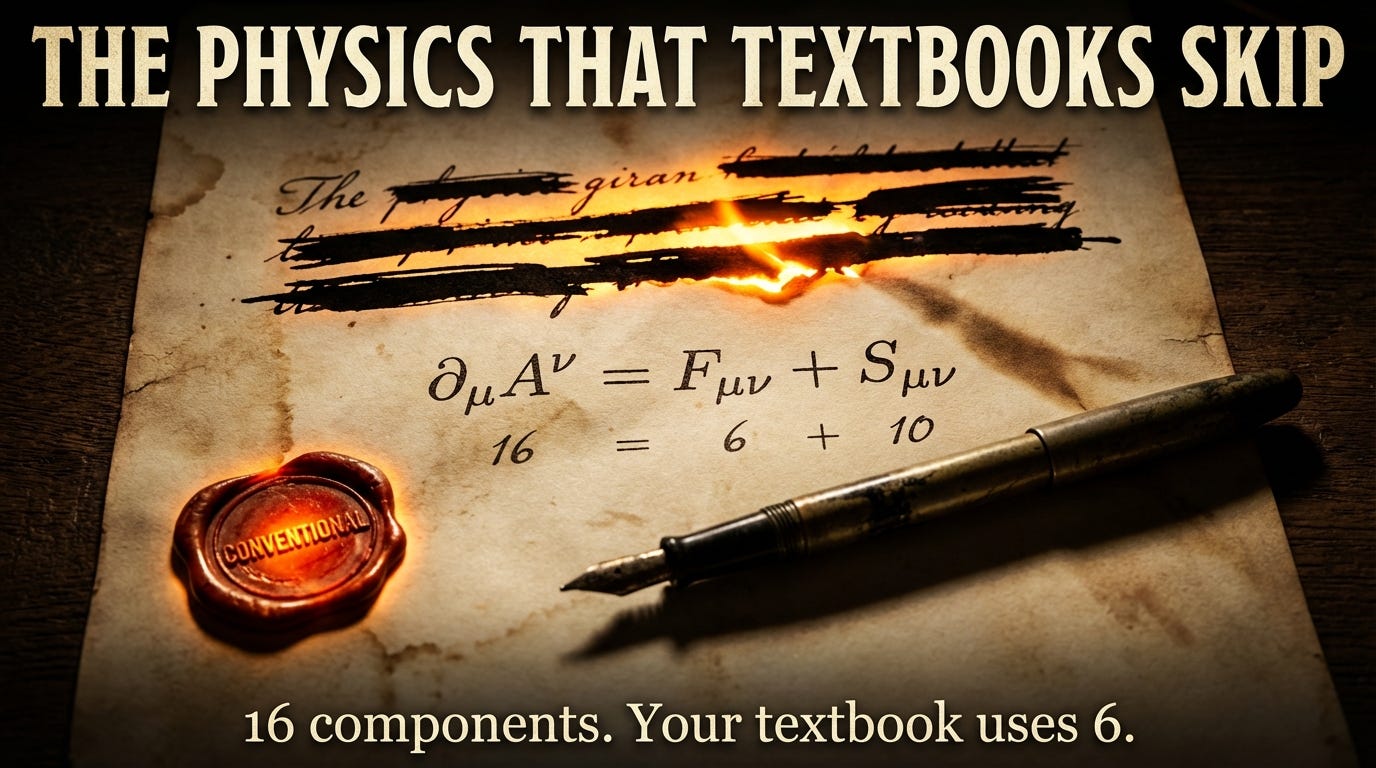
How three simplifications adopted between the 1860s and mid-20th century deleted 10 kinematic components from electrodynamics, and what four independent derivations found when they put them back.
Every physics student learns Maxwell’s equations. Four elegant vector equations that describe everything from radio waves to light to the magnetic field of the Earth. They are the foundation of electrical engineering, photonics, antenna theory, and quantum electrodynamics.
What most students never learn: those four equations are a simplified version. The original formulation by James Clerk Maxwell in 1873 had 20 equations. The simplification, performed by Oliver Heaviside between 1882 and 1884, was a genuine triumph of mathematical economy. But it came at a cost that physics has been paying for over a century.
I spent months tracing exactly what that cost was. The result is a research paper called “The Deleted Degrees of Freedom: A Case for Potential-Primary Electrodynamics.” This article is the accessible summary.
The 16-Component Problem
The electromagnetic potential is a mathematical object that describes how electromagnetic effects propagate through space and time. When you compute its full derivative (technically: the four-gradient of the four-potential), you get a tensor with 16 kinematic components.
Standard electrodynamics uses only the 6 antisymmetric components. These encode the electric field E and the magnetic field B. Everything in your textbook.
The remaining 10 symmetric components are eliminated by a mathematical convention called gauge fixing. The most common choice, the Lorenz gauge, sets the trace of this tensor to zero. Other gauges eliminate other components.
The critical point: none of these 10 components were ever shown to be unphysical through experiment. They were removed by mathematical convention. The distinction between “we proved this is zero” and “we defined this to be zero” is the entire subject of the paper.
Three Acts of Deletion
The deletion happened in three steps:
Act 1: Heaviside’s Reduction (1884). Maxwell’s quaternion formulation contained a scalar component alongside the magnetic field. When Heaviside replaced quaternions with vector calculus, this scalar component vanished. Heaviside was explicit about his intent: he called potentials “mystical” and sought to “murder them from the theory.”
Act 2: The Lorenz Gauge. A mathematical constraint that forces the divergence of the vector potential to be determined by the time derivative of the scalar potential. Any independent information carried by the divergence of A is suppressed. The gauge condition was derived by the Danish physicist Ludvig Lorenz in 1867 but has been misattributed to the Dutch physicist Hendrik Lorentz for over a century.
Act 3: The Ontological Demotion. The consensus that gauge freedom proves potentials are unphysical. The argument: if A can be transformed without changing E and B, then A cannot be real. But the Aharonov-Bohm effect shows this argument fails. Gauge-invariant quantities defined in terms of A (enclosed flux, holonomy, geometric phase) produce real, measurable effects.
The Evidence for Restoration
When the Lorenz constraint is relaxed, what comes back?
The scalar-longitudinal sector. Four independent research groups between 2003 and 2020 derived the same scalar field through different mathematical formalisms. This field, denoted C, is the Lorenz condition promoted from a constraint to a dynamical variable. It predicts waves that carry no magnetic field, penetrate Faraday cages, and propagate as coupled scalar-longitudinal modes. Woodside proved this is the unique gauge-free extension of Maxwell.
The Aharonov-Bohm effect. Confirmed definitively in 1986: electrons respond to the vector potential in regions where both E and B are zero. The potential is not auxiliary. It carries topological information (holonomy) that fields cannot represent.
Superconductor physics. The London equation J = -(nse²/m)A establishes the vector potential as the primary physical variable in every superconducting device since 1935. SQUIDs, MRI magnets, and particle accelerators all engineer A, not E or B.
Newton’s third law. Standard electrodynamics violates it for open circuits. Restoring the longitudinal force from the deleted scalar field fixes the violation.
The time-symmetric sector. Wheeler and Feynman showed time-symmetric electrodynamics is fully consistent. Cramer noticed that ψ* in quantum mechanics is already an advanced wave. The Born rule P = ψψ* uses both time directions in every calculation.
The electromagnetic-gravitational bridge. In the Kaluza-Klein framework, the vector potential is literally a component of the 5D spacetime metric. Deleting degrees of freedom from A deletes gravitational degrees of freedom.
What This Means
The paper does not argue for exotic physics. It argues the opposite: everything was already there. Standard mathematical tools (tensor analysis, the Stueckelberg mechanism, fiber bundle theory, geometric algebra) are sufficient to exhibit the full 16-kinematic-component content. No new formalism is required. The standard formulation is correct but incomplete, with engineering consequences.
The debate between “mainstream” and “fringe” electrodynamics rests on a gauge constraint adopted in the 1880s. The paper doesn’t resolve that debate. It makes it moot. The scalar-longitudinal sector, longitudinal forces, potential-mediated vacuum coupling, and the time-symmetric sector are not alternative physics. They are the physics that the standard formulation structurally hides behind a convention.
Four independent research groups, across two decades, with no cross-citation, arrived at the same physics through different mathematical doors. The convergence is the argument.
The full paper is free, open access, CC BY 4.0:
Read the paper: The Deleted Degrees of Freedom
PDF on Zenodo (DOI): zenodo.org/records/19019963
Academia.edu: academia.edu
Share it with anyone who told you scalar waves aren’t real.
🔁 Restack and join the Advanced Rediscovery community!
We've been told that when the bankers decided on a plan, they would only execute it years, if not decades, after their original plan to demonstrate how thorough was their planning effort. To get the universities to chime in and assist at least half a century before the bankers swooped in to benefit from that preparation is a classic case of 20/20 hindsight -- unless the devil has been orchestrating all of this from behind the scenes. But I don't believe in the devil being that smart. Demons are casually clever and are severely lacking in smartness. And aliens are not up my alley anyway, not since William Lyne made my acquaintance. But it's oh so popular to blame everything on demons or aliens as if we're not that smart enough to muck up our collective life on our own without outside assistance. I don't know how else to explain to myself how such a coordinated effort could pull off what you have described if not by way of a conspiracy among thieves. It makes sense that university types would have a hand in this charade since universities get to bond all of those doctoral theses and sell them to foreign stock exchanges to float their value for commercial trade. By the looks of what you're saying, it looks as if someone figured out around the late 1800s that energy was a powerful liberation for the common man to rise up above the institutional matrixes which have conspired to thwart us into submission and that this liberation must be prevented. One of these days the truth will out, along with everything else. Because it doesn't have to be a conscientious conspiracy to be effective. It need merely be a subliminal conspiracy of like-minded thieves in which each of them are contributing to the overall welfare of all thieves, everywhere.