


⬅️ Yesterday: negative energy is experimentally real.
In the late 1990s, NASA’s Breakthrough Propulsion Physics (BPP) program dared to chase the impossible: propulsion without propellant, energy from the vacuum, and even faster-than-light travel. These weren’t sci-fi dreams. They were concrete research threads with real budgets, real experiments, and real institutional anxiety.
But when the experiments started hinting at phenomena too disruptive to control, the public record went cold. The most provocative findings, especially those echoing the suppressed gravitomagnetic anomalies first reported by Podkletnov, didn’t die. They migrated, quietly, into the world of classified research. Today, mainstream physics papers on superconductors still pour out, but they systematically ignore the very anomalies that threatened to rewrite the rules of reality. The institutional burial wasn’t an accident. It was a containment strategy.
👉 Subscribe to Advanced Rediscovery. I’m sharing what I’m finding as I decode zero point energy, the quantum vacuum, and extended electromagnetism — 12+ years of independent research. Weekly briefings from my home lab to your inbox.
NASA’s physics gambit
The 1990s saw NASA launch a program that, on the surface, looked like institutional curiosity. Underneath, it was a calculated gamble with the fabric of physics itself. The Breakthrough Propulsion Physics (BPP) program wasn’t about solving rocket math. It was about engineering the impossible: propulsion without propellant, energy from the vacuum, faster-than-light travel.
This was no fringe effort. The BPP workshops convened the best minds to map out what it would take to bend spacetime and tap the quantum vacuum. As the program advanced, it became clear that some lines, once crossed, would threaten not just scientific dogma, but strategic military balance.
NASA’s BPP program: where open science met the limits of disclosure.
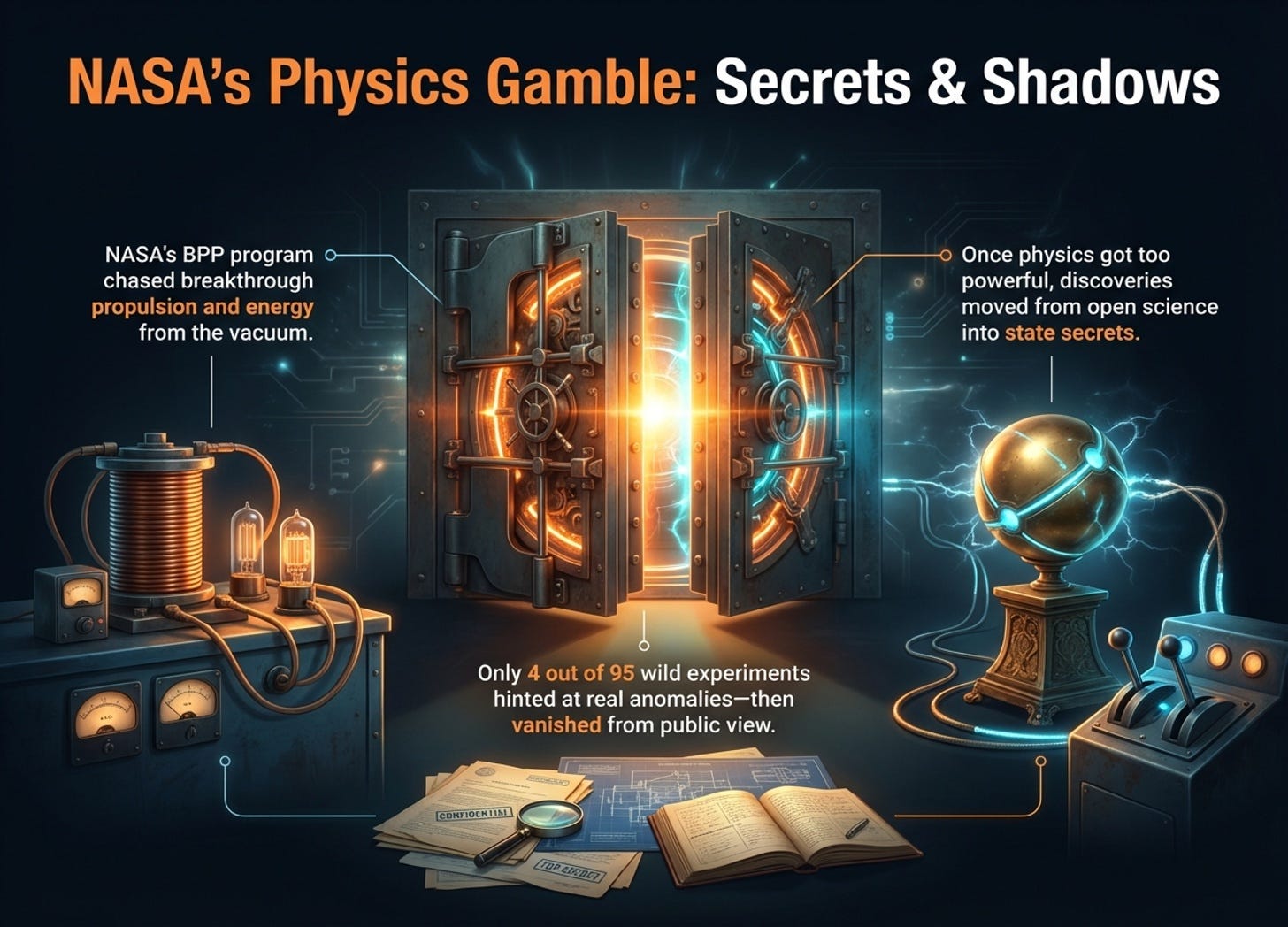
The BPP program was driven by a recognition that chemical rockets would never get us to the stars. Instead, it chased the wildest concepts in the open: manipulating zero-point energy (ZPE), engineering warp drives, and coupling gravity with electromagnetism. The workshops in 1997-1999 didn’t just brainstorm. They produced a list of 95 actionable research tasks, each aimed at prying open a different lock on the universe’s deepest vaults.
