


⬅️ Yesterday: the 10¹²⁰ orders of magnitude problem.
The quantum vacuum is the densest energy reservoir in physics, yet every engineering textbook treats it as an untouchable curiosity. The formulas are real, the measurements are precise, but the practical devices are absent. Why? Because the supposed physical barrier, thermodynamics, has quietly morphed into an institutional blockade.
Three distinct mechanisms for tapping vacuum energy have been proposed and even demonstrated at the edge of measurement: dynamic Casimir photon creation from moving boundaries, cycling Casimir cavities, and the parametric amplification of zero-point modes. Mainstream physics acknowledges these effects. The leap from effect to engine is what’s branded unserious, not by the laws of physics, but by the inertia of institutions. The real block isn’t conservation of energy. It’s the missing asymmetry that would let a device reset without paying back every joule. That asymmetry is topological, not mechanical, and it’s hiding in plain sight wherever monopole-like configurations break the cycle.
👉 Subscribe to Advanced Rediscovery. I’m sharing what I’m finding as I decode zero point energy, the quantum vacuum, and extended electromagnetism — 12+ years of independent research. Weekly briefings from my home lab to your inbox.
Three mechanisms. One institutional wall.
Every physics student learns the vacuum is alive with zero-point fluctuations, but the leap from measurement to machine is where the story stalls. Three mechanisms, dynamic Casimir photon production, Casimir cavity cycling, and parametric amplification, have all made it past theory into the realm of laboratory effect.
In each case, the moment the conversation shifts to energy extraction, the tone changes from excitement to dismissal. The math doesn’t fail. The willingness does. Why does this pattern repeat, even as the evidence grows?
Three distinct vacuum energy mechanisms, each blocked by a different kind of wall.
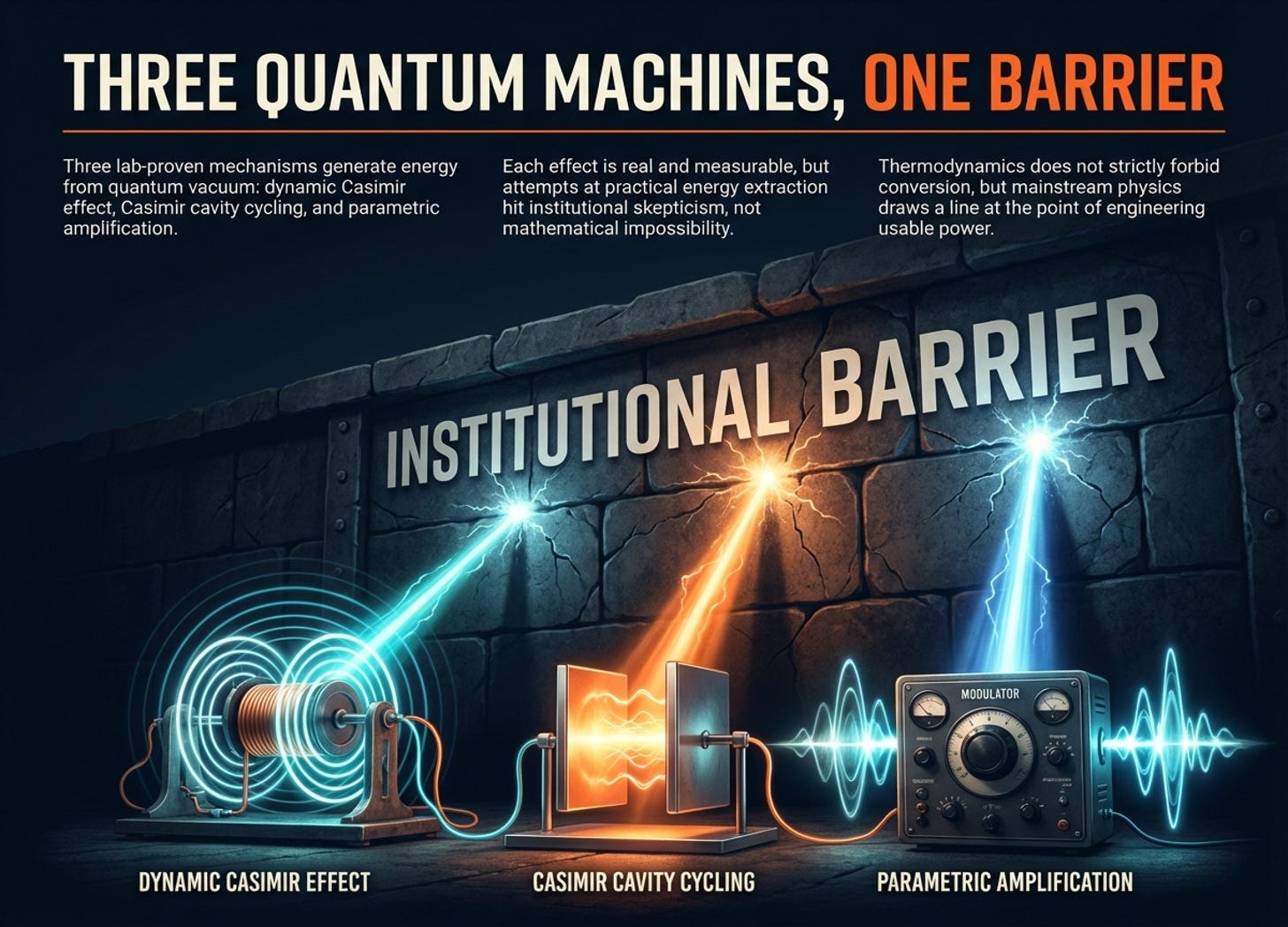
Dynamic Casimir photon production is the cleanest demonstration. Accelerate a boundary fast enough and photons emerge from the quantum vacuum. The effect is measured, the photons are real, but mainstream physics calls it a laboratory trick. The thermodynamic argument: the energy to accelerate the boundary always exceeds the photon yield, unless you find a way to amplify the effect without paying back every cycle.
Casimir cavity cycling exploits the fact that the Casimir force depends on geometry. By cycling the separation between plates, you can, in principle, extract energy as the vacuum state shifts. The catch is the reset. To close the cycle, you must return to the starting configuration, and the work required to do so cancels out the gain, unless the system is non-conservative. This is where most attempts stall, stuck in a loop of perfect symmetry.
Parametric amplification is the recurring wild card. By dynamically modulating system parameters, like permittivity or boundary conditions, you can amplify zero-point modes and, in theory, extract usable energy. Thermodynamics doesn’t block you outright here. Instead, it asks if you can make the amplification asymmetric, so the system doesn’t simply return all the energy at reset. This is where topology, not geometry, enters the picture.
Mainstream physics treats these mechanisms as real, but any attempt to engineer them for power is dismissed. The math permits it, the measurements confirm it, the institutional filter remains. When the mechanism loops back on itself, the energy cancels. When you break the loop, topologically, the rules change.
Geometry isn’t enough: the topology trap
Casimir’s original plates were the start. Change the shape, and the Casimir force flips: attractive, repulsive, or zero, depending on geometry. The first hint that the real key isn’t geometry but topology.
Engineers have built cavities that twist, fold, and loop, searching for a configuration where the reset energy problem disappears. The results: sometimes the force vanishes, sometimes it reverses. But the cycle always closes, unless you add a topological twist.
Casimir force depends on geometry, but only topology can unlock net extraction.
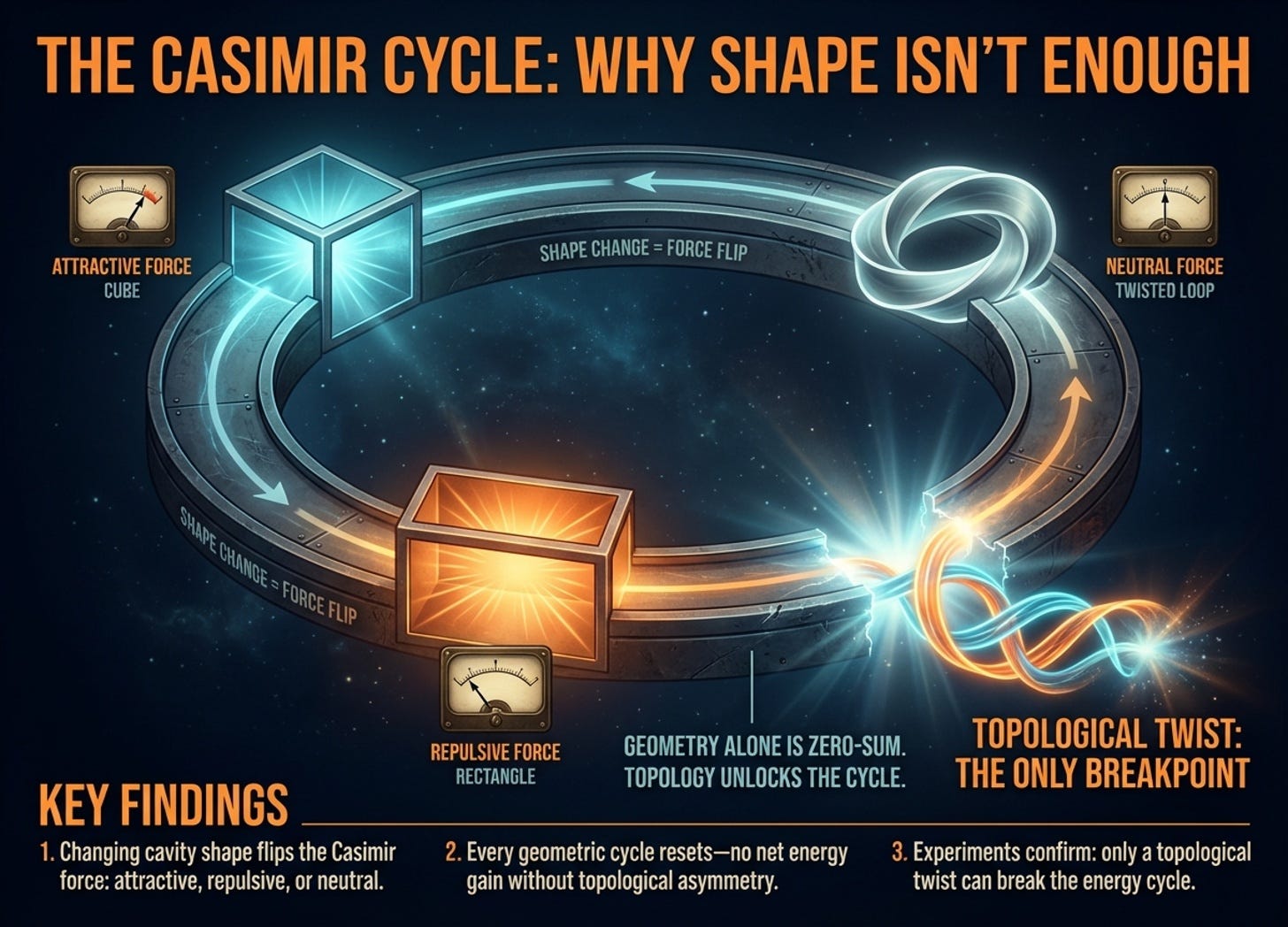
In rectangular and cubic cavities, the energy density inside can be positive, negative, or zero, depending on the ratios of the sides. You can engineer a cavity where the vacuum energy is higher or lower than outside. But cycling through shapes in a conservative system always brings you back to zero net gain.
Theoretical models with perfect conductors predict unphysical infinities, especially for curved boundaries. Real materials, with finite conductivity, smooth out the infinities but don’t solve the symmetry trap. Even with novel materials like negative-index metamaterials or superconductors, the cycle remains closed unless you introduce a genuine asymmetry.
Experimental advances in microelectromechanical systems (MEMS) and atomic force microscopy (AFM) have validated these effects at tiny scales. Devices can measure the Casimir force to within 1% of theory, and even flip its sign. But the practical dream, continuous energy extraction, remains out of reach as long as the system resets perfectly.
The geometry of the cavity shapes the force. The topology of the configuration space determines whether you can extract net energy. Without a topological defect or monopole-like feature, every cycle breaks even.
The reset energy problem
The Casimir force is tiny. Even with perfect control at the nanoscale, energy yields are measured in femtowatts. Scaling up hits a wall, not from quantum mechanics, but from thermodynamics as interpreted through conservative systems.
Every attempt at continuous operation runs into the same problem. The energy needed to reset the system wipes out the gain. Unless you break the cycle, you’re stuck with a one-shot device.
Scaling up Casimir devices is blocked by the reset energy trap, unless topology breaks the loop.
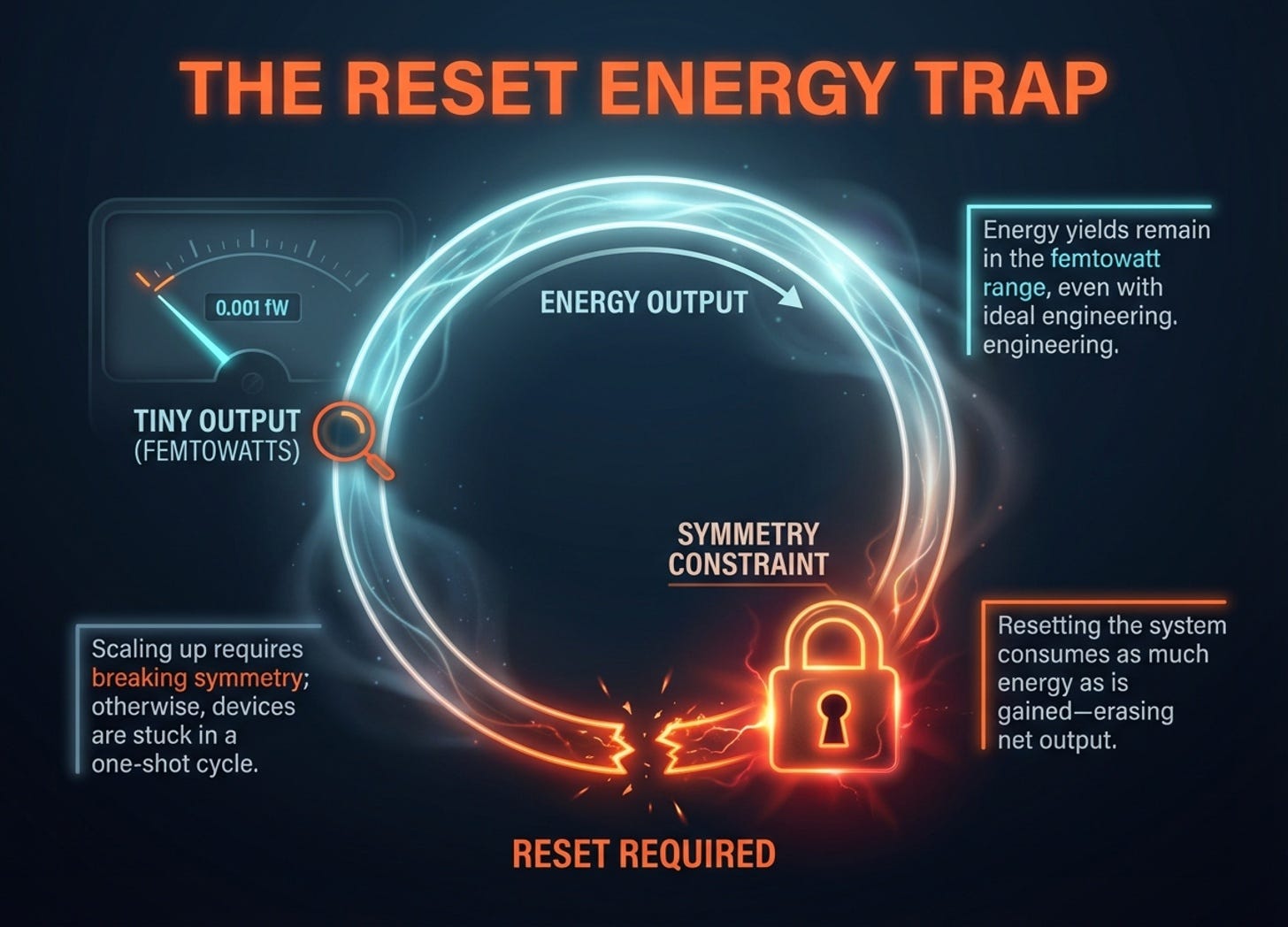
Maintaining micron or nanometer gaps for Casimir devices demands extreme engineering: atomic-level smoothness, feedback systems rivaling scanning tunneling microscopes, and materials that don’t degrade after billions of cycles. Even then, the energy per cycle is so small that any loss (friction, noise, imperfect reset) swamps the output.
The real killer is the reset energy. In a conservative, symmetric system, returning to the start state costs as much as you gained. This isn’t a fundamental law. It’s a consequence of the system’s topology. If every path through configuration space is reversible, there’s no net gain. Only by introducing an asymmetry, a topological defect, a monopole-like configuration, can you escape the trap.
Speculative designs propose materials that reset with zero energy cost, or quantum systems that exploit entanglement or exotic matter states to localize and amplify vacuum energy. Without a concrete mechanism to break the symmetry, these remain thought experiments.
The barrier to scaling isn’t physics. It’s the refusal to tackle the reset problem as a question of topology. Until someone builds a system that’s thermodynamically open but electrically closed, Casimir power stays in the realm of laboratory curiosities.
Topology breaks the cycle
Here’s where the story flips. Parametric amplification isn’t a clever trick. It’s the pattern that recurs, over and over, in independent research lines, because it’s the only mechanism that can bypass the reset energy problem when combined with topological asymmetry.
When you modulate a system’s parameters (permittivity, boundary conditions, even the vacuum itself) with the right asymmetry, the energy field changes. The cycle doesn’t close. The system becomes thermodynamically open, and net extraction is possible.
Parametric amplification and monopole topology combine to break the reset cycle and enable net energy extraction.
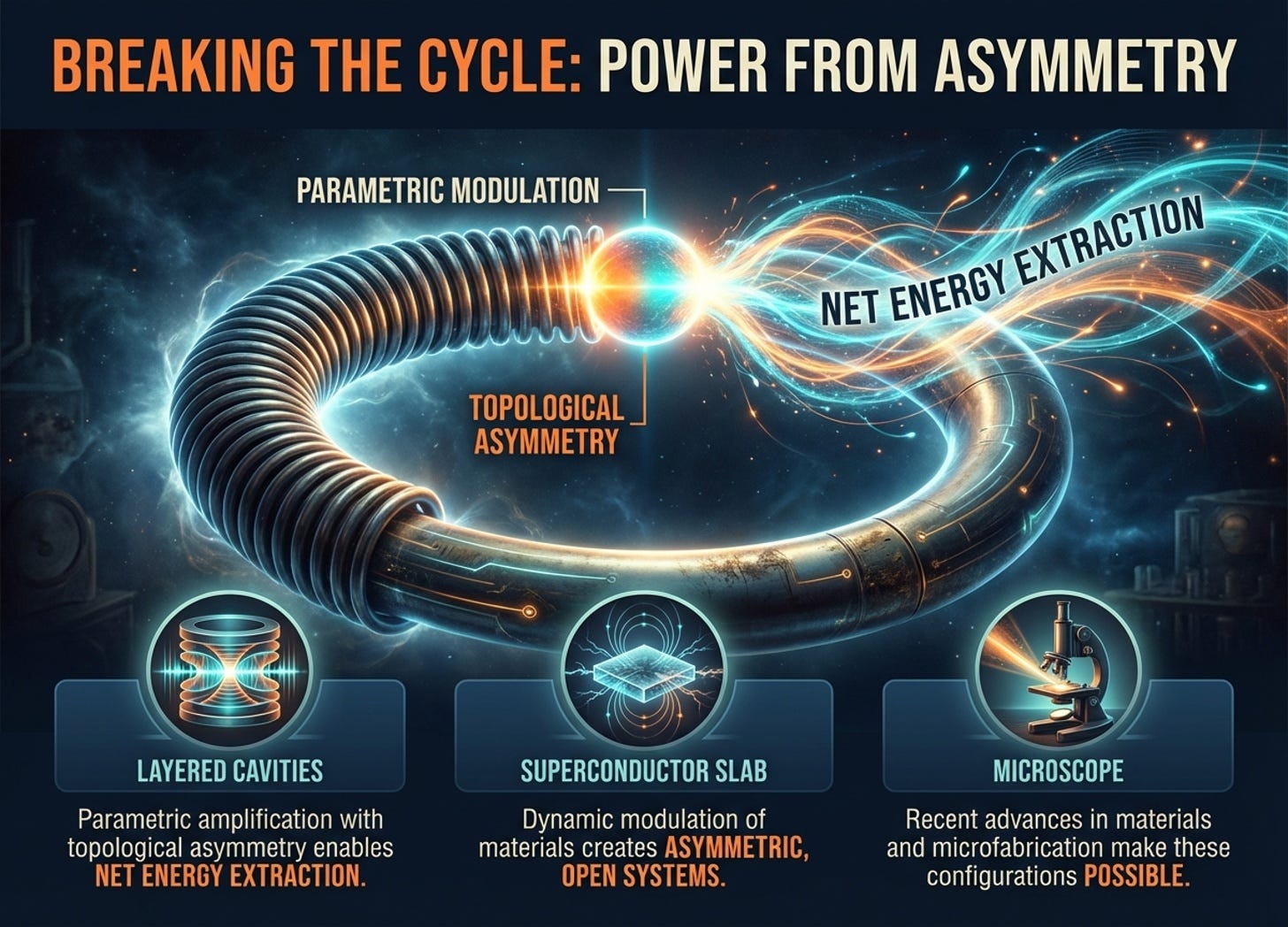
Theoretical models show that using multilayer cavities, metamaterials, and superconductors can amplify or even reverse the Casimir force by engineering the quantum boundary conditions. The real leap comes from dynamically modulating these parameters in time, creating a non-conservative, asymmetric system.
Topological features, like monopole-like configurations, provide the necessary asymmetry. In gauge theory, a magnetic monopole is a point where field lines begin or end, breaking the symmetry of the field. In Casimir engineering, analogous configurations can break the reset loop, allowing net energy extraction without violating thermodynamics.
Recent advances in microfabrication, atomic force microscopy, and AI-driven material discovery are making it possible to design and control these topological features at the nanoscale. Wherever parametric amplification and topological asymmetry intersect, the old thermodynamic limits dissolve. The remaining barrier isn’t physics. It’s the institutional refusal to take these configurations seriously.
The bridge between Casimir engineering and gauge theory isn’t mathematical abstraction. It’s the missing link that could make vacuum energy extraction practical. The pattern keeps resurfacing, ignored not by physics, but by the institutions that decide what counts as real.
Final thoughts
Physics never forbade vacuum energy extraction. It wrote it off as impractical, then built a wall of silence around the question of how topology, not geometry, could change the outcome. The mechanisms are real, the effects are measured, and the loophole (parametric amplification with topological asymmetry) keeps resurfacing across independent research lines.
If the institutional barrier finally cracks, it won’t be because someone found a bigger hammer. It’ll be because someone realized the reset energy problem isn’t a law of nature but a question of configuration. The vacuum isn’t empty, and the rules aren’t as rigid as we were taught. The only real prohibition is the one we’ve built ourselves.
⏭️ Tomorrow: The ingredient you need to build a warp drive, negative energy density, is experimentally real. Physicists have been making it in labs for decades.
🔁 Restack and join the Advanced Rediscovery community at

🧑🏼 Follow @drxwilhelm on Substack, X Twitter, Medium, YouTube, TikTok