


⬅️ Yesterday: Casimir proved the vacuum pushes back.
⚡ F = −π²ℏc / 240a⁴. The vacuum pushes back. Why can’t we push it harder?
Physics textbooks call the vacuum ‘empty,’ yet calculations assign it an energy density so immense it could collapse galaxies. Mainstream quantum electrodynamics (QED) insists these vacuum fluctuations are accounting tricks: ‘virtual,’ not real, and certainly not up for grabs. Stochastic electrodynamics (SED) calls their bluff, treating the vacuum as a physically real electromagnetic ocean that shapes everything from atomic spectra to the Casimir force.
This is not a debate over math. The ‘virtual’ label has walled off an entire engineering frontier for seventy years. If the vacuum is a plenum, a sea of possibility, then matter emerges where vacuum coherence exists, and nonlinearity might be the key to extracting zero-point energy. The stakes: the future of energy, propulsion, and our understanding of reality.
👉 Subscribe to Advanced Rediscovery. I’m sharing what I’m finding as I decode zero point energy, the quantum vacuum, and extended electromagnetism — 12+ years of independent research. Weekly briefings from my home lab to your inbox.
The reality clash
Two visions of the vacuum. QED treats it as a mathematical ghost: ‘virtual’ fluctuations with no physical teeth, forbidden from fueling perpetual motion or powering anything. SED claims the vacuum is a plenum: a real, ever-present sea of electromagnetic energy, waiting for the right nonlinear key.
The way we label the vacuum sets the rules for what’s possible. If ‘virtual’ is a conceptual blindfold, SED’s plenum is the challenge to rip it off.
QED’s ‘virtual’ vacuum locks the door. SED’s plenum dares us to engineer it.

QED’s ‘virtual’ vacuum fluctuations are managed with renormalization, a mathematical technique that tames infinite energy densities but also locks the door on continuous energy extraction. This approach has delivered unmatched predictive power for nonlinear and atomic phenomena (Lamb shift, magnetic moments, the Casimir force) but comes at the price of treating the vacuum as untouchable.
SED posits a physically real, Lorentz-invariant electromagnetic background. It matches QED’s spectral energy density at zero temperature, but flips the ontological script: what QED calls a bookkeeping artifact, SED treats as the main act. This distinction matters beyond philosophy. SED predicts that nonlinear systems, oscillators and engineered cavities, can continuously downshift high-frequency vacuum energy, potentially altering the spectrum and making the vacuum an accessible energy source.
Jaynes and others have argued that many QED vacuum effects could be reinterpreted as self-field phenomena, challenging the necessity of a strictly ‘virtual’ vacuum. The Casimir effect and cavity-QED experiments suggest that the vacuum can be engineered, at least in principle. If SED’s predictions for nonlinear regimes are validated, the plenum stops being a metaphor and starts being an engineering resource.
If the vacuum is real and engineerable, it could transform propulsion and on-board energy. If it’s forever virtual, the door stays shut. The next question: what would it take to pry it open experimentally?
Experiments at the quantum frontier
If the vacuum is a plenum, why can’t we tap it? The answer is tangled in measurement and materials, not theory alone. Every experiment that tries to distinguish SED from QED is a duel at the edge of what’s possible.
The action happens in nonlinear systems, where the vacuum’s character might finally show. But the quantum realm is noisy, and the signals are faint.
Precision experiments at the quantum frontier could force the vacuum to reveal its true nature.

Experimental setups designed to break the deadlock between SED and QED focus on manipulating and measuring the vacuum’s electromagnetic spectrum. Monatomic gases or liquids in Casimir tunnels, nonlinear oscillators for spectral downshifting, and cavity-based methods all aim to reveal whether the vacuum is immutable or malleable. Heavier monatomic elements in Casimir cavities allow multiple outer electrons to interact simultaneously with reduced zero-point radiation, potentially amplifying any observable effect.
Jaynes’ hypothesis pushes for experiments that probe whether QED effects arise from local source fields rather than a quantized vacuum. Nonlinear oscillators could downshift high-frequency vacuum fluctuations toward a Rayleigh-Jeans spectrum, a direct test of SED’s predictions. But the quantum vacuum’s effects are minute, scaling with Planck’s constant, and current measurement technology is only beginning to reach the required sensitivity.
Advanced Atomic Force Microscopy (AFM) techniques and microfabricated cantilevers offer a path forward, capable of frequency decomposition of local vacuum energy density. The goal: catch the vacuum in the act, mapping its spectral shifts and linking mechanical responses to specific frequencies. Novel materials like metamaterials or superconductors might amplify these effects, but the engineering challenges remain formidable.
If a single experiment tips the scales, revealing a spectral signature or energy differential that QED cannot explain, the plenum becomes real and the engineering race begins. Until then, the vacuum remains locked behind sensitivity thresholds and material science.
The Casimir conundrum
The Casimir effect is the vacuum’s signature: a force from nothing, measured and confirmed, yet still wrapped in theoretical ambiguity. Both QED and SED claim it, but their stories diverge in the details.
If SED’s classical zero-point field can explain Casimir forces in linear systems, what happens in the nonlinear or accelerated cases where QED’s quantum machinery takes over?
The Casimir effect: a force from nothing, but whose nothing is it?
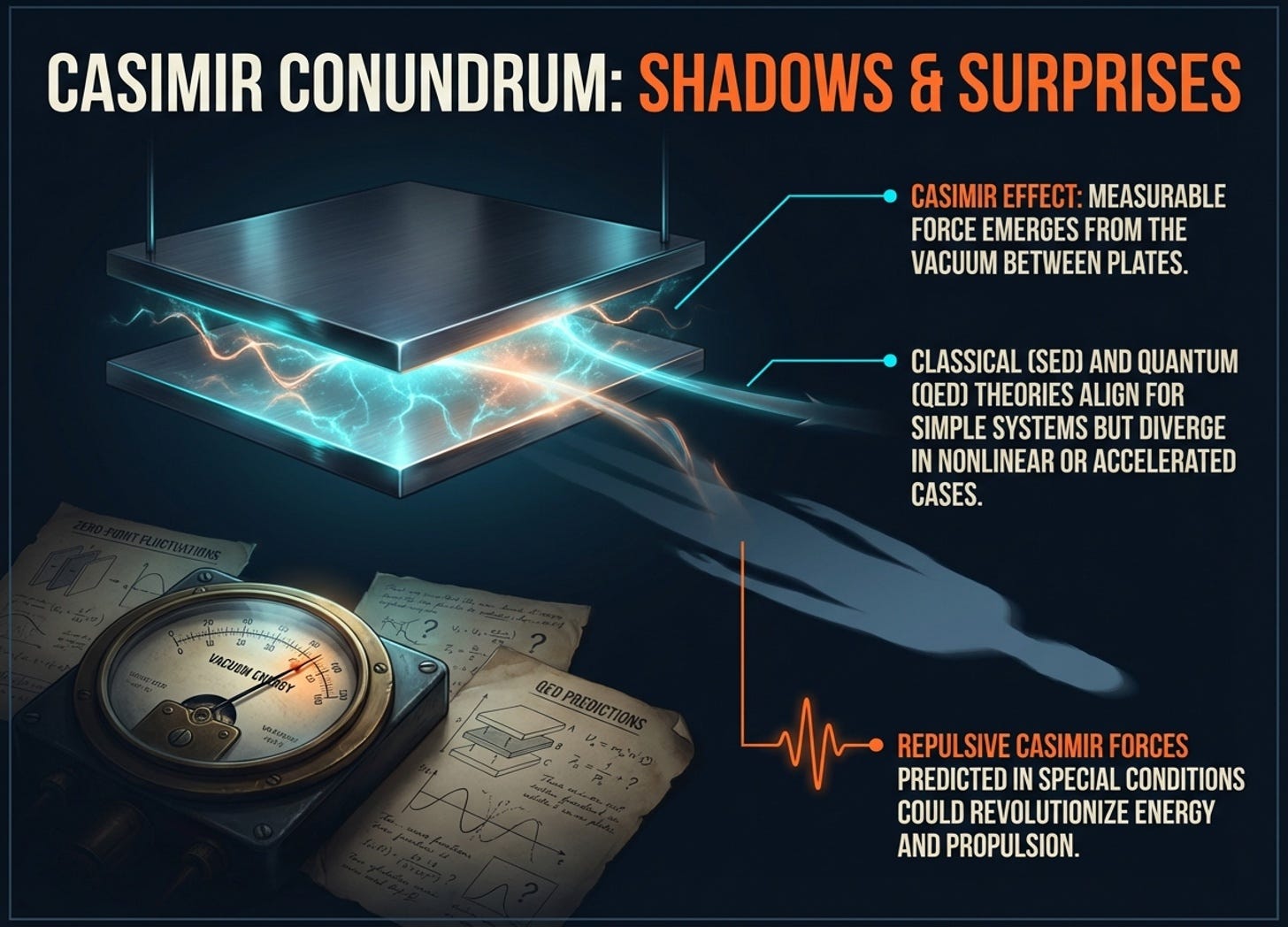
SED reproduces the Casimir effect by positing a classical zero-point field, aligning with QED for linear systems. But as soon as the system becomes nonlinear or is placed in an accelerating frame, the predictions split. Modified SED models introduce new constraints, statistical adjustments and nonlocality, to better match quantum results, including the Planck spectrum.
One of the boldest predictions from modified SED: repulsive Casimir forces in gravitational fields or accelerating frames, hinting at propulsive effects. If true, the vacuum’s energy gradients are engineerable, opening up new propulsion concepts. Jaynes’ neoclassical view goes further, suggesting that observed quantum effects might arise from self-fields of matter rather than independent vacuum fluctuations.
Experimental tests are the crucible. Measuring Casimir forces in non-parallel geometries, with monatomic substances, or using advanced AFM techniques could expose differences between SED and QED. But the theoretical groundwork for complex materials and shapes is incomplete, and continuous vacuum energy conversion remains unresolved in both frameworks.
If SED’s predictions for repulsive Casimir forces or energy density gradients are confirmed, the vacuum stops being a passive backdrop and becomes an active player in propulsion and energy. Until experiments close the gap, the Casimir conundrum remains.
Nonlinearity and the locked gate
Nonlinearity is where SED stumbles and where the opportunity hides. Original SED failed to predict the correct equilibrium spectrum or atomic details. LSED, a more recent attempt, patches many holes but leaves the biggest question open: can the vacuum’s energy be continuously extracted?
QED says no, enforcing an immutable, non-degradable vacuum. But alternative frameworks, from Jaynes to Barut, suggest that matter’s self-fields or nonlinearities could open cracks.
Nonlinear systems may hold the key to unlocking the vacuum’s energy, if the right conditions can be found.
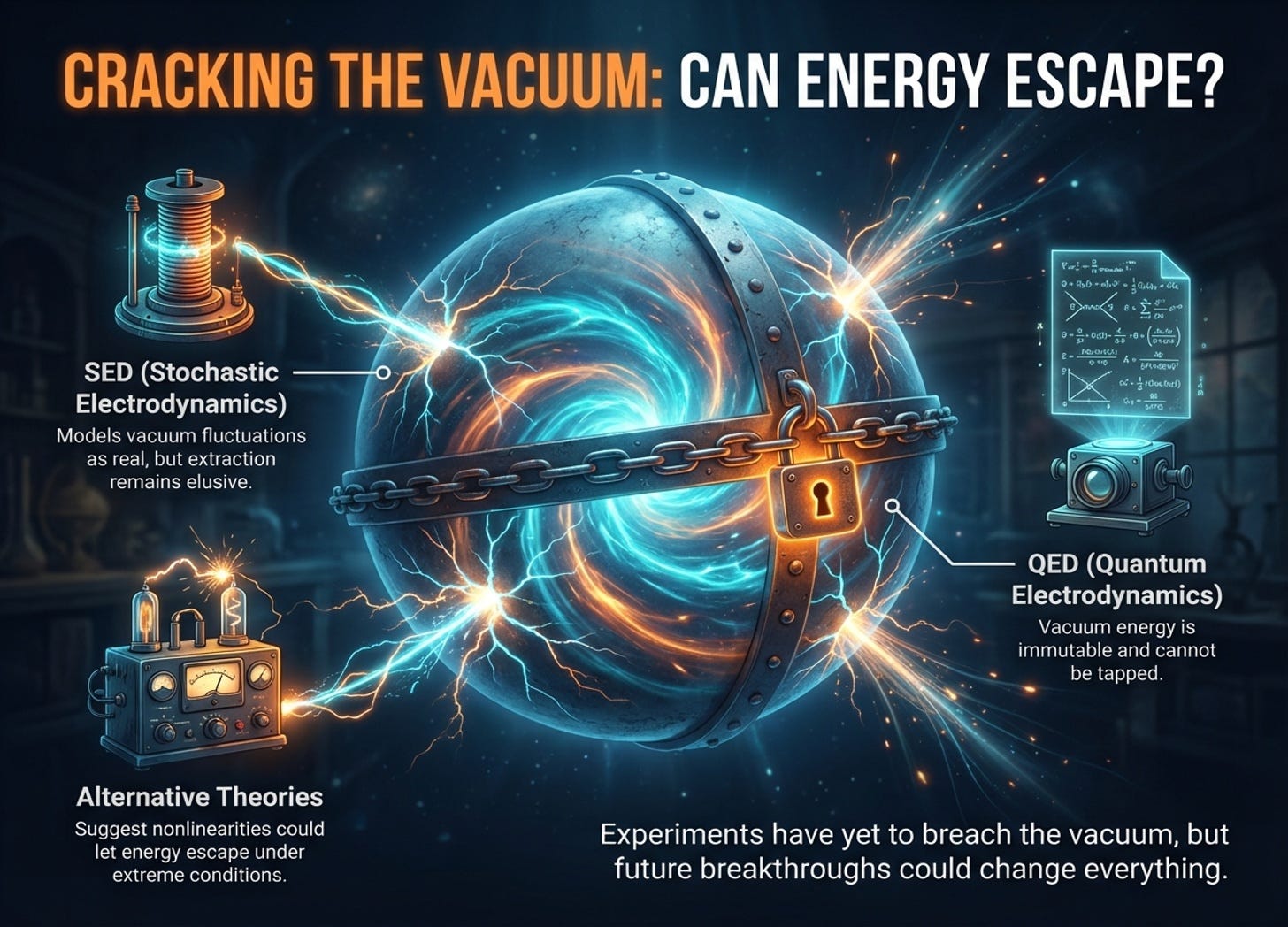
LSED introduces frequency-specific energy balance and statistical constraints, finally yielding a Planck spectrum and closer agreement with quantum mechanics for linear systems. Yet it still cannot provide a mechanism for continuous vacuum energy conversion. QED treats the vacuum as immutable: no loopholes, no exceptions. This immutability is both a strength and a constraint, forbidding the engineering frontier the plenum promises.
Alternative theories challenge this. Jaynes and Barut propose that quantum effects may arise from nonlinear self-fields or first-quantized sources, not from vacuum fluctuations. This opens the possibility that the vacuum’s energy can be degraded and converted under the right nonlinear conditions. Physical phenomena like the Casimir effect, and even cosmological inflation, hint that under extreme conditions, the vacuum can be tapped, at least transiently.
The divergence between SED and QED is sharpest in nonlinear systems, but experiments at low energies have yet to observe these effects. Theoretical models predict that extreme environments (neutron stars, black holes, high-energy-density labs) might finally reveal the differences. Barut’s nonlinear, non-second-quantized theory reproduces key QED effects without invoking vacuum fields, suggesting that quantization itself might be a property of sources, not the vacuum.
If the plenum is real and nonlinearity is the key, then the future of energy and communication could look radically different. Until we crack it in the lab, the question stays open: an engineering challenge waiting for its first practical breach.
Final thoughts
The war over the vacuum’s reality is more than semantics. QED’s insistence on ‘virtual’ fluctuations has kept the plenum behind a conceptual wall, with only rare leaks, like the Casimir effect, hinting at the energy within. SED, with its physically real background, challenges us to break through and engineer the vacuum directly.
Assumptions about what is ‘virtual’ and what is ‘real’ have shaped not just theory but the devices we build and the energy we dare to seek. If nonlinear systems and future experiments reveal cracks in QED’s framework, the implications for energy extraction, propulsion, and communication are enormous. The vacuum keeps its secrets well. Is the next breakthrough waiting in a nonlinear lab, or is the plenum destined to remain a forbidden sea? The answer decides whether the universe’s deepest energy well stays closed or finally powers our machines.
⏭️ Tomorrow: The worst prediction in physics, off by a factor of 10¹²⁰, and what it reveals about how little we understand the vacuum.
🔁 Restack and join the Advanced Rediscovery community at

🧑🏼 Follow @drxwilhelm on Substack, X Twitter, Medium, YouTube, TikTok
I propose that self organized quantum coherent plasmoids also known as "ball lightning" or Exotic Vacuum Objects are nature's engine that taps energy from the vacuum and sprays it out in multiple forms. If you look at a wide range of devices built over the last hundred years, whenever someone produces an energy producing technology utilizing this phenomenon, there are countless similarities. An entire book could be written going through each and every system and pointing out what they have in common. Suffice it to say, a few such similarities are....
1) A system that self organizes from the randomness of a plasma into a self organized and ordered structure.
2) One or more membranes or double layers that serve multiple purposes that are beyond the scope of this comment.
3) An extremely conducting and potentially even superconducting property of these membranes or double layers.
4) The ability of these structures to store immense amounts of energy like capacitors -- likely in their internal magnetic field. Likewise, when this energy is discharged it sprays outwards in a broad array of electromagnetic frequencies including gamma, x-rays, and extreme UV.
5) When one of these structures collapses partially or completely a back surge of power is often reported that can fry power supplies. At the same time, the EM emissions can become intense and have often been captured as a source of energy.
6) Ion acoustic oscillations are always present in these self organized systems due to the continual transfer of ions and electrons through the structure.
7) These structures are repeatedly able to chew through matter sometimes instantly vaporizing huge chunks of metal.
8) These structures repeatedly transmute elements and shift isotopic ratios perhaps generating a secondary source of energy that helps sustain the structure. The ability to discern what proportion of the energy produced comes from the ZPE field or vacuum fluctuations and which portion comes from novel nuclear reactions may require extreme discernment and care.
9) These structures seem capable of manipulating mass, gravity, inertia, and other properties of matter and forces. Ken Shoulders performed small scale experiments with microscopic structures that seemed to produce a warp drive effect -- he claimed an EVO would lose virtually all of it's mass and a structure of millions of electrons and a smaller number of ions could be accelerated with only a tiny fraction of the energy that should be required. He also stated that they seem to be induced into motion by changing the shape of their container which would be their quantum coherent membranes.
10) Atomic hydrogen gas has been used repeatedly by multiple teams as an additive that energizes these structures. Certain teams who do NOT claim to be producing a self organized plasmoid but who obviously are doing so in their demonstrations even theorize that hydrogen is being altered into a different form. This does not mean that hydrogen is a required component to produce excess energy from a plasmoid but only that it may be a useful additive that either helps with the structure of some plasmoids or can be induced into novel reactions that allow for a release of energy.
I could go on and on. But self organized plasmoids or EVOs are the lowest hanging fruit of exotic energy research, IMO. And I think the reason they have not been rigorously pursued in the "white world" except by smallish companies and individual inventors is because they were already mastered in the "black" or classified world many, many years ago. The Fluxliner ARV is an example of a craft that utilized a central column of mercury (likely isotope 199) that generated a self organized plasmoid. This was the component of the craft that both generated the energy for the crafts operation and allowed for the generation of the warp bubble. Although most people like to talk about the capacitor plates on the bottom of the craft, they were a secondary system that allowed for directional vectoring and a hovering mode. The self organized plasmoid of ionized mercury vapor was the key.
The TR3B was also claimed to use mercury in it's engines. However, the proponents of the existence of the vehicle claimed they were told it used mercury that was cooled to extreme temperatures to reach a superconducting state and then was spun rapidly. I believe this is disinformation to hide the central mechanism of the craft. Instead of using cooling to induce superconductivity in mercury which would be impractical due to the ultra low temps required, the self organized plasmoid itself is superconducting and spins on it's own without external turbines. The fields within a plasmoid can induce particles to spin at relativistic speeds generating synchrotron radiation which is the likely reason for the intense ionization of the area around a craft and the light that is seen.
Since the Fluxliner ARV and TR3B were built, there have likely been many additional models. I personally believe this is now a very mature technology. Likely, it's reaching the point of diminishing returns and this is the reason for the pursuit of meta-material based technologies.
If we want the truth about how to tap energy from the vacuum, we need to push for UFO disclosure including all technologies and craft that have been reverse engineered.
Wow! You've got a knack for great graphics. And your topic treatment rocks.