


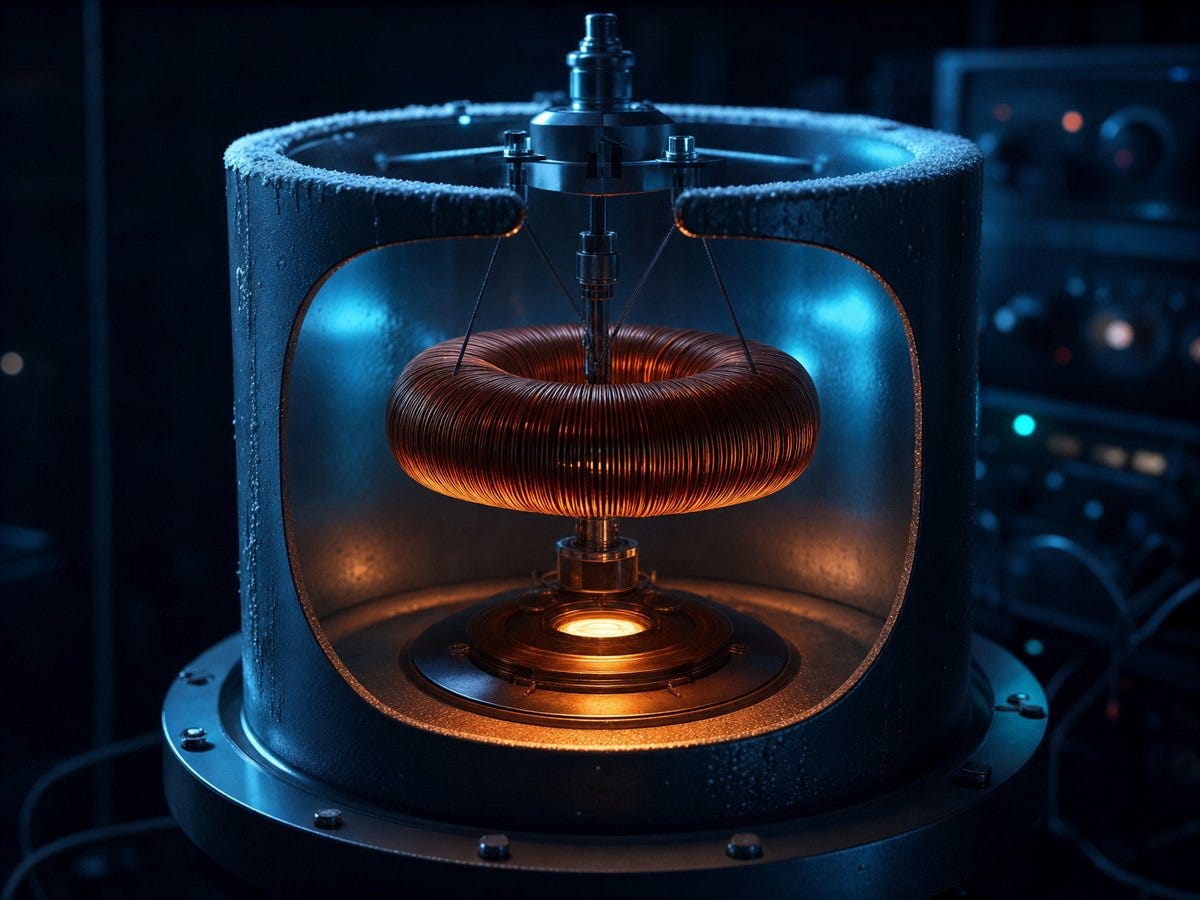
Take a lift down into a car park and watch the bars on your phone die. Step into one and the call drops. That is not a quirk of your carrier. A box of metal stops radio waves, reliably, and we build on that fact constantly: microwave ovens keep the microwaves in, sensitive instruments sit in shielded rooms, aircraft survive lightning strikes.
Metal blocks electromagnetic fields. It is one of the most dependable rules in engineering.
Now here is a device, built by engineers, published in IEEE journals, that pushes a signal through a superconducting shield. Not a leaky shield. The best magnetic shield physics currently knows how to make.
I want to walk you through why that is possible, because it is not a loophole and it is not exotic. It follows from something the textbook tells you not to take seriously.
This is the third piece of a read-along I have been posting all month, working through the cold fusion literature from the outside as an engineer. Nothing in this article is anomalous and none of it is contested: three settled results, all of them in the standard literature. That is the reason it is here. Before anyone has to weigh a disputed calorimeter, it is worth knowing that the quantity my whole argument turns on has been doing measurable work in mainstream physics since 1959.
This read-along stays free because paid subscribers fund it.
The thing the textbook calls bookkeeping
Electromagnetism can be written two ways. You can work with the electric and magnetic fields 𝐄 and 𝐁, which is what you were taught, or you can work with the potentials they are derived from, of which the important one here is the vector potential 𝐀.
The fields are what push on charges. The potential is the thing the fields are the slope of. And because you can change 𝐀 in certain ways without changing 𝐄 or 𝐁 at all, the standard teaching is that 𝐀 is a mathematical convenience. A scaffold. Real physics happens in the fields, the potential is how we compute them.
In 1959, Yakir Aharonov and David Bohm pointed out that this cannot be quite right.
Take a solenoid and confine its magnetic field entirely inside. Outside, 𝐁 is zero. Genuinely zero, not small. But 𝐀 outside is not zero, because 𝐀 wraps around the solenoid whether or not the field escapes. Now send electrons past it on both sides and let them interfere. If only fields matter, nothing should happen. The electrons never touch a magnetic field.
Something happens. The interference pattern shifts, and the size of the shift depends on how much flux is locked inside the solenoid the electrons never entered.
That prediction took nearly three decades to nail down properly, because the obvious objection is that a real solenoid leaks. The version that closed the argument came from Akira Tonomura’s group in 1986: a tiny ring-shaped magnet sealed inside a superconducting niobium shell. Superconductors expel magnetic fields, so the flux had nowhere to go. The measurement reached a phase sensitivity of about one part in a hundred of a full cycle, and the shift showed up exactly where the theory said it would.
The electrons responded to a region where there was no field. There was only potential.
The version with no quantum mechanics in it
The usual next move is to file this under quantum weirdness. Interference, phase, electrons behaving oddly. Not something that matters for engineering.
That filing does not survive the classical version.
Oliver Lodge, back in Maxwell’s era, wound a coil on a toroid and looked for induced voltage in a second coil placed outside the torus, in the region where the magnetic field is zero. He found it. Germain Rousseaux and colleagues repeated the experiment with modern instrumentation in 2008 and measured the same thing: a voltage in a region of strictly zero 𝐁, governed by the rate of change of the vector potential.
No electrons in superposition. No interference fringes. No ℏ anywhere in the derivation. Just a coil, a voltmeter, and a region where the field everyone says does the work is absent.
And then there is the case that has been hiding in plain sight since 1935. In a superconductor, the supercurrent is directly proportional to the vector potential itself. Not to 𝐄, not to 𝐁, to 𝐀. That is the London equation, and it is how the current responds to what it is sitting in inside every SQUID, every MRI magnet and every superconducting accelerator magnet on the planet. Ask anyone who models these devices for a living which variable they actually compute in, and the answer is the potential, because the field-only picture falls apart at material interfaces.
Someone always points out at this stage that the London equation is written in a particular gauge, and they are right. It is. That does not rescue the field picture, because this gauge is fixed by the physics of the material rather than chosen for anybody’s convenience.
The laboratories moved on decades ago. The textbooks did not.
The transformer that ignores the shield
Which brings me back to the device.
Masakazu Daibo and Shuichiro Oshima built what they call a vector potential transformer. The geometry is the interesting part: a long flexible solenoid wound around into a closed loop, so the winding chases its own tail. The result is a structure whose magnetic field cancels essentially to nothing outside the winding, while the vector potential outside does not cancel.

Put a secondary conductor in that field-free region, change the primary current, and a voltage appears across the secondary. Their published measurements used a superconducting secondary at 77 K, and then, to remove any remaining doubt about stray fields, they put the whole secondary inside a superconducting magnetic shield.
The induced voltage was the same. Shielded and unshielded, identical.
That result is in IEEE Transactions on Magnetics and IEEE Transactions on Applied Superconductivity, and the device is patented as US 10,037,840. It is not a preprint, it is not a conference abstract from someone’s garage, and I am not asking you to take my word for any of it.
I want to flag one thing carefully here, because it is a mistake I have seen made repeatedly and made once myself in an earlier draft of a campaign post. There is a different patent, US 9,306,527, that also concerns barrier-penetrating electromagnetic signals. Different inventor, different physics, different claims. The two get conflated in enthusiast writing constantly. They are not the same invention and I am not going to blur them.
Where the settled ground ends
Everything above is measured, published, and as far as I can tell uncontested. Zero field, real physics, three independent routes to it.
“As far as I can tell” is carrying real weight in that sentence, so let me say what it cost. I did not take any of those three from a summary. I went to the papers, the patent text and the measurement figures, because this campaign has already caught me repeating a claim I had only ever read at second hand, in public, in front of the person who corrected me. Checking at that depth is not a talent and it is not naturally fast. I built something to do it, which is the only reason a month was enough, and of everything in this read-along it is the part I think actually transfers to somebody else.
Here is where I have to draw a line, because past this point the ground gets softer and I would rather tell you that than let you find out later.
If the potential is physically primary, the obvious next question is what else lives inside it. My paper works through the arithmetic: the object the fields are carved from carries sixteen independent components, standard electrodynamics keeps six, and the rest are set aside by a convention adopted in the 1880s. Relax that convention properly and the theory gains one genuinely new propagating mode, a coupled scalar and longitudinal thing that carries a longitudinal electric field and no magnetic field at all.
An object with no magnetic field induces no eddy currents, and eddy currents are half of what makes metal an effective shield. I want to be careful about the other half, because I was not careful enough about it in the paper. The other half is charge relaxation: the free electrons in the wall rearrange themselves in well under a nanosecond and cancel whatever electric field arrives, and they do that whether the field points across the direction of travel or along it. A conducting box screens the electric field of this mode too.
What a box cannot screen is the potential structure underneath it. That isn’t a loophole I’m inventing to save the prediction, it’s the thing Daibo’s secondary was reading through a superconducting shield three sections ago. So the honest form of the claim is potential-level penetration read by a potential-sensitive receiver, not a field arriving intact on the far side of a cage. That correction is published, in an errata carrying twenty-three others alongside it, and it makes the prediction narrower and considerably harder to fake.
The other two signatures survive untouched: it falls off with distance differently from a normal wave, and it shows up on a monopole where a dipole hears nothing.
Three sharp, cheap, binary tests, and the honest state of the evidence is thinner than I would like. What reports exist come from the group that proposed the mode in the first place. Nobody outside that work has run any of the three, not once.
That is the honest state of it. A theory that is internally clean, a prediction that is unusually falsifiable, and an experimental record that consists of one group’s measurements. In my field that is not a result. It is an invitation that nobody has accepted.
What would actually settle it
The distance between the settled part of this article and the unsettled part is one weekend of somebody’s bench time.
Build a source with a geometry that cancels 𝐁 outside itself, which the Daibo work already shows how to do. Put a potential-sensitive monopole receiver inside a decent Faraday enclosure, which is the part that takes thought, since an ordinary field probe is exactly what the wall defeats. Look for signal. Swap the monopole for a dipole and check that the signal disappears. Move the receiver and see whether the falloff matches a normal wave or does not.
If nothing comes through, the prediction is dead and I will write that article too. If something comes through and survives the obvious objections about leakage and ground loops and capacitive coupling, then a piece of nineteenth-century mathematical tidying has been quietly costing us an entire communication channel.
I know which outcome I would bet on, and it is the boring one. But the reason I keep writing about this is that a hundred and forty years is a long time for a question this cheap to answer to stay open, and the reason it stayed open is not that anyone checked.
⬅️ Previous: two force laws that agree on every closed circuit and disagree about what happens inside one, and where the missing momentum actually goes.
⏭️ Next: a hundred billion electrons packed into a speck of dust, holding together when Coulomb’s law says they should detonate instantly. I run the candidate-mechanism audit the textbooks never did, with the arithmetic in the open, and the strongest candidate turns out to be the letter everyone quotes at me as proof the textbooks failed.
📬 Article 3 of the series. Free. Subscribe and the whole read-along lands in your inbox.
🔁 If this article resonated, a Restack helps others find it.
Research papers free at advanced-rediscovery.com/research · @drxwilhelm on X · Substack · YouTube
As I dimly recall, the graphs on that paper showed very low magnitude effects and odd shapes to the response. I think it likely that one could do a lot better than the coiled-coil approach, which has very long magnetic circuit, by using many small soft ferrite toroids arranged into a larger A-field loop. This maximizes B field and its curl. Using fewer turns and more current in the toroid windings not only helps frequency response and rate of change of B and its curl, A, but helps minimize the voltage gradient across the windings, which gave Lodge and Davies so much trouble. (Also use a second layer of winding going back over the first and ending at the starting place to avoid an implicit 1-turn winding around the larger circumference of the toroid.) All the toroids can be wired in parallel to further decrease inductance at a given B and thus maximize the rate of change of B.
Spinning a toroid or toroids so that their axes sweep around a circle shoud allow creating a sinusoidally varying A field; A pair of toroids with perpendicular axes driven in quadrature should produce the same effect.
[Edit: For your monopole receiver, the electric field should be detectible despite shielding, so try a TI OPA928, non-inverting impedance-converter setup (output to - input, + input floating or with an electrode with larger area to increase capacitive coupling) with a +/- 6-8V split battery power supply (12-16V total). With 10% humidity at 15-20C it should have a detection limit close to 1e-17A at up to 2.5MHz, with about 1uV noise. These can detect deep sub-electron charges, even sub-pico electron/s charges so they're just ridiculously sensitive to all sorts of things. They pick up 120V AC wiring from several meters away. Crossing your legs will peg them from the capactance change of your shoe. Don't breathe near them. Don't even move your eyes too near them. Less than $20 qty. 1, or about $400 for a dev board.]
Since so many physics mysteries are connected to the potentials and the scalar field, you might try to relate the Geometric Algebra Dirac wave equation scalar phase field, beta, as well: https://enonh.substack.com/p/x-the-dirac-equations-lorentz-invariant
Also check out my one-page "Physical Units Factor Tables", which shows the relationships between 50 types of physical quantities, including 22 EM quantities, by factoring them into space, time, mass and charge: https://enonh.substack.com/p/the-periodic-table-of-physics
The calculator / physically-typed language, Frink, that PUFT documents I have found very useful for over 20 years. All documentation is on the main frinklang.org page, as well as a link to a web interface. The .jar file has no dependencies except a JRE, it will run in a Chat GPT sandbox. The units.txt file is also worth browsing to see what's already built-in, of course you can easily add new named unit types and derived units to it.
*Masahiro Daibo ✨ https://ieeexplore.ieee.org/document/8304422