


If you’ve ever saved a photo as JPEG, you’ve performed lossy compression. The algorithm discards information it deems irrelevant. High-frequency detail, subtle color gradients, fine texture. The file gets smaller. The image looks almost the same. But the discarded information is gone. There is no “unjpeg” button. The compression is irreversible.
Physics has been doing the same thing to electromagnetism since the 1880s. It just doesn’t call it compression.
⬅️ Previous: Einstein built GR on Heaviside’s simplified EM. The bridge to gravity was in the part that got cut.

The Projection
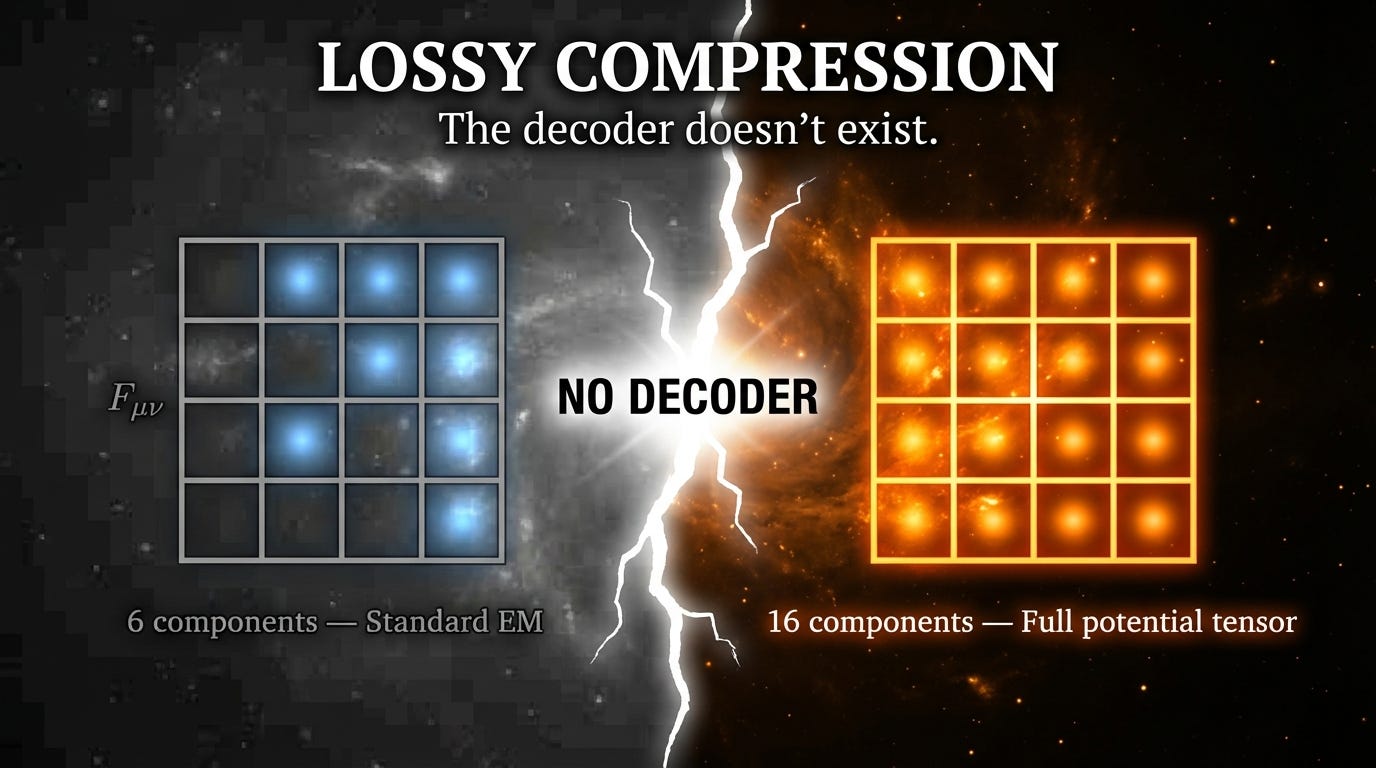
The full electromagnetic potential tensor has 16 independent kinematic components. Standard electrodynamics keeps 6: the three components of E and the three components of B. The remaining 10 are eliminated by gauge convention.
Think about what that means in information terms. You start with 16 numbers describing the state. You project them down to 6. Multiple different starting configurations land on the same 6 numbers. And there’s no way to go back. You can’t reconstruct the 16 from the 6.
That’s lossy compression. By definition.
The standard physics narrative says this is fine. Gauge freedom is “redundancy.” The different potential configurations that produce the same fields are “physically equivalent.” Choosing one is like choosing a coordinate system. Nothing real is lost.
That narrative has a problem. It’s experimentally falsified.
The Proof: Aharonov-Bohm
In 1959, Aharonov and Bohm predicted that a charged particle passing through a region with zero electric field and zero magnetic field would still experience a measurable phase shift, if the vector potential A in that region was nonzero.
In 1986, Osakabe and colleagues confirmed it definitively using electron holography. The result: two different A configurations that produce identical E and B fields produce different physical outcomes. The electron’s quantum phase depends on the potential, not the field.
This is exactly what lossy compression looks like from the inside. The compression algorithm (gauge fixing) said that the difference between those two A configurations was “redundant.” The experiment said it wasn’t. The algorithm discarded information that turned out to be physically real.
What Gets Lost
The 10 symmetric components that gauge fixing discards aren’t abstract mathematical curiosities. They encode specific physical content.
The trace of the symmetric tensor is the Lorenz divergence ∂_μA^μ. Setting it to zero is the Lorenz gauge condition. When you relax that condition, a scalar field C appears with its own wave equation, its own energy density, and its own source coupling. Waves without magnetic fields. Energy flow through a channel that the standard Poynting vector can’t represent. Communication through Faraday cages.
The off-diagonal symmetric components encode the scalar-longitudinal coupling between the time and space parts of the potential. Suppressing this coupling is what forces the theory to treat φ and A as independently solvable. Convenient? Yes. Information-preserving? No.
Topological content: winding numbers, holonomy, magnetic helicity. All defined in terms of potentials, not fields. When you project from potentials to fields, you lose topological information that no amount of field measurement can reconstruct. The fields don’t determine the potentials uniquely. That’s not a sign that potentials are unphysical. It’s the definition of information loss.
JPEG vs. Physics
The JPEG analogy is more precise than it first appears.
JPEG compression works by transforming the image into frequency space (discrete cosine transform), then zeroing out high-frequency coefficients that the algorithm judges to be below a perceptual threshold. The compressed image looks the same to a casual viewer. But a forensic analyst, or a medical imaging specialist, or an astronomer looking for faint signals in noise, would find that the discarded information matters.
Gauge fixing works by transforming the potential into a reduced representation (field tensor), then zeroing out components that the convention judges to be “unphysical.” The reduced theory works perfectly for every phenomenon it was designed to describe: transverse electromagnetic waves, radiation, scattering, QED. But when you look for longitudinal modes, or forces in field-free regions, or energy flow through the scalar channel, you find that the discarded components matter.
The parallel is exact: both operations are irreversible projections from a larger space to a smaller one. Both discard information that is invisible to the original use case. Both create artifacts when the use case expands beyond the original scope.
The difference: JPEG knows it’s lossy. Physics declared the compression lossless.
The Gauge Freedom Inversion
The standard argument runs: potentials are gauge-dependent, therefore unphysical. Gauge freedom is redundancy. Choosing a gauge is like choosing coordinates. Nothing is lost.
The information-theoretic perspective inverts this completely: gauge freedom is an unexploited parameter space. Within the space of all potential configurations that produce the same fields, different configurations produce different non-field effects. Different Aharonov-Bohm phases. Different vacuum polarization patterns. Different topological structures. Different flux quantization states in superconductors.
The canonical momentum p = mv + qA is gauge-dependent. The kinetic momentum p = mv is gauge-invariant. Standard physics uses kinetic momentum and discards the gauge-dependent part. But the canonical momentum is what the Hamiltonian uses. It’s what determines quantum phase evolution. It’s what superconductors physically enforce through the London equation.
The “gauge-dependent” part carries the engineering content.
Think of it this way: a city map and a topological transit map both represent the same city. The transit map discards distance, angle, and precise location. For route planning, nothing is lost. But try using the transit map to calculate walking time, plan emergency evacuation routes, or locate a building. The information that was “redundant” for one purpose turns out to be essential for another.
Gauge freedom isn’t redundancy. It’s the expanded design space that opens up when you stop treating the compressed representation as complete.
What the Decoder Can’t Recover
In information theory, a lossy compression is characterized by the information it destroys, not by the quality of what remains. JPEG’s output is perfectly useful. But you can never recover the original from it.
Similarly, the field representation F_μν is perfectly useful for transverse electrodynamics. But you cannot reconstruct the potentials from the fields. That’s what gauge freedom means: multiple originals map to the same compressed output. The decoder doesn’t exist.
The specific information that has no decoder:
Holonomy: the line integral of A around a closed path. This is what the Aharonov-Bohm effect measures. Gauge-invariant, defined from A, not reconstructable from E and B.
Flux quantization: in a superconductor, ∮A·dl = n(h/2e). Nature doesn’t treat gauge freedom as redundancy. It picks a value and enforces it physically. Every MRI machine, every SQUID magnetometer, every particle accelerator operates on this principle.
The scalar-longitudinal channel: the dynamical field C that appears when the Lorenz gauge is relaxed. Its wave equation, its energy density, its source coupling. All defined in the “compressed out” part of the tensor.
The gravitational bridge: the divergence of A, the quantity the Lorenz gauge sets to zero, connects to the gravitational potential in the Kaluza-Klein framework. Gauge-fixing the EM potentials simultaneously hides gravitational degrees of freedom.
All of this lives in the 10 components that gauge fixing zeroes out. The compression works perfectly for what it was designed to do. The question is whether “what it was designed to do” covers everything physics needs to do.
The answer, given 140 years of experimental evidence from Aharonov-Bohm to superconductors to the dynamical Casimir effect, is no.
The full argument is in my paper “The Deleted Degrees of Freedom.” Free to read.
https://advanced-rediscovery.com/research/deleted-degrees-of-freedom
⏭️ Next: I published this paper and 80+ people wrote back with questions. “Is this new physics?” “Where’s the experiment?” “What about the aether?” Here are all the answers. Friday.