


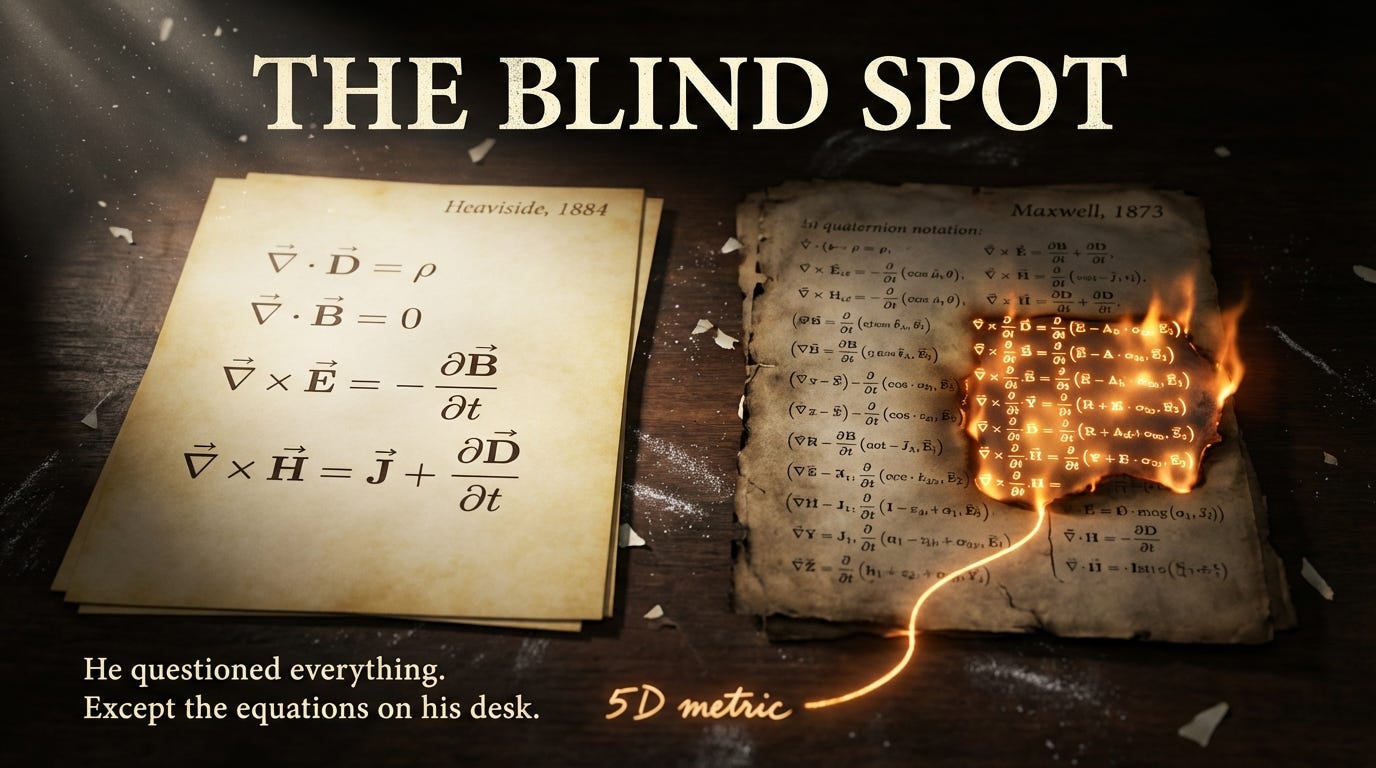
Einstein never questioned Maxwell’s equations.
That sentence should bother you. It bothered me for years before I understood why. Einstein questioned Newton. He questioned the aether. He questioned simultaneity, absolute time, the constancy of space. He rebuilt physics from the ground up, twice. But the four electromagnetic equations he inherited from his textbooks? Those he left untouched.
Here’s the problem: by the time Einstein encountered electrodynamics, it wasn’t Maxwell’s theory anymore. It was Heaviside’s.
⬅️ Previous: How three simplifications between the 1860s and 1880s deleted entire categories of electromagnetic phenomena from the equations.

The Timeline Nobody Talks About
Between 1882 and 1884, Oliver Heaviside rewrote Maxwell’s original twenty equations into the four vector equations every physics student learns today. Brilliant simplification. Heaviside explicitly wanted to “murder” the potentials from the theory. He called them “mystical.” His colleague Hertz declared potentials “not physical magnitudes” but useful “for calculations only.”
The simplification was complete by 1884. Einstein published Special Relativity in 1905 and General Relativity in 1915. He inherited the reduced equations without re-examining what Heaviside had cut.
This matters because of what happened six years after GR.
Kaluza’s Discovery
In 1921, Theodor Kaluza extended spacetime from four to five dimensions and solved Einstein’s field equations in the expanded space. What fell out was stunning: the electromagnetic four-potential A_μ appeared as the off-diagonal components of the five-dimensional metric tensor.
Read that again. The vector potential isn’t analogous to the gravitational metric. It IS part of the gravitational metric in five dimensions.
Gauge transformations, which every textbook treats as a sign that potentials are “unphysical,” turn out to be coordinate transformations in the fifth dimension. Electric charge is momentum in the fifth dimension. The connection between electromagnetism and gravity isn’t an analogy. It’s geometry.
Klein completed the picture in 1926 by compactifying the fifth dimension into a circle so small it’s unobservable, explaining why we don’t perceive it directly.
The Counterfactual
Now connect the dots.
Maxwell’s original theory had twenty equations and sixteen electromagnetic components. Heaviside kept six: the three components of E and the three components of B. The other ten, encoded in the symmetric part of the potential tensor, were defined away by gauge convention.
The Kaluza-Klein framework shows that the electromagnetic four-potential A_μ is a gravitational degree of freedom. Constraining A_μ through gauge fixing doesn’t just simplify the electromagnetic theory. It simultaneously hides gravitational degrees of freedom.
So here’s the counterfactual that keeps me up: What if Einstein had started from Maxwell’s full sixteen-component theory instead of Heaviside’s six-component reduction?
The EM-gravity bridge wouldn’t have been a surprise discovery by Kaluza six years after GR. It would have been visible from the structure of the equations themselves. The “incompatibility” between electromagnetism and gravity, the one that has driven a century of unification attempts, is at least partly an artifact of building General Relativity on top of an amputated electromagnetic theory.
The Evidence That Caught Up
In the weak-field limit of General Relativity, Einstein’s equations reduce to four equations structurally identical to Maxwell’s. This isn’t speculative. It’s called gravitoelectromagnetism, and it defines a gravitoelectric field E_g and a gravitomagnetic field B_g derived from gravitational potentials, the same way electromagnetic fields derive from electromagnetic potentials.
In 2011, the Gravity Probe B mission measured frame-dragging around Earth at 37.2 milliarcseconds per year. Moving mass generates a gravitational analogue of the magnetic vector potential. The gravitomagnetic field produces measurable effects on orbiting gyroscopes. The analogy between EM potentials and gravitational potentials isn’t just formal. It’s confirmed.
Li and Torr took it further in 1991. They showed that the London equations, which describe superconductors, can be extended to incorporate gravitomagnetic fields. The same Cooper pair condensate that physically fixes the electromagnetic vector potential A may simultaneously fix the gravitational vector potential A_g. The coupling between EM and gravity runs through the same potential that Heaviside wanted to murder.
The Deeper Structure
The potential hierarchy makes the connection even more precise. Whittaker showed in 1903 that every scalar potential can be decomposed into bidirectional wave pairs. Hillion demonstrated that these Whittaker scalars are a special case of the more general Hertz potentials. The four-potential derives from the Hertz potential, and the fields derive from the four-potential. Each step down the hierarchy is a derivative operation. Each derivative operation loses information.
At the top of the hierarchy, the Lorenz gauge, which at the four-potential level is an external constraint imposed by hand, is an automatic algebraic identity. It isn’t a physical law. It’s a tautology of a deeper structure.
Now consider: the superpotential formulation connects the divergence of A, the term the Lorenz gauge sets to zero, to the gravitational potential. If ∇·A carries gravitational information, then gauge-fixing the electromagnetic potentials simultaneously hides gravitational degrees of freedom.
This isn’t an analogy. It’s a mathematical consequence of the Kaluza-Klein embedding. Gauge freedom in four dimensions is geometric freedom in five dimensions. Constrain one and you constrain the other.
What This Changes
The standard story says electromagnetism and gravity are fundamentally different forces that resist unification. Decades of effort, from string theory to loop quantum gravity, have been driven by this narrative.
But the premise contains a hidden assumption: that the electromagnetic theory Einstein used was complete. It wasn’t. It was Heaviside’s reduction, with ten components defined away before Einstein ever saw it.
I’m not saying that restoring those components immediately unifies the forces. The spin-2 tensor structure of gravity versus the spin-1 vector structure of electromagnetism is a real distinction. Not an artifact. The GEM analogy breaks down for strong fields and relativistic velocities. The fifth dimension in Kaluza-Klein is compactified to unobservable scales, which is assumed but not derived.
What I am saying is that 140 years of treating EM and gravity as fundamentally incompatible may have been shaped, in part, by a simplification that predates the question by three decades. The bridge was always in the equations. It was in the part that Heaviside cut.
Einstein questioned everything except the equations on his desk. Those equations were already missing ten components. And the ten components they were missing turned out to include the connection to gravity.
The full argument, with the tensor decomposition, the Stueckelberg mechanism, and eight independent lines of evidence, is in my paper “The Deleted Degrees of Freedom.” Free to read.
https://advanced-rediscovery.com/research/deleted-degrees-of-freedom
⏭️ Next: Physics textbooks say gauge fixing is a harmless mathematical convenience. Information theory says it’s lossy compression with no decoder. The Aharonov-Bohm effect is the proof that the compression destroyed something real. Tuesday.
How does this relate to the Quicycle Team formulation under Dr John Williamson and vandermark?
This reminds me of how the “relative gauge” formulation I have been working on, ie the relative difference between two connections, is literally the contorsion tensor which is the antisymmetric part of the torsion tensor which can be transformed into the curvature tensor
Gauge, geometry, and topology are all intimately connected - how many generations of physicists have failed to see this?