Hello everyone, and a special welcome to all new subscribers!👋⚡
On New Year’s Eve I told you the fluid aether breaks at mutual induction. I said I’d come back with a resolution. Took me longer than a week. The answer turned out to be weirder and more interesting than I expected, and it came from a direction I didn’t see coming.
Short version: the aether is real, but it’s not a classical fluid. It’s a quantum condensate. And charges aren’t corks floating in it. They’re knots in its fabric.
Let me show you how I got there.
👉 Subscribe to Advanced Rediscovery. I’m sharing what I’m finding as I decode zero point energy, the quantum vacuum, and extended electromagnetism — 12+ years of independent research. Weekly briefings from my home lab to your inbox.
In today’s briefing
🔄 The equation that fixes the sign problem: P = mv + qA
🏃 Why induction is inertia, not friction
🧊 The quantum mechanism behind the math
🪢 Why only one type of superfluid works as aether
The sign problem, quickly
If you missed Part 1, here’s the situation. The fluid aether model maps scalar potential φ to fluid density and vector potential A to fluid velocity. This gives you mechanical explanations for Coulomb forces, magnetic attraction, self-inductance, the Aharonov-Bohm effect. Beautiful stuff.
Then you hit mutual induction and the model dies. Two coils. Primary ramps up current. Fluid accelerates at the secondary location. Charges in the secondary should get dragged along with the flow, like corks in moving water.
They don’t. They go the other way. Every time.
That’s Lenz’s law. And no classical fluid can produce it.
The equation that fixes everything
Here’s the fix, formula first:
P = mv + qA
P is the canonical momentum of a charged particle. Two pieces: the kinetic part (mv, what you see the charge doing) and the field part (qA, what the aether contributes to the charge’s momentum budget).
The thing about P: it’s conserved. When nothing external acts, P stays put.
Watch what happens during mutual induction:
Primary ramps up → A increases at the secondary
P has to stay constant
qA went up, so mv has to go down
We see negative velocity and call it “induced current”
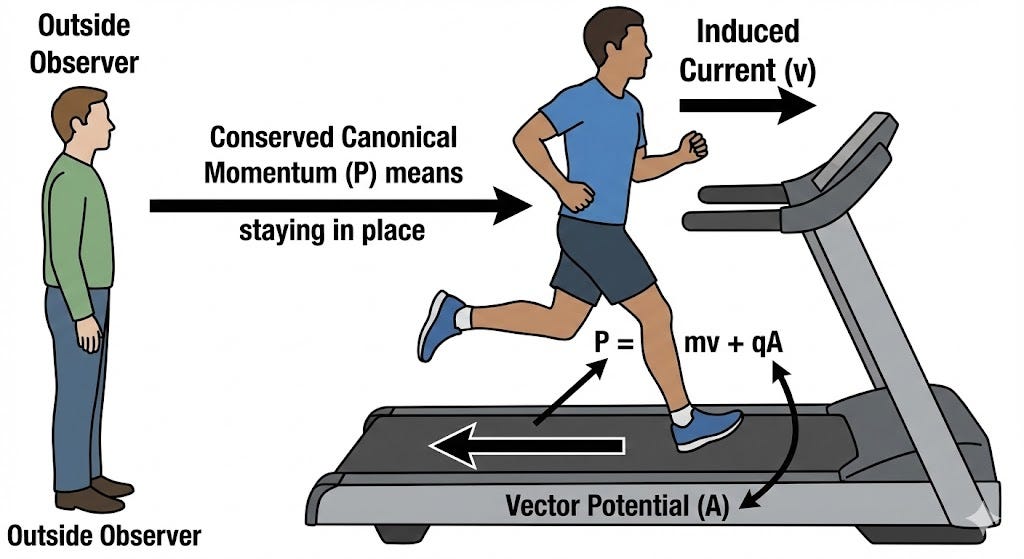
The charge isn’t getting dragged anywhere. It’s fighting to hold its total momentum constant. The fluid accelerates right, the charge runs left. Not because something pushes it left, but because it refuses to gain momentum.
The treadmill analogy. A is the belt accelerating under your feet. You run the other way to stay in place. An outside observer sees you running and calls it “current.” You’re just trying to stand still.
This is not friction. Friction would make the charge lag behind the flow, not reverse. This is inertia, a different animal entirely. The canonical momentum equation gives you the right sign, the right magnitude, the right everything.
This is where most textbooks stop. They hand you P = mv + qA, derive Lenz’s law, walk away. Class dismissed.
I don’t find that satisfying. The equation tells you what the charge does. Not why. What couples the charge to A so tightly that it compensates? If there’s a medium, what property of that medium produces this behavior?
Classical fluid mechanics gives you three options. Viscosity, but that’s dissipative, and EM waves don’t dissipate. Inertia, but that makes things lag, not reverse. Pressure, but Bernoulli effects act along streamlines, not against them.
None of these produce the right sign. You need something outside the classical toolkit.
A great answer provided by @TomMontalk on superfluid vacuum theory pointed me somewhere I hadn’t looked.
Superfluids are not fluids
I mean, they are, technically. But the difference between a classical fluid and a superfluid isn’t a matter of degree. It’s a different kind of thing.
A superfluid is a quantum condensate. Huge number of particles locked into one quantum state, described by a single wave function:
ψ = |ψ| e^(iθ)
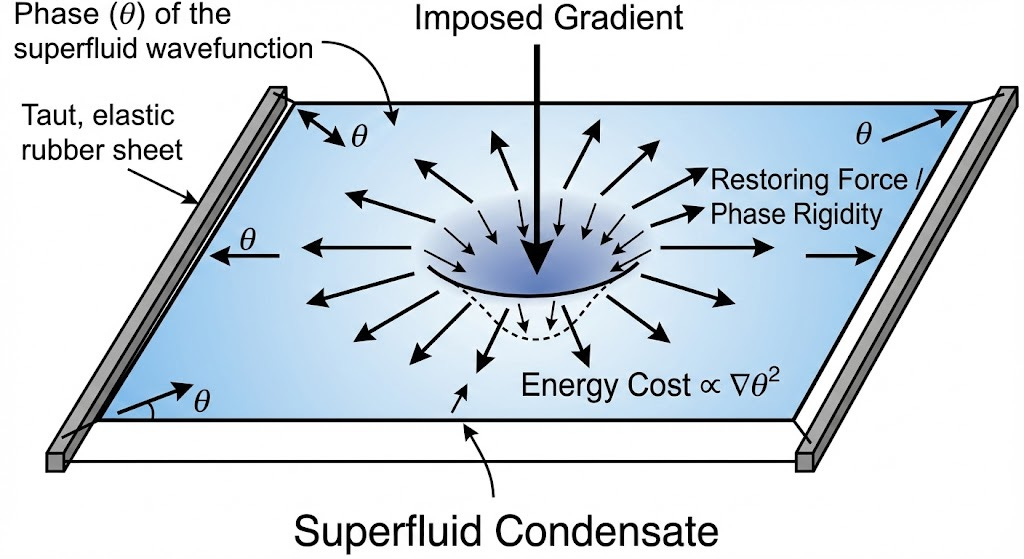
That phase angle θ runs the show. Its spatial gradient determines the flow. And the condensate is rigid about it. Any twist or gradient in θ costs energy proportional to the superfluid density. The system pays energy to keep its phase uniform.
Phase rigidity. The condensate resists imposed phase gradients the way a taut rubber sheet resists deformation. Push it down somewhere, it pushes back everywhere.
This matters because in a superfluid the velocity depends on both the phase gradient and the vector potential:
v_s = (ħ ∇θ − eA) / m
In equilibrium the phase adjusts to cancel A. The condensate locks onto the vector potential and neutralizes it, automatically, the way a spring returns to rest.
Now change A. Hit it with dA/dt from a primary coil. The phase can’t adjust instantly. So the condensate responds by generating compensating currents that oppose the change.
That’s Lenz’s law. Not as a textbook rule. As a physical process. The condensate’s phase gets pushed, it pushes back, and the pushback looks like induced current flowing opposite to the change.
And the canonical momentum equation? P = mv + qA being conserved is phase rigidity, translated from condensate language into particle language. The equation is the shadow on the wall. The phase dynamics are the thing casting it.
Three candidates, two funerals
Not every superfluid works as an aether. There are three types, and the elimination logic is clean.
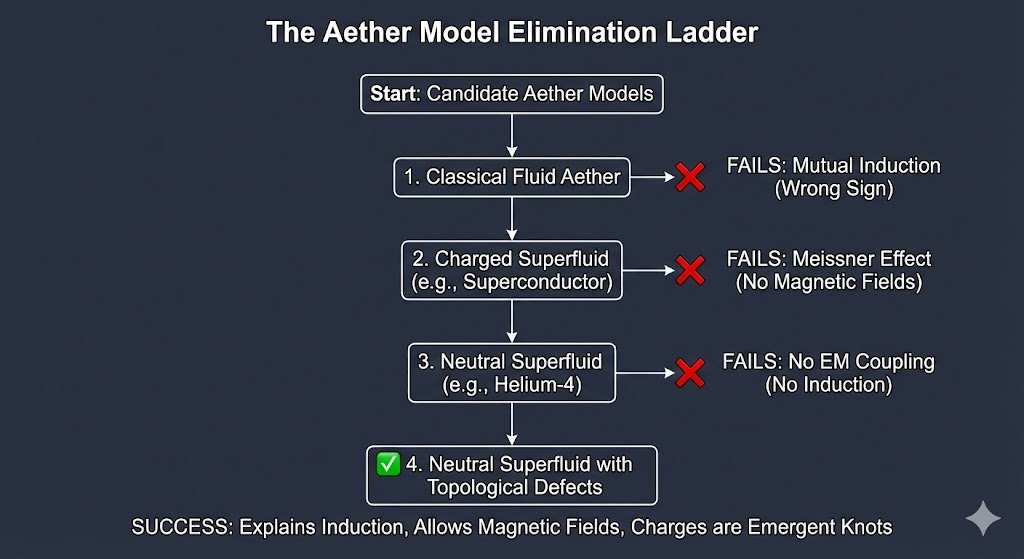
The elimination ladder. Classical fluid fails at mutual induction. Charged superfluid fails at the Meissner effect. Neutral superfluid fails at EM coupling. Only one candidate survives.
Charged superfluid. This is what a superconductor is. Cooper pairs carry charge, phase rigidity couples directly to A, you get Lenz-like opposition. Fritz and Heinz London worked this out in 1935.
The problem: the Meissner effect. A charged superfluid expels all static magnetic fields from its interior. If the vacuum were a charged superfluid, permanent magnets couldn’t exist. The Earth couldn’t have a magnetic field. Worse than the disease.
Neutral superfluid. Superfluid helium. No charge, no coupling to A. Magnetic fields pass right through, no Meissner problem. But now there’s zero mechanism for induction. The phase rigidity acts on the superfluid’s own dynamics and doesn’t see electromagnetism at all.
Neutral superfluid with emergent charges from topological defects.
This is the one.
Bulk is neutral, so fields penetrate freely. No Meissner effect. Magnets work. Earth has a field.
But the condensate supports topological defects: quantized vortices, phase singularities, knots in the order parameter. These aren’t objects floating in the medium. They’re structural features of the medium. A knot in a rope isn’t a thing sitting on the rope. It is a configuration of the rope.
These defects carry emergent electromagnetic charge. They couple to changes in A. And because they’re phase singularities, their dynamics are governed by the condensate’s phase rigidity. When dA/dt hits from outside, the phase pushes back, the defects move opposite to the change, and you get Lenz’s law.
The cork objection from Part 1 dissolves. Charges aren’t corks. They’re knots. Twist a rope one way and the knot propagates the other way, because its motion is topological, not hydrodynamic.
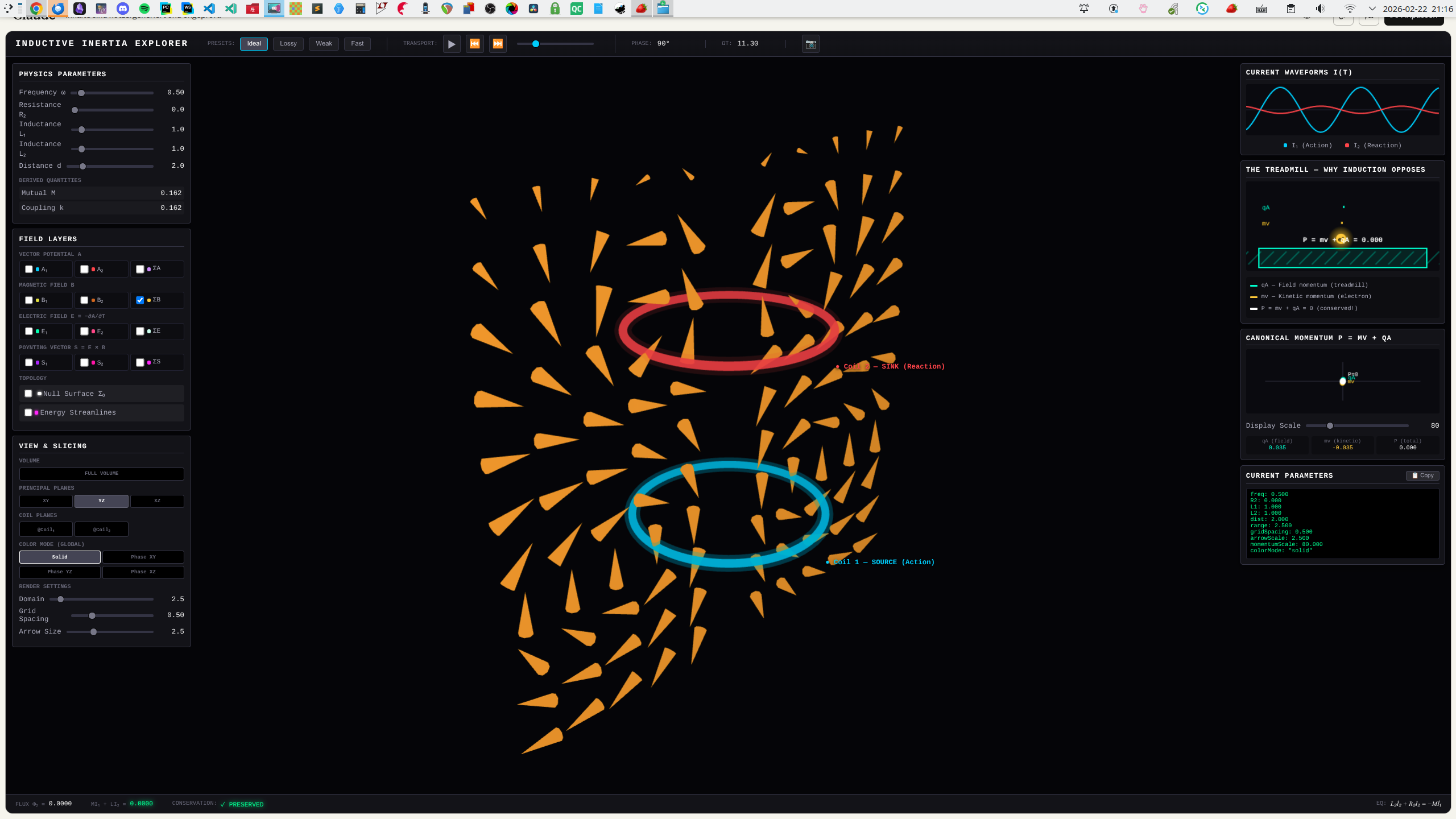
I vibe-coded this interactive simulator with Claude — ramp up a primary current and watch the canonical momentum constraint force the secondary current to oppose it in real time.
The classical fluid aether was never wrong. It was incomplete. It captured statics perfectly (Coulomb, Bernoulli, Aharonov-Bohm) because in equilibrium a superfluid’s density and velocity fields behave like a classical fluid’s. The model only breaks when dynamics enter, when dA/dt demands opposition that classical fluids can’t provide.
Phase rigidity fills that gap. Emergent charges on topological defects provide the coupling. The package is consistent with superfluid vacuum theory, a framework going back to Sinha, Sivaram, and Sudarshan (1976) and developed extensively in Volovik’s The Universe in a Helium Droplet (2003), where Lorentz invariance, gauge symmetry, and gravity all emerge from condensate dynamics.
The vector potential A was always the physical variable. The phase of the superfluid is A. E and B are derived quantities.
If you’re an engineer, this gives you a way to think about induction geometrically: phase twists, defect dynamics, topological coupling. If you’re a theorist, it slots into a program where all of electromagnetism is emergent condensate physics.
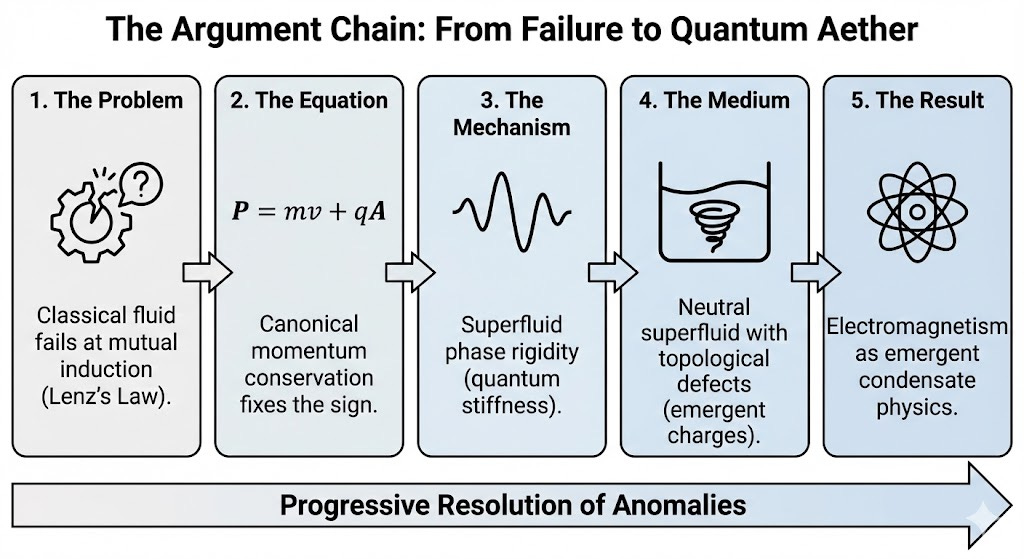
The argument chain. Each aether model gets further before it fails. Only the neutral superfluid with topological defects passes every test.
Hit reply if you see a hole. I want this stress-tested before I build on it.
— Paul
💡 Props to @TomMontalk for the research direction on superfluid vacuum theory. His thread on neutral superfluids with emergent charges from topological defects was the piece I was missing.