


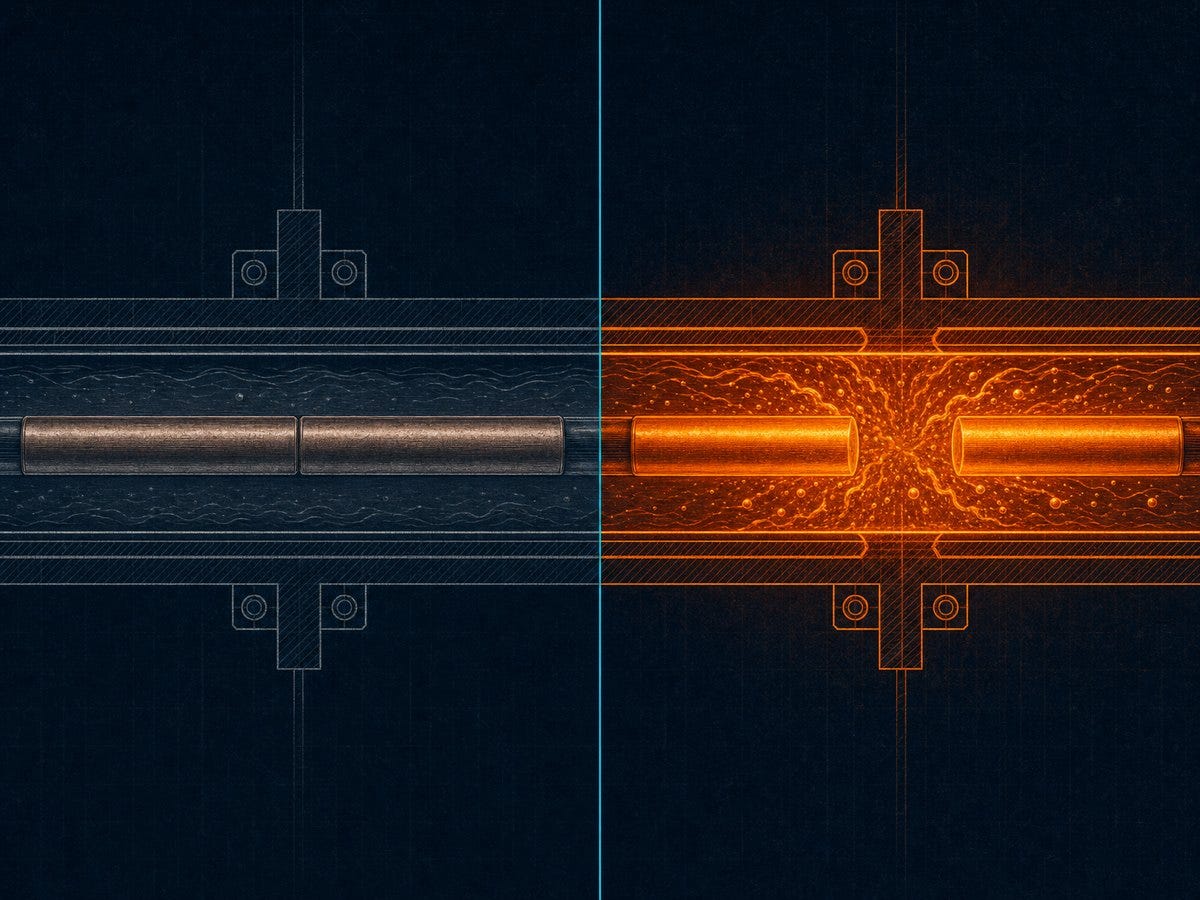
Fire a rifle and it kicks your shoulder. Push on something and it pushes back, equally, in the opposite direction. It is probably the only physics anyone remembers from school, and it is not a rule of thumb: it is why momentum is conserved, and momentum conservation is a load-bearing wall of the entire building.
Now lay two short copper rods end to end in a channel of mercury and run four hundred and fifty amps through them. They shove each other apart along the line of the current. The force law in your textbook says that particular push does not exist.
Somebody has been wrong about this since the 1820s, and it is still not settled which somebody.
This read-along stays free because paid subscribers fund it.

Two laws for the same force
In the 1820s, André-Marie Ampère worked out a formula for the force between two little pieces of current-carrying wire. It has a property he considered non-negotiable: the force each piece feels from the other is equal, opposite, and directed along the line between them. Newton, satisfied.
A few decades later, Hermann Grassmann wrote a different formula for the same situation. It is the one you learned, though probably not under his name, because it follows directly from the Lorentz force and the Biot-Savart law, and it slots neatly into Maxwell’s field theory. That fit is why it won.
Here is the awkward part. Integrate either formula over two complete, closed circuits and they agree exactly. Same attraction, same repulsion, no experiment can separate them. But zoom in on how the force is distributed inside a single circuit, piece by piece, and they part ways. Grassmann’s version produces no force along the wire. Ampère’s does. And Grassmann’s version, taken element by element, does not respect equal-and-opposite at all.
Maxwell noticed. He called Ampère’s the fundamental formula of electrodynamics, specifically because it was the one that kept action and reaction intact.
Then the field picture took over, and the question went quiet for a century.
The experiments that kept it awake
It did not go entirely quiet, because some people went and looked.
Peter Graneau put two short copper rods end to end in a narrow channel of mercury and ran roughly 450 amps through the assembly. The rods pushed apart. Not sideways, which is what the textbook force would do. Along the line of current, which is what Ampère’s formula predicts and Grassmann’s says should not happen at all.

Jan Nasilowski, working on exploding wires, found that wires carrying enormous pulsed currents do not simply melt and vaporize. They fragment, breaking into segments as if something were pulling them apart lengthwise. Graneau argued that the longitudinal pressure involved was substantially larger than the ordinary magnetic pinch that everyone agrees is there.
Now the part that most write-ups of this story leave out, and that I am not going to leave out: these results are contested, and the contest is legitimate. Exploding wires are violent, messy events. There is thermal shock, there are magnetohydrodynamic instabilities, there are phase changes happening in microseconds. Alternative explanations that never invoke a longitudinal force have been proposed for every one of these experiments, and they are not obviously wrong. Anyone who tells you Graneau settled this is overselling.
So I am not going to claim the experiments prove anything. What I am going to claim is smaller and much harder to wriggle out of.
Where the momentum actually went
Ask a good physicist about the missing reaction force and you will get a clean answer, because there is one.
The momentum is not missing. It is in the field.
When two pieces of current push on each other unequally, the difference does not vanish. It goes into the electromagnetic field itself, which carries momentum the way a moving object does. Add the field’s share to the matter’s share and the books balance perfectly. This is not a patch invented to save appearances. Field momentum is real, measurable, and the fact that the Lorentz form breaks local action-and-reaction was structurally important for the development of special relativity. That failure was a feature.
I want to be completely clear: that answer is correct. Momentum conservation is safe. Nobody needs to overturn anything.
But notice what the answer does. It resolves the discrepancy by moving it into an object, and then it hands you a description of that object. And the description you get is the one where the electromagnetic field has six numbers at every point: three for 𝐄, three for 𝐁.
The thing those six numbers are carved out of has sixteen.

The remainder nobody audited
This is the arithmetic from my paper, and it is not exotic. Take the four-dimensional gradient of the four-potential. It is a four-by-four object, so sixteen independent components. Split it the way you always split such a thing, into an antisymmetric part and a symmetric part. The antisymmetric part has six components, and those six are exactly 𝐄 and 𝐁. The symmetric part has the other ten, and standard electrodynamics does not use them. Not because an experiment ruled them out. Because a convention sets the relevant piece to zero, and the convention was adopted in the 1880s for the excellent reason that the equations get easier.
I should be precise about how much that costs, because ten is the wrong number to walk away with. Those sixteen are components of a derived object, and the underlying field has four. Sixteen is an honest count of the information in the tensor. It is not a count of things that propagate, and if you ask what actually propagates, relaxing the convention buys exactly one new mode. I put that in the paper too, because the bigger version is not true and a claim you have to inflate is not worth making.
One mode, though, is still one mode. And here is what it does to the story above.
The standard resolution says: the reaction force lives in the field. Fine. But the theory that tells you what the field is has been running with a piece of its own structure set to zero by hand for a hundred and forty years. When you relax that condition, the longitudinal sector comes back as a real dynamical thing, and the force law that emerges is reciprocal for open circuits directly, without needing the field to absorb the difference.
Two ways of balancing the same books. One of them we chose because it was tidier. Neither has been decided by a measurement of the piece in dispute, because nobody has built the instrument that would settle it.
Why this is the article in this series that I trust most
Everything else in this read-along leans on somebody else’s measurement at some point. Heat in a metal lattice that the chemical bookkeeping cannot cover. Charge packed past the density where Coulomb says it should already have blown itself apart. Both contested, both interesting, and both asking you to trust a calorimeter you did not watch.
(The self-organizing plasma I wrote about earlier in this series belongs in a different column entirely. That one is ordinary magnetohydrodynamics, settled since Taylor in 1974, and it needs nothing anybody deleted. I said otherwise in print two weeks ago, a reader took it apart in public, and he was right.)
This one is not like that. Nothing here is anomalous. Ampère’s law and Grassmann’s law are both in the literature, their disagreement is a matter of record, the closed-circuit equivalence is a theorem, and the field-momentum resolution is standard physics taught in graduate courses. I have not smuggled in a single disputed measurement.
The whole argument is that a completely mainstream, completely correct resolution quietly depends on a description that was compressed for convenience, and nobody has gone back to check what the compression cost. That is not a conspiracy and it is not a scandal. It is just a piece of unfinished bookkeeping sitting in plain sight, in the part of the theory everyone thinks is finished.
And once you have seen it there, in the tidy part, the messy anomalies start to look less like noise and more like the same unfinished business showing up somewhere less convenient.
⬅️ Previous: how the 1989 null replications ran below the loading threshold that later work identified as the entry condition, and why a null below threshold measures the threshold rather than the claim.
⏭️ Next: the effect where the field is exactly zero and the physics happens anyway. Electrons that change behavior in a region with no 𝐄 and no 𝐁, a transformer that pushes a signal through a superconducting shield, and what it costs to keep calling the potential a bookkeeping trick.
📬 Article 2 of the series. This one is free. Subscribe to get the next one delivered to your inbox, the physics that textbooks skip.
🔁 If this article resonated, a Restack helps others find it.
Research papers free at advanced-rediscovery.com/research · @drxwilhelm on X · Substack · YouTube
They push each other apart since their voltage drop analysis would dictate that each possesses a difference in voltage with respect to each other is my guess. This is why I sometimes find myself swapping the serial positions of two components in a simulation since different results are possible with each permutation. Their current is shared but their voltage is not. This is simple voltage division due to their serial position relative to each other and the polarity of the current and the polarity of the voltage plus any microscopic differences I assume exists between the two rods since no two electronic components are exactly the same. So, why should two copper rods be exactly the same? But voltage division assigning a left-hand and a right-hand to their serial (sequential) position is the main theme. So, in a sense, it shouldn't be a mystery at all! Just a lack of homework. ;-)